Tile Roofing in Texas
Get instant tile roofing quotes from pre-vetted Texas contractors. Compare clay barrel, concrete, and S-tile options with premium aesthetics and 75 to 100+ year lifespans for Hill Country, Mediterranean, and estate homes — no phone calls, no spam, no obligation.
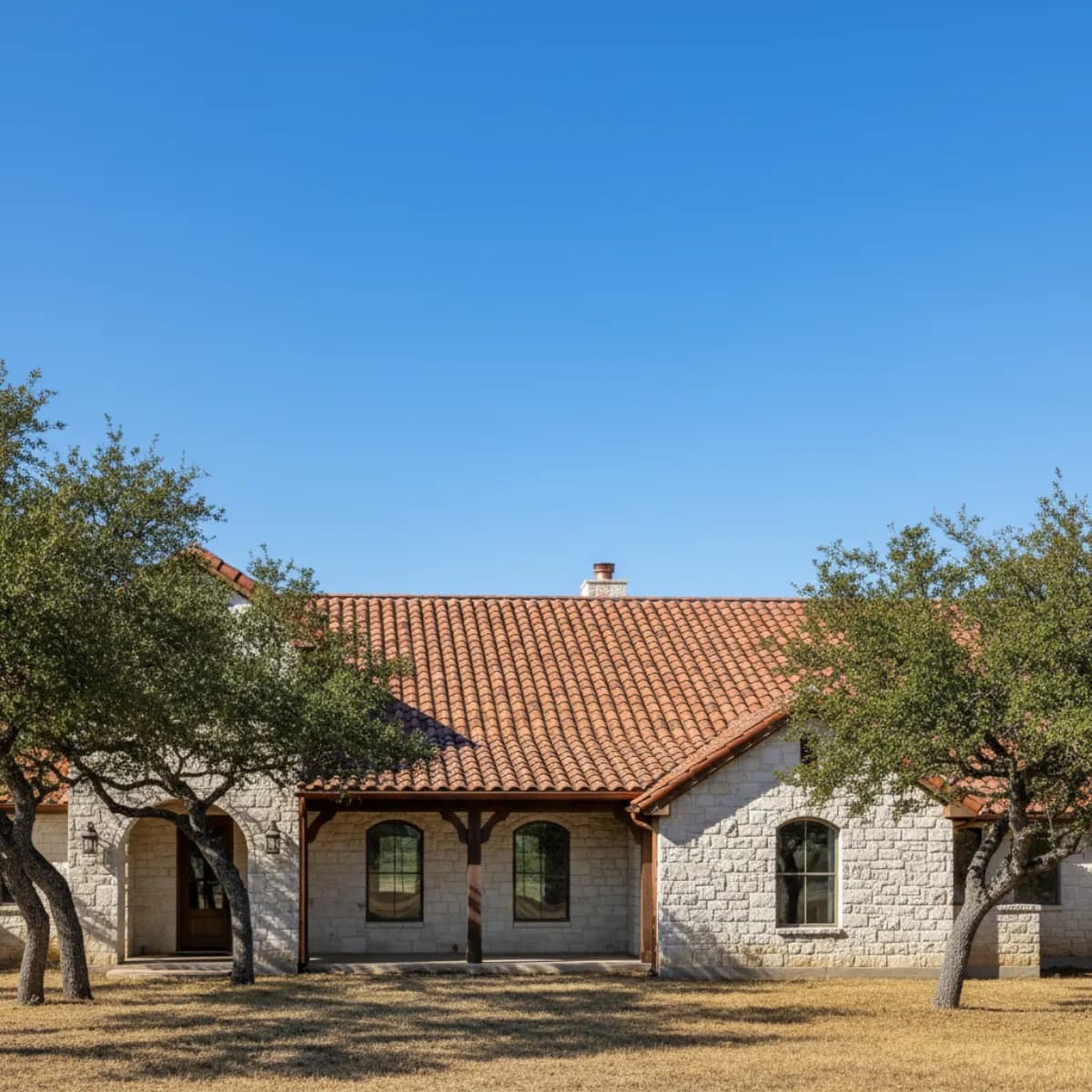
Tile roofing defines some of the most iconic residential architecture in Texas. From the terra cotta barrel tiles crowning Hill Country haciendas to the earth-toned concrete profiles on DFW estate homes, tile delivers a combination of aesthetic permanence, extreme heat performance, and multi-generational durability that no other roofing material can match. Natural clay tile lasts 75 to 100+ years, concrete tile offers 40 to 60 years of service, and both materials provide Class A fire resistance, superior thermal mass for Texas summers, and wind ratings that meet Gulf Coast hurricane codes when properly installed.
This guide covers tile roofing costs specific to Texas, the five major tile types available (barrel, flat, S-tile, concrete barrel, and concrete flat), how tile handles the state's extreme heat, hail, hurricanes, and UV exposure, structural weight requirements, building code and HOA compliance, and a head-to-head comparison with asphalt shingles and metal roofing. Whether you own a Spanish Colonial in San Antonio, a Mediterranean estate in Westlake, a ranch home near Austin, or a luxury build in Frisco, this resource will help you decide if tile roofing is the right investment for your Texas home.
Why Tile Roofing Thrives in the Texas Climate
Tile roofing was engineered for hot, sun-drenched climates centuries before air conditioning existed. The Texas climate is exactly where tile performs at its best.
Thermal Mass Cuts Cooling Costs 15-25%
Tile roofing leverages thermal mass and a natural air gap to dramatically reduce heat transfer into your home. Unlike asphalt shingles that lay flat against the roof deck and conduct summer heat directly into the attic, tile creates a ventilation channel between the curved tile surface and the underlayment. When Texas roof surfaces hit 130 to 160 degrees Fahrenheit in July and August, tile roofs keep attic temperatures 20 to 40 degrees cooler than asphalt-shingled attics. For Texas homeowners spending $3,000 to $5,000 annually on air conditioning, tile roofing delivers $600 to $1,200 in annual cooling savings without any additional insulation upgrades.
Class A Fire Resistance for Wildfire Zones
Clay and concrete tile carry a Class A fire rating, the highest available classification. Tile will not ignite, support combustion, or contribute to flame spread even under direct flame contact or intense radiant heat. This is critical for Texas Hill Country homes in the wildland-urban interface, Panhandle grassland communities, and the expanding Austin-San Antonio corridor where wildfire risk has increased dramatically. Flying embers from brush fires that can ignite asphalt shingles and wood shake simply bounce off tile without damage. Many Texas insurance providers offer premium reductions for Class A fire-rated roofing in designated wildfire risk zones.
Wind Resistance for Gulf Coast and Tornado Alley
Modern tile roofing systems installed with mechanical fasteners and foam adhesive achieve wind ratings of 125 to 150 mph, exceeding the 130 mph design wind speed required in Texas coastal counties. Hurricane clip attachment systems secure each tile individually to the roof deck, preventing the cascading tile loss that plagued older mortar-only installations during hurricanes. For North Texas properties in Tornado Alley, foam-adhered tile systems maintain integrity during the straight-line winds and sudden pressure changes that accompany severe thunderstorms and tornadoes. Properly installed tile roofing outperforms standard asphalt shingle wind ratings by 30 to 50 percent.
75 to 100+ Year Lifespan with Clay
Natural clay tile is one of the longest-lasting roofing materials ever manufactured, with documented service lives exceeding 100 years in hot climates. Unlike asphalt shingles that lose protective granules and embrittle under Texas UV radiation within 15 to 20 years, fired clay is chemically inert and impervious to ultraviolet degradation. The color is integral to the tile body, meaning it cannot fade, peel, or wash away regardless of UV exposure intensity. Concrete tile offers 40 to 60 years of service, still delivering three to four times the lifespan of asphalt shingles in Texas conditions. The underlayment beneath tile requires replacement every 25 to 40 years, but the tiles themselves can be lifted, the underlayment replaced, and the original tiles relaid.
Impact Resistance for Hail Season
Concrete tile roofing with Class 3 and Class 4 impact ratings (ASTM C1167 and UL 2218) resists hailstone impacts up to 2 inches in diameter. While individual clay tiles can crack under severe hail, the damage is typically isolated to the impacted tiles, which can be individually replaced without disturbing surrounding tiles or the underlying waterproof barrier. This modular repair capability is a significant advantage over asphalt shingles, where hail damage often necessitates full roof replacement because compromised granule coverage causes progressive leaking across the entire surface. In the DFW Hail Alley and San Antonio corridor, impact-rated concrete tile is a cost-effective defense against annual hailstorm damage.
Superior Moisture Management in Humid Regions
East Texas and the Gulf Coast corridor experience high humidity and intense rainfall that causes persistent moisture problems for many roofing materials. Tile roofing is non-porous and does not absorb water, eliminating the moss, algae, and lichen growth that plagues asphalt shingles in humid Texas regions. The air gap beneath barrel and S-tile profiles promotes continuous airflow that dries residual moisture quickly after rainstorms, preventing the trapped moisture conditions that accelerate wood rot in the roof deck. Tile roofing eliminates the need for chemical algae treatments and zinc strip installations that humid-climate asphalt roofs require for aesthetic maintenance.
Thermal Cycling Durability in Extreme Conditions
Texas subjects roofing materials to some of the most extreme thermal cycling in the country. Summer surface temperatures regularly exceed 160 degrees Fahrenheit, while winter cold fronts drop temperatures below freezing within hours. Fired clay tile has survived this type of cycling for millennia, as the kiln firing process at 2,000+ degrees makes the material dimensionally stable across all ambient temperature ranges. Concrete tile accommodates thermal expansion and contraction through engineered gaps between tiles. Neither material cracks, curls, or delaminates from thermal stress, unlike asphalt shingles that progressively deteriorate from repeated expansion and contraction cycles.
Severe Storm Resilience
Texas severe thunderstorms deliver a combination of high winds, large hail, torrential rain, and occasionally tornadoes in a single event. Tile roofing handles this compound threat better than most materials because each failure mode is independently addressed: mechanical fastening resists wind uplift, the dense tile body resists hail penetration, the non-porous surface sheds water instantly, and Class A fire resistance protects against lightning-strike ignition. When individual tiles do sustain damage, they can be replaced individually without compromising the surrounding roof system, allowing homeowners to restore full protection quickly after a storm.
Tile Roofing Types Available in Texas
Five tile roofing systems are widely installed across Texas, spanning natural clay and engineered concrete in profiles suited to every architectural style and budget.
Tile Roofing Type Comparison
| Type | Cost/sqft | Lifespan | Wind Rating | Weight |
|---|---|---|---|---|
| Barrel (Half-Round) Clay | $16-$22 | 75-100+ years | 125-150 mph | 700-900 lbs/sq |
| Flat (Slate Profile) Clay | $15-$20 | 75-100+ years | 110-140 mph | 800-1,000 lbs/sq |
| S-Tile (Double Roman) | $14-$20 | 50-75 years | 115-140 mph | 850-1,050 lbs/sq |
| Concrete Barrel Tile | $12-$18 | 40-60 years | 120-150 mph | 900-1,100 lbs/sq |
| Concrete Flat (Interlocking) | $12-$16 | 40-60 years | 120-145 mph | 900-1,100 lbs/sq |
Barrel (Half-Round) Clay
The quintessential Texas tile roofing profile. Barrel tiles create the distinctive undulating roofline synonymous with Spanish Colonial architecture across the Hill Country, San Antonio, and Austin. Each half-round tile channels rainwater efficiently during Gulf Coast deluges and creates a natural ventilation space above the roof deck that reduces attic temperatures by 20 to 40 degrees Fahrenheit compared to flat-laid asphalt shingles. Authentic barrel clay tiles fired at 2,000+ degrees Fahrenheit are impervious to UV degradation, freeze-thaw cycling, and insect damage. Available in natural terra cotta, red, brown, and custom glazed finishes that maintain color for the full 75 to 100 year lifespan without fading or granule loss.
Flat (Slate Profile) Clay
Flat clay tiles deliver a sleek, low-profile aesthetic popular in Tuscan-inspired estates across DFW suburbs like Southlake, Westlake, Highland Park, and Frisco. The smooth, planar surface creates a refined appearance that complements contemporary and transitional architecture. Flat clay tiles interlock tightly, reducing wind uplift vulnerability compared to barrel profiles while maintaining the thermal mass benefits of natural clay. They are especially popular for homes with lower roof pitches (4:12 to 6:12) where barrel tiles may not drain as effectively. Available in a broader range of colors than barrel tiles, including charcoal, slate gray, and custom blends that work with modern Texas design palettes.
S-Tile (Double Roman)
S-tile combines a concave and convex curve in a single piece, creating a gentle wave pattern across the roofline. This profile is the most versatile tile option for Texas neighborhoods where architectural styles vary, as it complements Spanish, Mediterranean, Mission, and even traditional Colonial aesthetics. S-tile installs faster than two-piece mission tile systems and costs less than handmade barrel clay, making it the value-driven choice for homeowners who want the tile look without premium pricing. Available in both clay and concrete, with concrete S-tile being the most commonly installed tile roofing product in Texas due to its balance of aesthetics, durability, and cost.
Concrete Barrel Tile
Concrete barrel tile replicates the classic Spanish Colonial look of natural clay at 20 to 40 percent lower cost. Modern manufacturing produces concrete tiles with color-through technology that resists fading far better than surface-painted tiles of previous decades. Concrete tile is the most popular tile roofing material installed in Texas due to its combination of affordability, durability, and aesthetic flexibility. It weighs slightly more than clay, so structural verification is essential, but it offers superior impact resistance (Class 3-4 ratings available) and excellent performance in the Texas heat. Available in barrel, flat, and S-tile profiles in colors ranging from traditional terra cotta to modern charcoal and blended tones.
Concrete Flat (Interlocking)
Flat interlocking concrete tiles offer the most affordable entry point into tile roofing for Texas homeowners. The precision-molded interlocking design creates a tight seal against wind-driven rain and provides strong uplift resistance through mechanical engagement between adjacent tiles. This profile works well on the moderate roof pitches (3:12 to 8:12) common on Texas ranch-style and modern homes. The smooth surface is easier to walk on during maintenance than curved profiles, reducing inspection and repair costs. Lightweight concrete formulations are available that reduce weight by 15 to 20 percent compared to standard concrete tile, easing structural requirements for retrofit installations.
Concrete vs Clay Tile: Which Is Right for Your Texas Home?
The concrete-vs-clay decision is the single most impactful choice for Texas tile roofing projects. Here is how they compare across every factor that matters.
Natural Clay Tile
- 75-100+ year lifespan (longest available)
- Color baked into the clay body, never fades
- Lighter weight than concrete (700-900 lbs/sq)
- Premium aesthetic with authentic character
- Highest resale value and curb appeal
- Higher cost: $15-$25/sqft installed
- Individual tiles more brittle under severe hail
Concrete Tile
- 40-60 year lifespan (3-4x asphalt in TX heat)
- 20-40% less expensive than natural clay
- Superior hail resistance (Class 3-4 available)
- More color options including modern tones
- Available in all profiles (barrel, flat, S-tile)
- Heavier weight: 900-1,100 lbs/sq
- Surface color may fade after 20-30 years
Bottom line for Texas homeowners: If your budget allows and you plan to stay in the home long-term, clay tile is the superior investment with its 75-100+ year lifespan and permanent color. If cost-effectiveness is the priority, concrete tile delivers 90% of the visual impact and thermal performance at 60-80% of the price. Both outperform asphalt shingles in every climate metric that matters in Texas. For a personalized cost comparison, enter your address above to get instant quotes for both options from pre-vetted tile roofing contractors.
Texas Tile Roof Cost Breakdown
Tile roofing costs in Texas vary by tile type, home size, roof pitch, and whether structural reinforcement is required. Here is what to expect for a complete installation.
Tile Roof Cost by Home Size in Texas
Total installed cost including materials, labor, underlayment, and tear-off
| Roof Size (sqft) | Clay Barrel | Concrete Tile | S-Tile (Clay/Concrete) |
|---|---|---|---|
| 1,200 sqft | $19,200-$26,400 | $14,400-$21,600 | $16,800-$24,000 |
| 1,800 sqft | $28,800-$39,600 | $21,600-$32,400 | $25,200-$36,000 |
| 2,000 sqft | $32,000-$44,000 | $24,000-$36,000 | $28,000-$40,000 |
| 2,500 sqft | $40,000-$55,000 | $30,000-$45,000 | $35,000-$50,000 |
| 3,000+ sqft | $48,000-$66,000 | $36,000-$54,000 | $42,000-$60,000 |
Regional Tile Roofing Price Variation Across Texas
Hill Country and San Antonio (Higher)
The Texas Hill Country and Greater San Antonio have the highest concentration of tile roofing in the state, with Spanish Colonial and Mediterranean architecture dominating communities like Boerne, Fredericksburg, New Braunfels, and the Dominion. This established demand supports a deep pool of experienced tile installers, but premium materials and steep Hill Country roof pitches push pricing 5-10% above statewide averages. Clay barrel tile installations in this region typically range $17-$24 per square foot.
DFW Metroplex (Higher)
Tile roofing in DFW is concentrated in upscale communities like Southlake, Westlake, Highland Park, University Park, Colleyville, and Frisco estate neighborhoods. These projects tend toward larger homes (3,000-6,000+ sqft) with complex roof geometries that increase both material waste and labor hours. Concrete flat tile is the dominant profile in DFW due to its compatibility with Tuscan and transitional architecture. Pricing runs 5-10% above state averages.
Austin Metro
Austin and surrounding communities like Round Rock, Cedar Park, Lakeway, and Bee Cave have a growing tile roofing market driven by new construction in Mediterranean and Hill Country modern styles. Pricing aligns with statewide averages, with concrete S-tile and flat profiles dominating the market for their versatility and cost-effectiveness. The influx of luxury home construction west of Austin has expanded the tile installer workforce, improving availability.
Gulf Coast and Rio Grande Valley
Houston, Corpus Christi, and the Rio Grande Valley from McAllen to Brownsville have moderate tile demand with pricing at or slightly below state averages. Mission Revival architecture in the Valley and Mediterranean-influenced estates in west Houston drive most tile installations. Wind uplift requirements in coastal counties add $1-$3 per square foot for enhanced fastening systems. Concrete tile with Class 4 impact ratings is preferred in hail-active areas.
Structural Requirements for Tile Roofing in Texas
Tile is the heaviest residential roofing material. Understanding the structural implications is essential before committing to a tile roof installation.
Weight Comparison
- Asphalt shingles: 200-350 lbs per roofing square
- Clay tile: 700-900 lbs per roofing square
- Concrete tile: 900-1,100 lbs per roofing square
- Metal roofing: 50-150 lbs per roofing square
One roofing square = 100 square feet of roof surface area.
When Reinforcement Is Needed
- Homes built pre-2000 with conventional framing typically need assessment
- Post-2000 engineered truss homes often pre-rated for tile loads
- Structural engineer assessment: $300-$800
- Reinforcement work if needed: $2,000-$8,000
- Required before building permit issuance in most TX cities
Steep-Pitch Roof Considerations
Tile roofing is most commonly installed on steep-pitch roofs ranging from 4:12 to 12:12 slope. The steep pitches typical of Hill Country Spanish Colonial and DFW estate homes (often 8:12 to 12:12) are ideal for tile because they enhance drainage, maximize the thermal air gap between tile and deck, and showcase the dimensional tile profile from street level. However, steep-pitch installation increases labor costs by 15 to 30 percent due to scaffolding requirements, safety harness systems, and slower installation pace.
For lower-pitch roofs (3:12 to 4:12), flat interlocking concrete tile is the recommended profile. Barrel and S-tile profiles require a minimum 3:12 pitch for proper water shedding, with 4:12 or steeper recommended. Below 3:12, tile roofing is not recommended, and a flat or low-slope roofing system (TPO, modified bitumen, or built-up) should be used instead.
Underlayment Requirements for Texas Tile Roofs
The underlayment beneath tile roofing is the primary waterproof barrier. Choosing the right underlayment is critical in the Texas climate where extreme heat accelerates material degradation.
Synthetic Underlayment
High-temperature synthetic underlayment is the standard for Texas tile roofing installations. Products rated for 240 degrees Fahrenheit or higher withstand the extreme heat trapped between the tile surface and roof deck during Texas summers. Synthetic underlayment lasts 25 to 40 years, resists moisture absorption, and does not wrinkle or deteriorate under UV exposure.
Self-Adhering Modified Bitumen
Self-adhering modified bitumen (peel-and-stick) provides the highest level of waterproofing beneath tile roofing. It seals around fastener penetrations and creates a fully bonded secondary water barrier. Required in many Gulf Coast jurisdictions and recommended for any Texas location prone to wind-driven rain and severe thunderstorms.
Felt Underlayment
Traditional 30-lb or 40-lb organic felt underlayment degrades rapidly under Texas tile roofing. Temperatures between the tile and deck regularly exceed 180 degrees during summer, causing felt to dry out, crack, and lose waterproofing integrity within 8 to 12 years. This premature failure requires costly tile removal and replacement of the underlayment well before the tiles themselves need attention.
Critical for Texas: The underlayment is the component most likely to fail before the tile itself. Always specify high-temperature synthetic or self-adhering modified bitumen underlayment rated for 240 degrees Fahrenheit or higher. The upfront cost premium of $300 to $1,500 over felt saves $5,000 to $15,000 in premature underlayment replacement costs over the lifespan of the tile roof.
Current Texas Roofing Material Prices
Live pricing data for all roofing materials in Texas, updated regularly from contractor bids on the RoofVista marketplace.
Tile vs Asphalt vs Metal in the Texas Climate
How does tile compare against the two most popular roofing materials in Texas across every performance and cost metric?
| Feature | Tile Roofing | Asphalt Shingles | Metal Roofing |
|---|---|---|---|
| Installed Cost (per sqft) | $12-$25 | $4-$8 | $7-$16 |
| Lifespan in TX Climate | 40-100+ years | 15-20 years | 40-70 years |
| Wind Resistance | 110-150 mph | 60-130 mph | 110-180 mph |
| Hail Resistance | Class 3-4 | Class 1-3 | Class 4 |
| Fire Rating | Class A | Class A-C | Class A |
| Cooling Cost Reduction | 15-25% | Minimal | 20-25% |
| Weight (per square) | 700-1,100 lbs | 200-350 lbs | 50-150 lbs |
| Curb Appeal | Premium | Standard | Modern/Industrial |
| Structural Reinforcement | Often required | Never | Never |
| Maintenance | Low (replace cracked tiles) | Regular inspections | Near zero |
50-Year Cost Analysis: Why Tile Wins for Legacy Homes
Clay Tile
- Initial install: $36,000
- Underlayment replacement (yr 30): $4,000
- Tile repairs over 50 yrs: $1,500
- Energy savings: $10,000-$18,000
- 50-year net cost: $23,500-$31,500
Asphalt Shingles
- Initial install: $10,000
- 2nd roof (yr 17): $14,000
- 3rd roof (yr 34): $18,000
- Maintenance and repairs: $6,000
- 50-year net cost: $48,000+
Metal Roofing
- Initial install: $22,000
- Maintenance over 50 yrs: $500
- May need coating at yr 35: $3,000
- Energy savings: $12,000-$20,000
- 50-year net cost: $5,500-$13,500
Based on a 2,000-sqft roof in the DFW/Hill Country market. Asphalt assumes replacement every 17 years due to accelerated TX heat degradation. Metal and tile energy savings assume 20% cooling cost reduction. For a detailed material comparison, see our Texas metal roofing guide.
Texas Architecture and Tile Roof Compatibility
Texas has three dominant architectural traditions where tile roofing is the authentic and architecturally appropriate choice.
Spanish Colonial and Mediterranean (Hill Country, San Antonio, Austin)
The Texas Hill Country between San Antonio and Austin is the heartland of Spanish Colonial architecture in the state. Communities like Boerne, Fredericksburg, Kerrville, Wimberley, and the master-planned developments along the Highway 281 and Highway 46 corridors feature barrel clay tile roofing as the defining architectural element. Terra cotta barrel tile in warm reds, oranges, and browns complements the limestone, stucco, and iron detailing characteristic of Hill Country Spanish homes. Mediterranean and Italianate variations with flat clay or concrete tile in earth tones are equally common, particularly in San Antonio's Dominion, Shavano Park, and the Alamo Heights neighborhoods.
Tuscan and Modern Estate (DFW, Houston Suburbs)
The luxury suburbs of DFW and Greater Houston have embraced Tuscan-inspired architecture featuring flat or low-profile concrete tile in sophisticated earth tones. Southlake, Westlake, Highland Park, Colleyville, and Frisco estate neighborhoods in DFW, along with The Woodlands, Sugar Land, and Katy in the Houston metro, showcase concrete flat tile on 3,000 to 6,000+ square foot homes with complex roof geometries. Charcoal, slate gray, weathered stone, and blended multi-tone concrete tiles dominate this market, paired with stone and brick facades. This style accommodates moderate pitches (4:12 to 7:12) and benefits from the clean lines of interlocking flat tile profiles.
Mission Revival (El Paso, Rio Grande Valley, South Texas)
Mission Revival architecture has deep roots in South and West Texas, particularly in El Paso, Laredo, McAllen, Brownsville, and the historic neighborhoods of San Antonio. This style uses a traditional two-piece mission tile system with alternating convex and concave tiles (or the more common one-piece S-tile that replicates this look). Deep red and burnt sienna clay tiles complement the white or cream stucco walls, arched doorways, and bell tower elements characteristic of Mission architecture. S-tile in both clay and concrete is the most practical and widely installed profile for Mission Revival homes, offering the authentic look at a fraction of the cost of true two-piece systems.
HOA Compliance and Texas Building Codes for Tile
Navigating HOA requirements and building codes is essential for a smooth tile roofing project in Texas.
HOA Rules and State Protections
- TX Property Code Sec. 202.011 protects hail-resistant roofing choices
- HOAs cannot ban tile roofing with Class 3-4 impact ratings
- HOAs may regulate color, profile, and manufacturer
- Tile is pre-approved in most upscale TX HOA communities
- Submit architectural review application before starting work
Building Code Requirements
- IRC Chapter 9 governs tile roofing installation in Texas
- Building permit required in most TX municipalities
- Structural engineer letter required for weight compliance
- Coastal counties: 130-150 mph design wind speed compliance
- TWIA zone: WPI-8 windstorm inspection required
TDLR and Contractor Requirements
- No statewide roofing license required in Texas
- TDLR registration needed for insurance claim work
- Tile requires specialized training beyond general roofing
- Verify manufacturer certification for warranty coverage
Wind Uplift and Fastening Standards
- Mechanical fastening required (screws or hurricane clips)
- Foam adhesive supplements fasteners for enhanced wind resistance
- Mortar-set ridge and hip tiles for finished edges
- ASTM C1568 and TAS 108 standards for wind resistance testing
Tile Installer Qualification: Tile roofing installation is a specialized trade that requires training beyond general roofing. Improper installation is the leading cause of tile roof failures, not material defects. Always verify that your contractor has specific tile installation experience, manufacturer certification (Eagle, Boral, Ludowici, or equivalent), and at least five completed tile roofing projects in Texas. All pre-vetted contractors on RoofVista are verified for tile-specific qualifications when applicable.
Maintaining a Tile Roof in Texas
Tile roofing requires minimal maintenance compared to asphalt shingles, but a few proactive steps ensure maximum lifespan and performance in the Texas climate.
Annual and Post-Storm Tasks
- Annual inspection: Check for cracked, shifted, or broken tiles. Individual tiles can be replaced without disturbing adjacent tiles, costing $25-$75 per tile including labor.
- Post-hail inspection: Walk the roof (or use drone/satellite imagery) after any hailstorm producing 1-inch or larger hailstones. Replace damaged tiles promptly to prevent water infiltration.
- Debris clearing: Remove leaves, branches, and debris from valleys and behind penetrations twice yearly. Organic debris traps moisture and can displace tiles over time.
- Flashing check: Inspect metal flashing around chimneys, walls, and penetrations annually. Thermal cycling in Texas can loosen flashing sealant over time.
Long-Term Maintenance Milestones
- Year 15-20: Inspect mortar at ridges and hips. Re-point or re-mortar ridge tiles if cracking or gaps are visible. Cost: $500-$2,000.
- Year 25-40: Underlayment assessment. Lift tiles in several areas to inspect underlayment condition. High-temperature synthetic lasts 25-40 years; felt may need replacement as early as year 10-12.
- Year 30-40: Underlayment replacement if needed. Tiles are lifted, underlayment replaced, and original tiles relaid. Cost: $4,000-$8,000 for a 2,000-sqft roof.
- Ongoing: Never walk on tile roofs unless necessary. Clay and concrete tiles crack under foot traffic. Use drone inspection or binoculars for routine visual checks.
Frequently Asked Questions About Tile Roofing in Texas
Common questions from Texas homeowners considering tile roofing.
How much does a tile roof cost in Texas?
Can tile roofing withstand Texas hurricanes and tornadoes?
Is concrete tile a good alternative to clay tile in Texas?
Does my Texas home need structural reinforcement for tile?
How does tile roofing handle extreme Texas heat?
What tile roof styles match Texas home architecture?
How long does a tile roof last in Texas?
Can Texas HOAs restrict tile roofing installation?
Related Resources
Texas Roofing
All roofing options for TX homeowners
Hill Country Roofing
Roofing for Hill Country homes and estates
Texas Roof Replacement
Full replacement guide for TX homeowners
TX Roof Cost Calculator
Instant cost estimates for all materials
Texas Metal Roofing
Metal roofing costs and options in TX
Texas Roof Cost Guide
Complete cost breakdown for all materials
Get Your Tile Roofing Quote in 60 Seconds
Enter your Texas address below for an instant AI-powered satellite estimate. Compare tile roofing quotes from pre-vetted contractors — no phone calls, no spam.
Serving all Texas communities including Houston, Dallas, San Antonio, Austin, Fort Worth, El Paso, the Hill Country, and the entire Gulf Coast region. Clay and concrete tile specialists available statewide.
Compare 1256+ vetted roofers near Tile Roofing, Texas
See independent reviews, BBB ratings, and Google data — then compare quotes side-by-side from pre-vetted local contractors.