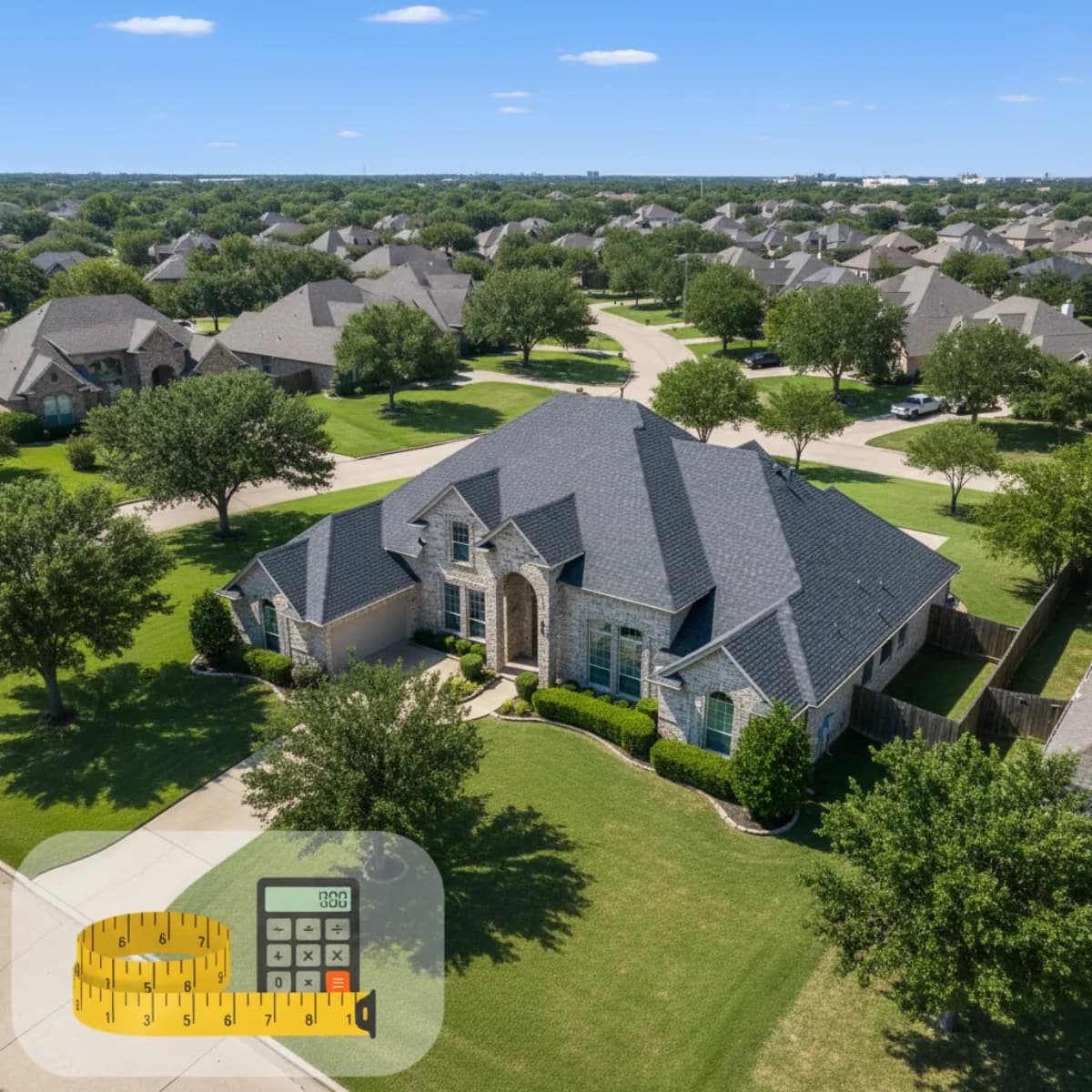
How Our AI Roof Cost Calculator Works
Unlike generic calculators that ask you to guess your roof size, RoofVista uses the same satellite measurement technology that professional roofing estimators rely on — but delivers results in seconds instead of days.
Enter Your Texas Address
Type any residential address in Texas. Our system covers all 254 counties, from major metros like Dallas and Houston to rural communities across West Texas and the Hill Country.
AI Measures Your Roof via Satellite
Our AI analyzes high-resolution satellite imagery to calculate your roof's exact dimensions, pitch, facets, dormers, valleys, and overall complexity — all automatically.
Get Instant Multi-Material Pricing
Receive side-by-side pricing for asphalt, metal, tile, and more — all based on current Texas labor rates and material costs for your specific metro area.
Texas Roof Replacement Cost Breakdown (2026)
Texas is one of the most affordable states in the country for roof replacement, running 10-15% below the national average. The combination of a fiercely competitive contractor market, lower labor costs than coastal states, no state income tax reducing contractor overhead, and year-round installation weather keeps pricing accessible for most homeowners. However, Texas also presents unique cost variables that other states do not face: extreme hail exposure across the I-35 corridor, hurricane-code requirements along the Gulf Coast, intense UV and heat that shortens material lifespan, and dramatic regional price differences across a state that spans 268,000 square miles.
The average Texas homeowner pays between $6,500 and $18,000 for a standard roof replacement using architectural shingles. However, the actual cost for your specific home depends on your roof's square footage, the material you choose, your region within the state, your roof's pitch and complexity, and whether you opt for impact-resistant upgrades. We break down every factor in detail below.
Average Roof Replacement Costs by Material
Texas homeowners have access to the full spectrum of roofing materials. The state's diverse climate zones — from the humid Gulf Coast to the arid desert west — mean different materials perform better in different regions. Here is a comprehensive breakdown of per-square-foot installed costs across the state:
| Material | Cost / sq ft (installed) | Expected Lifespan | Best For |
|---|---|---|---|
| 3-Tab Asphalt Shingles | $3.00 - $5.00 | 15-20 years | Budget-conscious, rental properties |
| Architectural Shingles | $4.00 - $7.00 | 25-30 years | Most Texas homes, best value |
| Impact-Resistant (Class 4) | $5.00 - $8.50 | 25-30 years | Hail zones, insurance savings |
| Metal Standing Seam | $8.00 - $14.00 | 40-70 years | Longevity, hail/heat resistance |
| Concrete / Clay Tile | $12.00 - $25.00 | 50-100 years | Hill Country, Mediterranean style |
| Flat / TPO | $5.00 - $8.00 | 20-30 years | Flat roofs, commercial buildings |
| Wood Shake | $8.00 - $14.00 | 20-30 years | Rustic aesthetic, ranch homes |
| Slate (Natural) | $15.00 - $30.00 | 75-100+ years | Premium, historic properties |
Architectural shingles are the dominant choice for Texas residential roofing, accounting for roughly 70% of replacements statewide. At $4.00-$7.00 per square foot installed, they offer an excellent balance of affordability, durability, and curb appeal. Most major manufacturers offer 30-year warranties, and the dimensional profile provides wind resistance ratings of 110-130 mph — critical for Texas storm exposure. Their popularity means contractors carry ample inventory, keeping pricing competitive and installation timelines short.
Impact-resistant (Class 4) shingles deserve special attention for Texas homeowners. These UL 2218-rated shingles are engineered to withstand hailstones up to 2 inches in diameter without cracking or losing their waterproof integrity. The $0.50-$1.50 per square foot premium over standard architectural shingles is often recovered within 3-5 years through mandatory insurance premium discounts of 5-35% that the Texas Department of Insurance requires all carriers to offer. In hail-prone areas like DFW, San Antonio, and the Hill Country, Class 4 shingles have become the de facto standard for new installations.
Metal standing seam roofing has surged in popularity across Texas, particularly for homeowners seeking maximum longevity and energy efficiency. At $8.00-$14.00 per square foot, the upfront cost is roughly double architectural shingles, but a metal roof can last 40-70 years — potentially the last roof your home will ever need. Reflective coatings reduce cooling costs by 20-25%, which matters enormously in a state where air conditioning can account for 40-50% of summer electricity bills. Metal also provides Class 4 hail resistance and wind ratings up to 180 mph, making it the best all-around performer for Texas weather extremes. See our detailed Texas metal roofing guide for a deeper dive on metal options and pricing.
Concrete and clay tile is the premium choice for Texas homes, particularly in the Hill Country, San Antonio, Austin, and South Texas where Mediterranean and Spanish Colonial architecture is prevalent. At $12.00-$25.00 per square foot, tile is a significant investment, but it can last 50-100 years with proper maintenance. Tile provides excellent thermal mass, slowing heat transfer through the roof in triple-digit summer temperatures. The weight of tile requires structural verification — not all Texas homes are framed to support it without reinforcement. For more on tile options, see our Texas tile roofing guide.
Flat / TPO roofing is the standard for low-slope and flat-roof applications common on Texas commercial buildings and some residential properties, especially in urban areas and in El Paso where flat roofs are architecturally common. TPO (Thermoplastic Polyolefin) with a white reflective surface offers superior solar reflectance, reducing cooling loads significantly in the Texas heat. At $5.00-$8.00 per square foot, it is one of the most cost-effective solutions for buildings with flat or minimal-slope roof profiles. Proper drainage design is critical in Texas, where sudden heavy rainstorms can dump several inches in an hour.
Total Project Cost by Roof Size
To help you estimate your total project cost, here is a breakdown of what Texas homeowners can expect to pay based on roof size across four popular material categories. These figures include materials, labor, tear-off, disposal, and standard permits:
| Roof Size (sq ft) | 3-Tab Asphalt | Architectural | Metal | Tile |
|---|---|---|---|---|
| 1,000 | $3,000 - $5,000 | $4,000 - $7,000 | $8,000 - $14,000 | $12,000 - $25,000 |
| 1,500 | $4,500 - $7,500 | $6,000 - $10,500 | $12,000 - $21,000 | $18,000 - $37,500 |
| 2,000 | $6,000 - $10,000 | $8,000 - $14,000 | $16,000 - $28,000 | $24,000 - $50,000 |
| 2,500 | $7,500 - $12,500 | $10,000 - $17,500 | $20,000 - $35,000 | $30,000 - $62,500 |
| 3,000+ | $9,000 - $15,000+ | $12,000 - $21,000+ | $24,000 - $42,000+ | $36,000 - $75,000+ |
These ranges represent statewide averages. Your actual cost may be higher or lower depending on the specific factors detailed below. The most accurate way to get a price for your specific home is to enter your address into our AI calculator, which measures your actual roof and applies local pricing for your metro area.
Why Texas Roofing Costs Are Below the National Average
Texas: 10-15% Below National Average
Texas consistently ranks among the most affordable states for roof replacement. While the national average for a 2,000 sq ft architectural shingle roof runs $10,000-$16,000, the same job in Texas averages $8,000-$14,000. Several structural factors drive this advantage:
Massive Contractor Market
Texas has more registered roofing contractors than any other state, creating intense competition that keeps pricing aggressive and homeowners in control.
Lower Labor Costs
Cost of living is 8-12% below the national average in most Texas metros, translating directly to lower labor rates for roofing crews.
Year-Round Installation
Mild winters mean contractors work 12 months a year, spreading fixed overhead costs across more projects and avoiding seasonal price spikes.
No State Income Tax
Contractor businesses save on overhead without state income tax, and those savings flow through to customer pricing in a competitive market.
High Storm Volume
Frequent hail and wind events keep contractor pipelines full, enabling volume-based pricing that benefits all homeowners, not just storm claimants.
Material Distribution
Major material distributors maintain extensive Texas warehousing, reducing delivery costs and lead times compared to remote or sparsely populated states.
Cost Factors Unique to Texas Roof Replacement
Beyond material choice and roof size, several Texas-specific variables influence the final cost of your roof replacement. Understanding these factors helps explain why two similar-sized homes in different parts of the state might receive very different quotes:
Region and Metro Area
Texas is enormous, and roofing costs vary significantly by region. DFW and Houston metro areas run 5-10% above the state average due to higher labor demand and urban complexity. Gulf Coast properties carry a 10-20% coastal premium for wind-rated materials and hurricane-code compliance. West Texas and the Rio Grande Valley are 5-15% below average thanks to lower labor costs and cost of living. Our AI calculator automatically applies regional pricing for your specific address.
Hail Zone and Impact Rating
Texas leads the nation in hail damage, with the I-35 corridor from San Antonio through DFW forming Hail Alley. Upgrading from standard architectural shingles to Class 4 impact-resistant (UL 2218) adds $0.50-$1.50 per square foot but earns insurance premium discounts of 5-35%. In high-hail areas, this upgrade pays for itself within 3-5 years through insurance savings alone. Many Texas homeowners now consider Class 4 shingles the default choice rather than an upgrade.
Hurricane Zone Proximity
Properties within 100 miles of the Gulf Coast must meet enhanced wind-resistance requirements under Texas building codes. This means wind-rated shingles (110-130 mph minimum), reinforced decking attachments, and sometimes secondary water barriers. These requirements add $0.75-$2.00 per square foot but are essential for protecting your home during hurricane season. Galveston, Corpus Christi, Beaumont, and Brownsville are the most affected areas.
Roof Pitch and Number of Stories
Steeper roofs require more safety equipment, scaffolding, and labor time. A roof with an 8/12 pitch or steeper can cost 20-35% more than a standard 4/12 pitch. Two-story and three-story homes also incur higher labor costs due to the additional height and staging complexity. Most Texas ranch-style homes have moderate pitches (4/12 to 6/12), keeping labor costs reasonable. Our satellite AI automatically detects your roof pitch and factors it into the estimate.
Tear-Off Layers
Texas building codes in most municipalities allow a maximum of two shingle layers before a full tear-off is mandatory. Removing existing layers adds $1.00-$2.00 per square foot for labor and disposal. If your home already has two layers, complete tear-off is required regardless. Single-layer overlay installations are possible but can void manufacturer warranties and trap heat in the brutal Texas climate, accelerating shingle deterioration from the underside.
Extreme Heat and UV Exposure
Texas summers routinely exceed 100 degrees Fahrenheit with intense UV radiation that is among the highest in the continental United States. This extreme exposure shortens the lifespan of standard asphalt shingles by 3-5 years compared to northern states. Choosing materials with higher UV resistance, reflective coatings, or natural thermal mass (tile, metal) adds upfront cost but extends roof life significantly and reduces cooling energy costs by 15-25%. Proper attic ventilation and radiant barriers compound these savings.
Regional Cost Breakdown Across Texas
Texas spans multiple climate zones and economic regions, each with distinct pricing dynamics. A roof replacement in Corpus Christi faces different material requirements and labor markets than the same job in Lubbock or Dallas. Here is a detailed look at what drives pricing in each major Texas region:
DFW Metroplex
5-10% above state averageLargest metro market in Texas with higher labor demand, urban access challenges, and the highest concentration of hail damage claims in the state. Dallas, Fort Worth, Plano, Frisco, Arlington, and McKinney all fall in this pricing band. Post-hailstorm demand surges can temporarily push DFW pricing 15-25% above normal, especially from March through June during peak hail season.
Houston Metro
5-10% above state averageHurricane preparedness requirements, wind-rated materials for coastal proximity, and a massive contractor market keep pricing slightly above average. The Houston metro area spans Harris, Fort Bend, Montgomery, and Brazoria counties with varying pricing. Demand surges after tropical storms can temporarily push costs 20-30% higher, particularly for homes requiring enhanced wind-resistance upgrades.
Gulf Coast
10-20% above state averageFrom Galveston to Corpus Christi and down to Brownsville, Gulf Coast properties face the most stringent roofing requirements in Texas. Wind-rated materials (130+ mph), corrosion-resistant fasteners, enhanced decking attachment, and hurricane-code compliance all add cost. Limited contractor availability in smaller coastal towns compounds the premium. Properties directly on the waterfront may face additional insurance-mandated specifications.
Austin / Hill Country
At or near state averageAustin proper has grown into a competitive market with good contractor availability and pricing near the state average. The surrounding Hill Country communities, including Cedar Park, Round Rock, Georgetown, and San Marcos, see similar pricing. More remote Hill Country properties with steep terrain and limited access can run 5-10% above average due to logistical challenges. Tile roofing is popular in Hill Country subdivisions and adds a premium.
San Antonio
5-10% below DFW/HoustonStrong contractor competition and a lower cost of living keep San Antonio roofing prices among the most affordable of the major Texas metros. Hail exposure is moderate, with fewer annual events than DFW, which means less demand-surge pricing disruption. The city has a well-established contractor base that handles both residential and military housing (Joint Base San Antonio) projects.
West Texas
5-15% below state averageLubbock, Amarillo, Midland, Odessa, Abilene, and San Angelo benefit from lower labor costs and lower cost of living. The arid climate is relatively gentle on roofing materials, with UV exposure being the primary degradation factor. Limited material selection in remote areas can occasionally add delivery surcharges, but overall pricing is among the most affordable in Texas. Panhandle hailstorms can create localized demand spikes.
Rio Grande Valley
10-15% below state averageMcAllen, Brownsville, Harlingen, Laredo, and the broader Rio Grande Valley have the lowest roofing costs in Texas due to significantly lower labor rates and cost of living. Tile roofing is more prevalent here than in other Texas regions, influenced by the area's architectural traditions and warm climate. Hurricane exposure along the coast near Brownsville adds wind-rating requirements for some properties.
Roof Replacement Costs by Texas City
Roofing costs vary across Texas due to differences in labor markets, building codes, storm exposure, and local conditions. Here is how the major cities compare, with links to detailed city-specific cost information and local contractor availability:
| City | Cost Level | Notes |
|---|---|---|
| Dallas | Above Average | Hail Alley center, high demand post-storm, 5-10% above state average |
| Houston | Above Average | Hurricane-code materials, large metro premium, surge pricing after tropical storms |
| San Antonio | Moderate | Competitive market, moderate hail risk, near state average pricing |
| Austin | Moderate | Growing market, good contractor availability, at state average |
| Fort Worth | Above Average | Similar to Dallas, high hail exposure, strong contractor demand |
| El Paso | Below Average | Lower labor costs, minimal hail/hurricane risk, flat roof prevalence |
| Plano | Above Average | Affluent DFW suburb, larger roof sizes, Class 4 shingle adoption high |
| Corpus Christi | Coastal Premium | Wind-rated materials required, hurricane zone, corrosion-resistant fasteners |
Cost levels are relative to the Texas state average. Click any city to see detailed local pricing and contractor availability.
Insurance Savings with Impact-Resistant Roofing in Texas
Texas is one of the best states in the country for recovering the cost of an impact-resistant roof upgrade through insurance premium discounts. The Texas Department of Insurance mandates that all carriers offer discounts for UL 2218 Class 4 rated roofing materials, and these discounts are substantial enough to make the upgrade a clear financial winner in most cases.
Class 4 Impact-Resistant Upgrade: The Math
Upfront Cost Premium
- $0.50-$1.50 more per sq ft than standard architectural
- On a 2,000 sq ft roof: $1,000-$3,000 additional cost
- Same installation labor as standard shingles
Annual Insurance Savings
- 5-35% premium discount (varies by carrier and location)
- $500-$2,000+ annual savings in hail-prone areas
- Upgrade typically pays for itself in 2-5 years
Contact your insurance agent before your roof replacement to get your exact discount percentage. Provide them with the specific product name and its UL 2218 Class 4 certification.
Beyond the insurance math, Class 4 shingles also provide genuine protection for your home. Texas averages more damaging hailstorms per year than any other state, and the DFW metroplex alone accounts for billions of dollars in hail damage claims annually. Standard architectural shingles can crack and lose granules from hailstones as small as 1 inch in diameter, while Class 4 shingles are tested to withstand 2-inch steel ball impacts without damage. Over a 25-30 year roof life, the probability of encountering at least one significant hailstorm in north-central Texas approaches near certainty. Learn more about storm protection in our Texas hail damage roofing guide.
When Texas Roofing Costs Increase: Demand Surge Pricing
While Texas roofing is generally affordable, there are specific situations where costs can spike dramatically. Understanding these patterns helps you time your project for maximum savings or at least set realistic expectations during high-demand periods.
After Major Hailstorms
When a significant hailstorm hits a Texas metro, thousands of homeowners need roof replacements simultaneously. This creates demand surge pricing that inflates costs 15-30% above normal rates for months.
- DFW averages 3-5 major hail events per year
- Surge pricing can last 3-6 months post-storm
- Out-of-state storm chasers inflate prices further
During Hurricane Season
Hurricane season runs June through November, and a direct hit on the Texas Gulf Coast creates the most extreme demand surge in the roofing industry. Post-hurricane pricing can spike 25-50% above normal.
- Material shortages compound labor cost increases
- Recovery can take 12-18 months for pricing to normalize
- Pre-storm planning can lock in normal-rate pricing
How to Avoid Overpaying
- Plan ahead: If your roof is aging, get quotes before storm season rather than waiting for damage to force your hand. November through March offers the best pricing window in Texas.
- Avoid storm chasers: Out-of-state contractors who arrive after major storms often charge premium prices and may not be available for warranty work later. Use RoofVista to compare quotes from pre-vetted local contractors who have established Texas operations and local reputations to protect.
- Get a baseline estimate now: Use our AI calculator to understand what your roof should cost under normal market conditions. This gives you a reference point to evaluate post-storm quotes and avoid overpaying during surge periods.
- Invest in impact-resistant materials: Class 4 shingles reduce the probability of needing replacement after hail, helping you avoid the demand-surge pricing cycle entirely while earning ongoing insurance discounts.
Financing a Roof Replacement in Texas
A new roof is a major investment, but Texas homeowners have multiple financing options to spread the cost over time without depleting savings. Here are the most common approaches, along with their advantages and considerations for Texas homeowners:
Home Equity Loan / HELOC
Tap your home equity at rates typically 2-4% lower than personal loans. Interest may be tax-deductible since a roof replacement qualifies as a home improvement. Best for homeowners with significant equity and strong credit scores. Texas home equity lending has specific regulations under the Texas Constitution that cap total home equity borrowing at 80% of your home's appraised value.
Typical rates: 6-9% APR | Terms: 5-30 years
Personal Home Improvement Loan
Unsecured loans available from banks, credit unions, and online lenders. No home equity required, and funds are typically disbursed within days of approval. Higher interest rates than home equity options but faster and simpler to obtain with no risk to your home if you cannot repay.
Typical rates: 8-16% APR | Terms: 3-10 years
Contractor Financing
Many roofing contractors on RoofVista offer in-house financing or partnerships with lending institutions. Some offer promotional 0% APR periods of 12-24 months. Read the fine print carefully — deferred interest programs charge retroactive interest on the full original balance if not paid in full by the promotional deadline.
Rates vary | Often 0% promo for 12-24 months
Insurance Claim
If your roof was damaged by a covered peril (hail, wind, tornado, fire), your homeowners insurance should cover replacement cost minus your deductible. Texas law prohibits contractors from paying or waiving your deductible. File claims promptly and document all damage thoroughly with dated photographs before any temporary repairs.
Cost: Your deductible ($1,000-$5,000 typical for TX wind/hail)
Regardless of how you finance your roof, getting accurate pricing upfront is essential for informed budgeting. Our AI calculator gives you instant estimates across multiple materials so you can make smart decisions about both the roofing material and the financing approach that best fits your financial situation.
Live Texas Roofing Material Prices
The pricing table below pulls directly from our contractor database and reflects current Texas material and labor rates. Unlike static cost guides that go stale within months, this data updates as our pre-vetted contractors adjust their pricing:
Why Our Roof Cost Calculator Is Different
Most “roof cost calculators” online are thinly disguised lead forms. You enter your personal information, and instead of getting a price, you get flooded with phone calls from salespeople. RoofVista's approach is fundamentally different:
Traditional “Calculator”
- ✕Fill out a form with your name, phone, and email
- ✕Wait 1-3 days for a callback from a salesperson
- ✕Schedule an in-person inspection (another 3-7 days)
- ✕Get a single quote after a 60-90 minute sales pitch
- ✕Your info is sold to multiple contractors who all call you
- ✕Total time to get a number: 1-2 weeks
RoofVista AI Calculator
- ✓Enter your address — that's it
- ✓AI measures your roof using satellite imagery in seconds
- ✓Get instant pricing across multiple materials
- ✓Compare quotes from pre-vetted Texas contractors
- ✓No spam calls, no shared leads, your info stays private
- ✓Total time to get a number: about 30 seconds
The difference comes down to technology. Traditional lead-generation sites have no way to estimate your roof cost because they do not know anything about your roof. They need a human to physically inspect it. RoofVista's AI uses the same satellite imagery and measurement technology that professional roofing estimators use, but delivers the result instantly and without a sales pitch.
Once you have your AI estimate, you can choose to compare quotes from our network of pre-vetted Texas contractors. Every contractor on RoofVista is registered with the Texas Department of Licensing and Regulation (TDLR), carries proper insurance, and has passed our background and quality checks. You control the process, and you decide when and if you want to hear from a contractor. No surprise phone calls, no pressure tactics.
Related Texas Roofing Guides
Texas Roofing Hub
Explore all Texas cities with instant quotes and local contractor availability.
Texas Hail Damage Roofing
Insurance claims, Class 4 upgrades, and storm recovery for Texas homeowners.
Texas Metal Roofing
Standing seam, metal shingles, and corrugated options for Texas heat and hail.
Texas Tile Roofing
Concrete and clay tile costs for Hill Country and South Texas homes.
Texas Roof Replacement
Complete guide to the roof replacement process, timelines, and what to expect.
National Roofing Cost Guide
Compare Texas costs against other states with our comprehensive national guide.
Frequently Asked Questions About Texas Roof Costs
How much does a roof replacement cost in Texas?
A typical Texas roof replacement costs between $6,500 and $30,000 depending on the material, roof size, and your location within the state. Architectural shingles, the most popular choice, average $4.00-$7.00 per square foot installed. Texas pricing runs 10-15% below the national average thanks to a competitive contractor market, lower labor costs, and year-round installation weather. DFW and Houston metro costs are 5-10% above the state average, while West Texas and the Rio Grande Valley are 5-15% below. The most accurate way to price your specific home is to enter your address into our AI calculator, which measures your actual roof via satellite and applies local pricing for your metro area.
Why is roofing cheaper in Texas than the national average?
Texas benefits from several factors that keep roofing costs below the national average. The state has one of the largest and most competitive contractor markets in the country, which drives pricing down. Lower overall cost of living translates to lower labor rates compared to coastal states like California, New York, or Massachusetts. Year-round mild weather means contractors can work 12 months a year without winter shutdowns, spreading their overhead across more jobs. No state income tax reduces contractor operating costs. And the sheer volume of storm damage work, particularly hail in DFW and hurricanes along the Gulf Coast, keeps contractor pipelines full and competitive.
Do I get an insurance discount for impact-resistant shingles in Texas?
Yes. The Texas Department of Insurance requires insurers to offer premium discounts for Class 4 impact-resistant roofing certified under UL 2218. Discounts typically range from 5% to 35% off your homeowners insurance premium, depending on your insurer, location, and coverage level. In hail-prone areas like DFW, San Antonio, and the I-35 corridor, these discounts can save $500 to $2,000 or more per year. The upgrade from standard architectural shingles to Class 4 impact-resistant costs roughly $0.50-$1.50 per square foot more, meaning the insurance savings often pay for the upgrade within 3-5 years. Ask your insurance agent for your specific discount percentage before choosing materials.
What is the best roofing material for Texas heat?
Metal standing seam roofing with reflective coatings is the top performer for Texas heat, reducing cooling costs by 20-25%. Cool-roof rated architectural shingles in lighter colors reflect more solar radiation than traditional dark options. Concrete and clay tile, popular in the Hill Country and South Texas, provide excellent thermal mass that slows heat transfer into the attic. For flat commercial roofs, white TPO membrane offers the best solar reflectance index (SRI). Regardless of material, proper attic ventilation and radiant barrier installation multiply the energy savings. Our AI calculator shows energy-efficiency ratings alongside pricing for each material option.
How does hail damage affect roofing costs in Texas?
Texas leads the nation in hail damage insurance claims, with the DFW metroplex sitting at the center of what insurers call Hail Alley. After a major hailstorm, roofing costs in the affected area can spike 15-30% due to demand surge pricing, as thousands of homeowners need simultaneous repairs and contractors from across the state converge on the area. This surge can last 3-6 months after a significant storm event. Upgrading to Class 4 impact-resistant shingles costs $0.50-$1.50 more per square foot than standard architectural shingles but earns insurance premium discounts of 5-35% and provides far better storm resilience. If you are filing an insurance claim, document all damage with dated photos and get an independent estimate before your adjuster visit.
How accurate is an online roof cost calculator for Texas?
Most online roof cost calculators rely on self-reported square footage and national average pricing, which can be off by 30-50% for any given Texas home. RoofVista's AI-powered calculator is fundamentally different. We use high-resolution satellite imagery to measure your actual roof dimensions, pitch, number of facets, and complexity features like dormers, valleys, and skylights. We then apply current Texas labor rates and material pricing specific to your metro area to generate an estimate that is typically within 5-10% of final contractor bids. The entire process takes about 30 seconds and requires nothing more than your street address.
When is the best time to replace a roof in Texas?
Texas allows year-round roof installation, but the best timing depends on your goals. Late fall through early spring (November through March) offers lower demand and potentially better pricing, since most storm-related work has been completed. Summer installations are common but extreme heat above 100 degrees Fahrenheit can affect shingle adhesive curing and reduce crew productivity, though experienced Texas roofers manage this well. The worst time is immediately after a major hailstorm or during active hurricane season (June through November), when demand surge pricing can inflate costs 15-30%. Planning ahead and booking during the off-season can save you meaningful money.
Does homeowners insurance cover roof replacement in Texas?
Texas homeowners insurance covers roof replacement when damage results from covered perils including wind, hail, fallen trees, tornado, and fire. Normal wear, tear, and age-related deterioration are not covered. Most policies pay replacement cost minus your deductible, although some insurers apply actual cash value depreciation for roofs over 10-15 years old. Texas law prohibits contractors from paying or waiving your deductible, and insurers cannot non-renew a policy solely because you filed a hail claim. After a storm, document all damage with dated photographs and file your claim promptly. Having a pre-existing RoofVista estimate can help substantiate your claim amount during the adjuster review.
Get Your Free Texas Roof Estimate Now
Enter your address and get an instant AI-powered estimate. No phone calls, no spam, no waiting. Compare quotes from pre-vetted Texas contractors on your own terms.