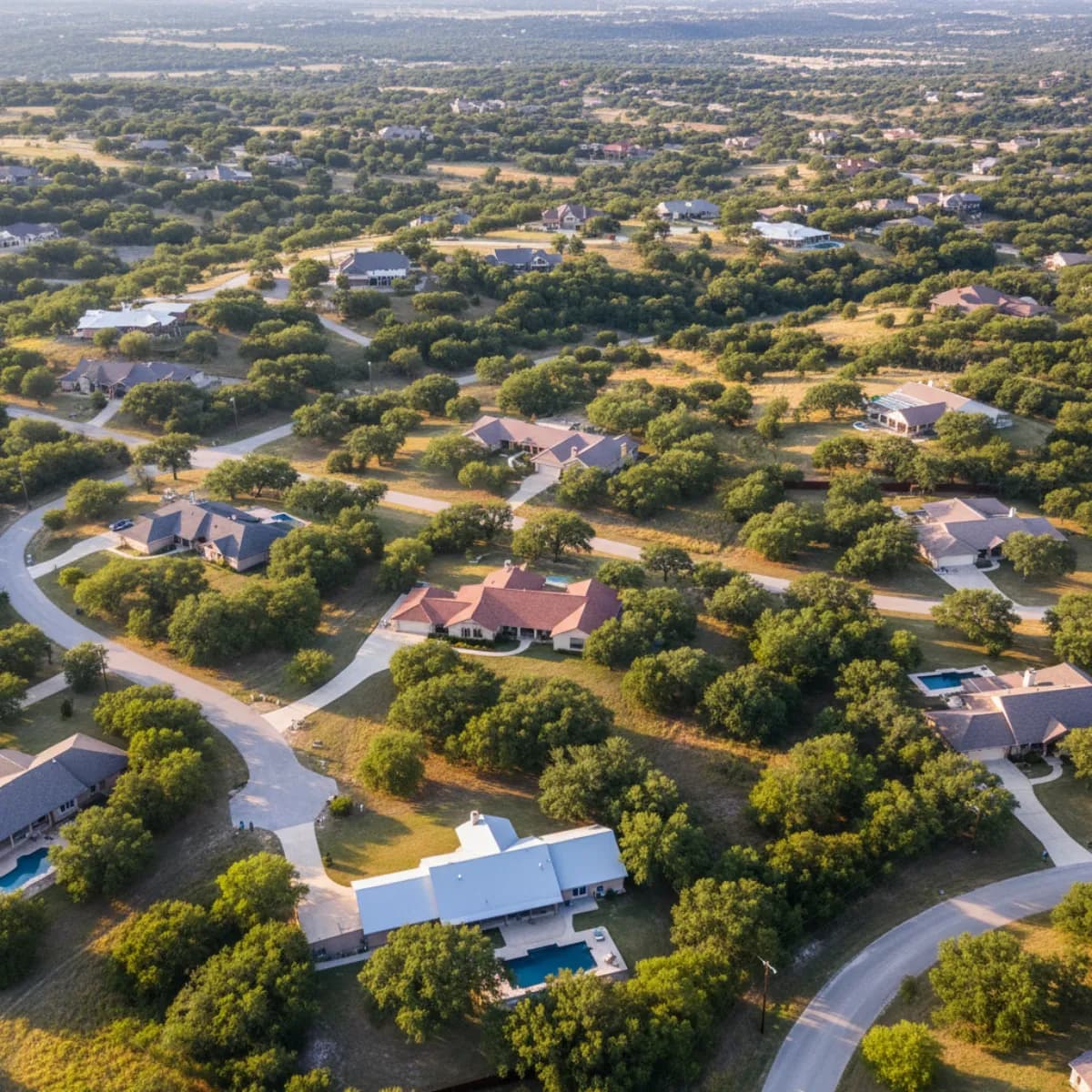
The Texas Hill Country is one of the most beautiful and fastest-growing regions in the United States — and one of the most demanding environments for residential roofing. Stretching from the western edges of Austin and San Antonio through the rolling limestone terrain of Fredericksburg, Kerrville, and the Highland Lakes, the Hill Country presents a unique combination of roofing challenges that no other region in Texas quite matches: extreme heat that regularly exceeds 100 degrees Fahrenheit for weeks at a time, moderate to high hail risk along the I-35 corridor, flash flooding that ranks among the worst in North America, wildfire exposure in the cedar-covered western hills, and year-round cedar debris accumulation that accelerates roof deterioration.
Add to those climate challenges the region's architectural character — Spanish Colonial, Mediterranean, and Tuscan-inspired homes that call for clay and concrete tile roofing — and the economic reality of Austin's explosive population growth driving contractor demand and labor costs to premium levels, and you have a region where the right roofing decisions save homeowners tens of thousands of dollars over the life of their home, while the wrong choices lead to premature failure, repeated storm damage claims, and costly emergency repairs.
This guide covers everything Hill Country homeowners need to know about roof replacement: which materials perform best in this specific climate, how to protect your home from hail and wildfire, what proper drainage looks like in Flash Flood Alley, the true cost of different roofing systems across 11 Hill Country counties, and how to compare quotes from pre-vetted contractors who understand the region's unique demands. Whether you own a custom limestone ranch on 20 acres outside Dripping Springs, a Spanish Colonial in the Stone Oak suburbs of San Antonio, a Victorian in downtown Georgetown, or a new build in one of Williamson County's master-planned communities, this resource will help you make the right decision for your Hill Country roof.
The Hill Country Region: 11 Counties, One Marketplace
RoofVista serves the entire Texas Hill Country region — from the major metros of Austin and San Antonio to the rural communities of Blanco, Gillespie, and Llano counties. Compare quotes from pre-vetted contractors across the region.
Hill Country Counties We Serve
| County | County Seat / Major City | Population | Metro Area |
|---|---|---|---|
| Travis County | Austin | 1.3M+ | Metro |
| Bexar County | San Antonio | 2.0M+ | Metro |
| Williamson County | Georgetown | 650K+ | Metro |
| Hays County | San Marcos | 280K+ | Metro |
| Comal County | New Braunfels | 170K+ | Metro |
| Kendall County | Boerne | 50K+ | Rural |
| Blanco County | Johnson City | 12K+ | Rural |
| Gillespie County | Fredericksburg | 28K+ | Rural |
| Kerr County | Kerrville | 53K+ | Rural |
| Llano County | Llano | 22K+ | Rural |
| Burnet County | Burnet / Marble Falls | 65K+ | Rural |
Five Climate Challenges That Define Hill Country Roofing
The Hill Country's unique geography creates a convergence of roofing challenges found nowhere else in Texas. Understanding these factors is essential for choosing the right materials and contractor.
Extreme Heat and UV Degradation
The Texas Hill Country regularly exceeds 100 degrees Fahrenheit from June through September, with ground-level temperatures on dark-colored roofs reaching 160 to 180 degrees. This relentless thermal cycling — extreme expansion during the day followed by contraction overnight — accelerates the aging of asphalt shingles by 30 to 40 percent compared to manufacturer expectations based on northern climates. Granule adhesion weakens, underlayment dries out, and sealant strips fail prematurely. A roof rated for 30 years in Minnesota may realistically last only 18 to 22 years in the Hill Country without heat-specific material choices. Reflective materials — standing seam metal with Kynar 500 finish, light-colored tile, or cool-roof-rated shingles — significantly reduce thermal stress and can extend roof lifespan by 5 to 10 years while lowering cooling costs by 10 to 25 percent.
Hail Risk Along the I-35 Corridor
The Hill Country sits at the heart of the Texas I-35 hail corridor, where warm Gulf moisture collides with cold fronts and dry air from the west, spawning supercell thunderstorms capable of producing baseball-sized hailstones. Austin averages 4 to 6 significant hail events per year, San Antonio 4 to 7, and the northern suburbs — Georgetown, Round Rock, Cedar Park, Pflugerville — frequently bear the worst impacts due to terrain-enhanced storm development. The April 2021 Central Texas hailstorm caused hundreds of millions in damage across the Austin metro alone. Class 4 impact-resistant shingles, standing seam metal, and concrete tile all provide meaningful hail protection and qualify for 10 to 35 percent insurance premium discounts from most Texas insurers.
Flash Flooding and Drainage Demands
The Hill Country is nicknamed Flash Flood Alley for good reason — the region receives intense, short-duration rainfall events that dump 3 to 6 inches per hour onto rocky limestone terrain with virtually no absorption capacity. The steep terrain channels water downhill with extreme velocity, overwhelming undersized gutters and inadequately flashed roof-to-wall transitions within minutes. Roof drainage failure during Hill Country storms leads to water intrusion behind fascia boards, accelerated foundation erosion where roof runoff concentrates, and saturated soffits that promote mold and rot. Every Hill Country roof replacement should include oversized 6-inch gutters with high-capacity downspouts, gutter guards rated for heavy debris loads, properly sealed valley flashing, and kick-out flashing at every roof-to-wall junction.
Wildfire Risk in WUI Zones
The western Hill Country — from Dripping Springs and Wimberley through Fredericksburg, Johnson City, Marble Falls, and Kerrville — contains extensive wildland-urban interface (WUI) zones where residential development borders cedar, live oak, and dry grassland. The 2011 Bastrop Complex Fire burned over 34,000 acres and destroyed nearly 1,700 homes, and smaller wildfires threaten Hill Country communities during every drought cycle. Homes in WUI zones should have Class A fire-rated roofing — standing seam metal, concrete or clay tile, or fire-rated architectural shingles with fiberglass mat reinforcement. Beyond the roof covering itself, fire-resistant underlayment, metal drip edge, enclosed soffits, and a 5-foot noncombustible zone around the roofline dramatically reduce ignition risk from wind-driven embers.
Cedar Pollen and Debris Accumulation
The Hill Country is densely forested with Ashe juniper (locally called "mountain cedar"), which sheds massive quantities of pollen from December through February and drops needles, bark strips, and small branches year-round. Cedar debris accumulates in roof valleys, behind dormers, at pipe boots, and in gutters far faster than most homeowners expect. Left unchecked, accumulated organic debris traps moisture against roofing materials, promotes moss and algae growth, blocks drainage pathways, and accelerates the deterioration of underlayment and flashing. Hill Country roofs require more frequent cleaning — at minimum twice yearly and after major wind events. Zinc or copper ridge strips can help inhibit algae and moss growth, and gutter guards rated for fine debris are essential for maintaining drainage between cleanings.
Best Roofing Materials for the Texas Hill Country
Material selection in the Hill Country must balance heat resistance, hail protection, fire rating, drainage performance, and architectural compatibility. Here are the top options ranked by long-term value for Hill Country homeowners.
Clay and Concrete Tile
50-75 yearsTile roofing is the signature of Hill Country architecture. Clay tiles offer unmatched aesthetic authenticity for Spanish Colonial and Mediterranean designs that dominate communities from San Antonio through Austin and into the wine country around Fredericksburg. Concrete tile provides a more affordable alternative with similar durability and excellent heat resistance. Both materials handle extreme UV and thermal cycling far better than asphalt, with lifespans of 50 to 75 years — making tile the lowest cost-per-year option despite the higher upfront investment. Weight is the primary consideration: tile weighs 850 to 1,100 pounds per square (100 sqft), requiring structural verification during re-roofing. Most Hill Country homes built for tile can handle the load, but older conversions from shingles to tile may need reinforcement.
Price Per Sqft
$10.00 - $18.00 / sqft
Typical Project Total
$15,000 - $35,000+
Best For
Spanish Colonial, Mediterranean, and Tuscan-style homes throughout the Hill Country
Standing Seam Metal
40-60 yearsStanding seam metal roofing has surged in popularity across the Hill Country as homeowners prioritize heat management, hail resistance, and fire safety. A properly installed metal roof with Kynar 500 or Hylar 5000 finish reflects 60 to 70 percent of solar radiation, meaningfully reducing attic temperatures and cooling costs in a region where summer energy bills are a major concern. Metal offers Class 4 hail resistance and Class A fire rating in a single material, making it ideal for WUI zones. The interlocking panel design also excels in flash flood conditions — no exposed fasteners means fewer potential water entry points. Standing seam metal pairs well with both modern Hill Country architectural styles and traditional Texas ranch homes. The 40 to 60 year lifespan means most homeowners only install one metal roof in their lifetime.
Price Per Sqft
$8.00 - $14.00 / sqft
Typical Project Total
$12,000 - $28,000
Best For
Heat reflection, hail resistance, wildfire zones, ranch-style and modern Hill Country homes
Class 4 Impact-Resistant Shingles
25-35 yearsFor Hill Country homeowners who want effective hail protection without the higher cost of metal or tile, Class 4 impact-resistant shingles are the most practical upgrade. These shingles pass UL 2218 Class 4 testing — repeated impacts from a 2-inch steel ball dropped from 20 feet without cracking — and cost only 15 to 30 percent more than standard architectural shingles. The real value is in insurance: most Texas insurers offer 10 to 35 percent premium discounts for verified Class 4 roofs, which typically recoups the upgrade cost within 3 to 5 years. Top-performing options for the Hill Country include Owens Corning Duration FLEX, GAF Timberline AS II, and CertainTeed Landmark IR. Choose light colors to reduce heat absorption.
Price Per Sqft
$4.50 - $7.00 / sqft
Typical Project Total
$7,000 - $14,000
Best For
Maximum hail protection at the lowest upfront cost; insurance premium savings
Architectural Shingles (Standard)
15-22 years (Hill Country adjusted)Standard architectural shingles remain the most installed roofing material in the Hill Country due to the lowest upfront cost and wide contractor availability. However, Hill Country homeowners should understand that manufacturer-rated lifespans of 25 to 30 years are based on moderate climate conditions — in the extreme UV and thermal cycling of Central Texas, actual lifespans are typically 15 to 22 years. If budget constraints require standard architectural shingles, choose the lightest color your HOA allows to reduce thermal stress, ensure proper ridge and soffit ventilation to manage attic heat, and budget for more frequent inspections. For most Hill Country homeowners, the modest upgrade to Class 4 impact-resistant shingles pays for itself through insurance savings.
Price Per Sqft
$3.50 - $5.50 / sqft
Typical Project Total
$7,000 - $11,000
Best For
Budget-conscious replacements where hail and fire risk are moderate
Insurance upgrade opportunity: If your insurer approves a full roof replacement after hail damage, you pay only the policy deductible regardless of material choice. This is the ideal time to upgrade from standard shingles to Class 4 impact-resistant or standing seam metal — you pay only the difference between the insurance-covered standard material and the upgrade, which is typically $2,000 to $5,000. The future insurance premium savings make the net upgrade cost close to zero.
Wildfire Safety: Roofing in Hill Country WUI Zones
The western Hill Country contains extensive wildland-urban interface zones where proper roofing is your home's first line of defense against wildfire.
Class A Fire-Rated Materials
- Standing seam metal: Inherently Class A rated, noncombustible, no embers can lodge in panels
- Concrete and clay tile: Class A rated, withstands direct flame contact without ignition
- Fire-rated asphalt: Fiberglass-mat shingles with Class A underlayment achieve Class A assembly rating
- Synthetic slate: Engineered polymer composites with Class A fire and Class 4 impact ratings
Beyond the Roof Covering
- Fire-resistant underlayment: Synthetic or fiberglass-based underlayment that resists ember penetration
- Metal drip edge: Prevents embers from entering the roof-to-fascia gap
- Enclosed soffits: Block ember entry into attic space through vented soffits
- 5-foot defensible space: Noncombustible zone around the roofline including trimmed overhanging branches
WUI zone check: If your property is in Kendall, Blanco, Gillespie, Kerr, Llano, or Burnet County — or in western portions of Travis or Hays County — contact your county or local fire marshal to determine whether your property falls within a designated wildland-urban interface zone before selecting roofing materials. WUI designations may restrict material choices and require specific fire-resistance assemblies. Many Hill Country HOAs also have fire-rating requirements that exceed minimum code.
How Austin's Explosive Growth Affects Hill Country Roofing
Austin has been the fastest-growing major metro in the United States, and the ripple effect reaches every corner of the Hill Country. Here is what that means for your roofing project.
Demand-Driven Challenges
- Longer lead times: Schedule 3-6 weeks ahead in peak season (spring and fall) — post-hail waits can stretch to 6-10 weeks
- Metro premium pricing: Austin and San Antonio labor costs run 10-15% above smaller Hill Country towns like Fredericksburg or Kerrville
- Storm chaser influx: High-value metro market attracts out-of-state operators after every major hail event
Growth-Driven Advantages
- More contractors: High demand attracts quality contractors to the region, increasing competition and quote options
- Material availability: Major suppliers maintain extensive Hill Country distribution — materials rarely back-ordered
- Competitive pricing through comparison: Comparing 3+ standardized quotes through RoofVista ensures fair market pricing even in a hot market
Rural Hill Country note: Homeowners in Gillespie, Kerr, Llano, and Blanco counties should expect fewer available contractors compared to the Austin-San Antonio metro corridor. Travel charges of $0.50 to $1.00 per square foot may apply for contractors traveling from metro areas. Planning further ahead — 4 to 8 weeks — and comparing quotes from multiple contractors through RoofVista ensures you get competitive pricing even in lower-density markets.
Current Texas Hill Country Roofing Prices
Live pricing data from vetted Texas contractors. Austin and San Antonio metro pricing may run 10-15% above state averages due to higher labor demand. For full cost details, see our Texas Roof Cost Guide.
Get Your Hill Country Roof Estimate in Minutes
Enter your address for an AI-powered satellite assessment. Compare quotes from pre-vetted Texas contractors — no spam, no obligation, no storm chasers.
Get Your Free EstimateHill Country Communities We Serve
From the state capital to small Hill Country towns, RoofVista connects homeowners with pre-vetted contractors who understand local building codes, climate challenges, and architectural traditions.
State capital and fastest-growing metro. Extreme heat, significant hail risk, and booming demand drive competitive contractor pricing. Travis County permits required.
The Hill Country gateway city. Strong tile roofing tradition on Spanish Colonial homes. Northern suburbs face the heaviest hail exposure. Bexar County permits required.
One of Austin fastest-growing suburbs in Williamson County. High hail exposure and rapid new construction. Impact-resistant materials strongly recommended.
Georgetown
Williamson County seat and one of the fastest-growing cities in America. Historic downtown requires sympathetic material choices. Northern exposure to hail corridor.
San Marcos
Hays County seat between Austin and San Antonio on I-35. University town with a mix of older homes and rapid new development. Moderate hail risk.
New Braunfels
Comal County seat with strong German heritage architecture. One of the fastest-growing cities in Texas. Flash flood risk from the Guadalupe and Comal Rivers demands superior drainage.
Cedar Park
Northwest Austin suburb in Williamson County. High hail exposure from terrain-enhanced storms. Predominantly shingle roofs with growing metal adoption.
Dripping Springs
The "Gateway to the Hill Country" west of Austin. WUI wildfire zones require Class A fire-rated materials. Ranch-style and custom Hill Country homes dominate.
Fredericksburg
Heart of the Texas wine country in Gillespie County. German-Texas heritage architecture. Remote location means fewer contractor options — compare quotes carefully.
Boerne
Kendall County seat northwest of San Antonio. Mix of historic buildings and new master-planned communities. WUI considerations for western developments.
Wimberley
Artist community in Hays County along the Blanco River. Significant flash flood and wildfire risk. Many homes on steep terrain require specialized roofing access.
Marble Falls
Burnet County hub in the Highland Lakes region. Growing retirement and second-home community. Cedar debris accumulation is a major roof maintenance factor.
Kerrville
Kerr County seat deep in the Hill Country. Significant wildfire risk during drought. Remote location commands higher contractor travel costs.
Pflugerville
Northeast Austin suburb with rapid growth. Directly in the I-35 hail corridor — among the highest hail claim rates in the region. Class 4 shingles strongly recommended.
Kyle
Southern Hays County between Austin and San Marcos on I-35. Explosive residential growth with predominantly new construction. Moderate hail and heat exposure.
Johnson City
Blanco County seat and LBJ hometown. Rural Hill Country with significant wildfire risk. Limited contractor availability — plan further ahead for scheduling.
What Drives Roofing Costs in the Hill Country
Roofing costs in the Hill Country vary significantly depending on location, material, roof complexity, and market conditions. Understanding these cost drivers helps you evaluate quotes accurately.
Material and Labor Factors
- Roof size and pitch: Steeper pitches common in Hill Country architecture increase labor time and safety equipment costs by 15-25%
- Tile weight considerations: Clay and concrete tile may require structural reinforcement on older homes, adding $2,000-$5,000 to the project
- Tear-off complexity: Removing existing tile roofing costs 50-100% more than shingle tear-off due to weight and disposal requirements
- Ventilation upgrades: Proper ridge and soffit ventilation is critical in Hill Country heat — budget $500-$1,500 if current ventilation is inadequate
Regional Price Variations
- Austin metro: Highest labor costs in the Hill Country due to contractor demand. Expect 10-15% above state average
- San Antonio metro: 5-10% above state average. Stronger tile roofing market with more specialist contractors
- Rural Hill Country: Base material costs similar to metro, but travel charges ($0.50-$1.00/sqft) may apply for remote properties
- Post-storm surge: After major hail events, labor costs spike 15-30% due to demand. Compare quotes to avoid overpaying
Hill Country Roof Replacement Cost Summary
| Material | Cost / sqft | 1,500 sqft Roof | 2,500 sqft Roof |
|---|---|---|---|
| Standard Architectural | $3.50 - $5.50 | $5,250 - $8,250 | $8,750 - $13,750 |
Class 4 Impact-Resistant Recommended for Hill Country | $4.50 - $7.00 | $6,750 - $10,500 | $11,250 - $17,500 |
| Standing Seam Metal | $8.00 - $14.00 | $12,000 - $21,000 | $20,000 - $35,000 |
| Concrete Tile | $10.00 - $15.00 | $15,000 - $22,500 | $25,000 - $37,500 |
| Clay Tile | $12.00 - $18.00 | $18,000 - $27,000 | $30,000 - $45,000 |
Permits and Regulations Across the Hill Country
Permitting requirements vary significantly across Hill Country jurisdictions. Your contractor should handle permits, but understanding the landscape helps you verify compliance.
City Permits Required
- Austin: Building permit through Development Services Department. $100-$400 fee. Historic district review for Old West Austin, Hyde Park, Clarksville
- San Antonio: Building permit through Development Services. Historic review for King William, Lavaca, Monte Vista districts
- Georgetown: Permit required. Historic downtown has specific material and color requirements
- New Braunfels: Permit required. Flood zone considerations for Guadalupe River corridor properties
County and ETJ Considerations
- Travis County: Properties in unincorporated areas follow county permitting rules. ETJ properties may follow city or county rules
- Rural counties: Blanco, Gillespie, Kerr, and Llano counties have lighter permitting requirements but may still require fire-rating compliance in WUI zones
- HOA requirements: Many Hill Country master-planned communities have material, color, and fire-rating restrictions that exceed local code
- Texas licensing: Texas has no statewide roofing license. Verify contractor insurance, local registration, and any required municipal permits
Texas Hill Country Roofing FAQ
Answers to the most common questions Hill Country homeowners ask about roof replacement, materials, costs, and local challenges.
How much does a roof replacement cost in the Texas Hill Country?
A standard asphalt shingle roof replacement in the Texas Hill Country costs $7,000 to $20,000 for a typical home, depending on size, pitch, and material. Architectural shingles average $3.50 to $5.50 per square foot installed. Tile roofing runs $15,000 to $35,000 or more depending on whether you choose concrete or clay tile. Standing seam metal costs $8.00 to $14.00 per square foot but offers superior heat reflection and a 40 to 60 year lifespan. Austin and San Antonio metro pricing typically runs 10-15% higher than smaller Hill Country communities.
What roofing materials work best in the Texas Hill Country climate?
The Hill Country climate demands materials that handle extreme UV, 100+ degree F temperatures, moderate to high hail risk, and flash flooding. Clay and concrete tile is the traditional choice for Hill Country architecture, offering excellent heat resistance and a 50-75 year lifespan. Standing seam metal reflects solar heat and withstands hail. Class 4 impact-resistant shingles are the most cost-effective hail protection, offering 10-35% insurance discounts. For WUI zones in western Hill Country, Class A fire-rated materials are required.
Does the Hill Country get hail damage?
Yes, the Hill Country sits along the I-35 corridor within Texas Hail Alley. Austin and San Antonio each experience 3-7 significant hail events per year, peaking March through June. Georgetown, Round Rock, Cedar Park, and Pflugerville are particularly vulnerable. Golf-ball to baseball-sized hailstones are not uncommon during severe spring storms. Class 4 impact-resistant materials are strongly recommended throughout the region.
Do I need fire-rated roofing in the Texas Hill Country?
Homes in western Hill Country — including areas around Fredericksburg, Kerrville, Johnson City, Marble Falls, Dripping Springs, and Wimberley — may be in designated wildland-urban interface (WUI) zones where Class A fire-rated roofing is required or strongly recommended. The cedar, live oak, and dry grass landscape creates significant wildfire risk, especially during drought. Class A materials include metal, tile, and fire-rated asphalt shingles. Check with your county or local fire marshal for requirements.
How does the Austin growth boom affect roofing costs in the Hill Country?
Austin has ranked as the fastest-growing major US metro for several consecutive years, and the entire Hill Country region is experiencing a construction boom. Roofing crews are booked further out — schedule 3-6 weeks ahead in peak season. Metro area labor costs run 10-15% above smaller Hill Country towns. However, the volume of contractors also means competitive pricing when you compare multiple quotes through a marketplace like RoofVista.
Why is proper roof drainage so important in the Hill Country?
The Texas Hill Country is one of the most flash-flood-prone regions in North America. Rocky limestone terrain, steep topography, and intense thunderstorms create rapid runoff that overwhelms inadequate drainage. Hill Country homes should have oversized 6-inch gutters, strategically placed downspouts, gutter guards for cedar debris, and proper kick-out flashing. Upgrading drainage during roof replacement is one of the highest-return investments a Hill Country homeowner can make.
More Texas Roofing Resources
Explore our other Texas-specific guides and city pages to make a fully informed decision about your Hill Country roof.
Texas Roofing Hub
Overview of roofing across the Lone Star State with links to all city pages, service guides, and regional resources.
Austin Roofing Quotes
Detailed guide for the state capital including Travis County permits, hail risk, and neighborhood-specific considerations.
San Antonio Roofing Quotes
Bexar County roofing guide covering Spanish Colonial tile traditions, hail exposure, and historic district requirements.
Round Rock Roofing Quotes
Williamson County guide for one of Austin's fastest-growing suburbs with high hail exposure.
Texas Tile Roofing Guide
Complete guide to clay and concrete tile roofing in Texas including costs, lifespan, and architectural compatibility.
Get an Instant Quote
Enter your address to get an AI-powered satellite estimate and compare quotes from vetted TX contractors.