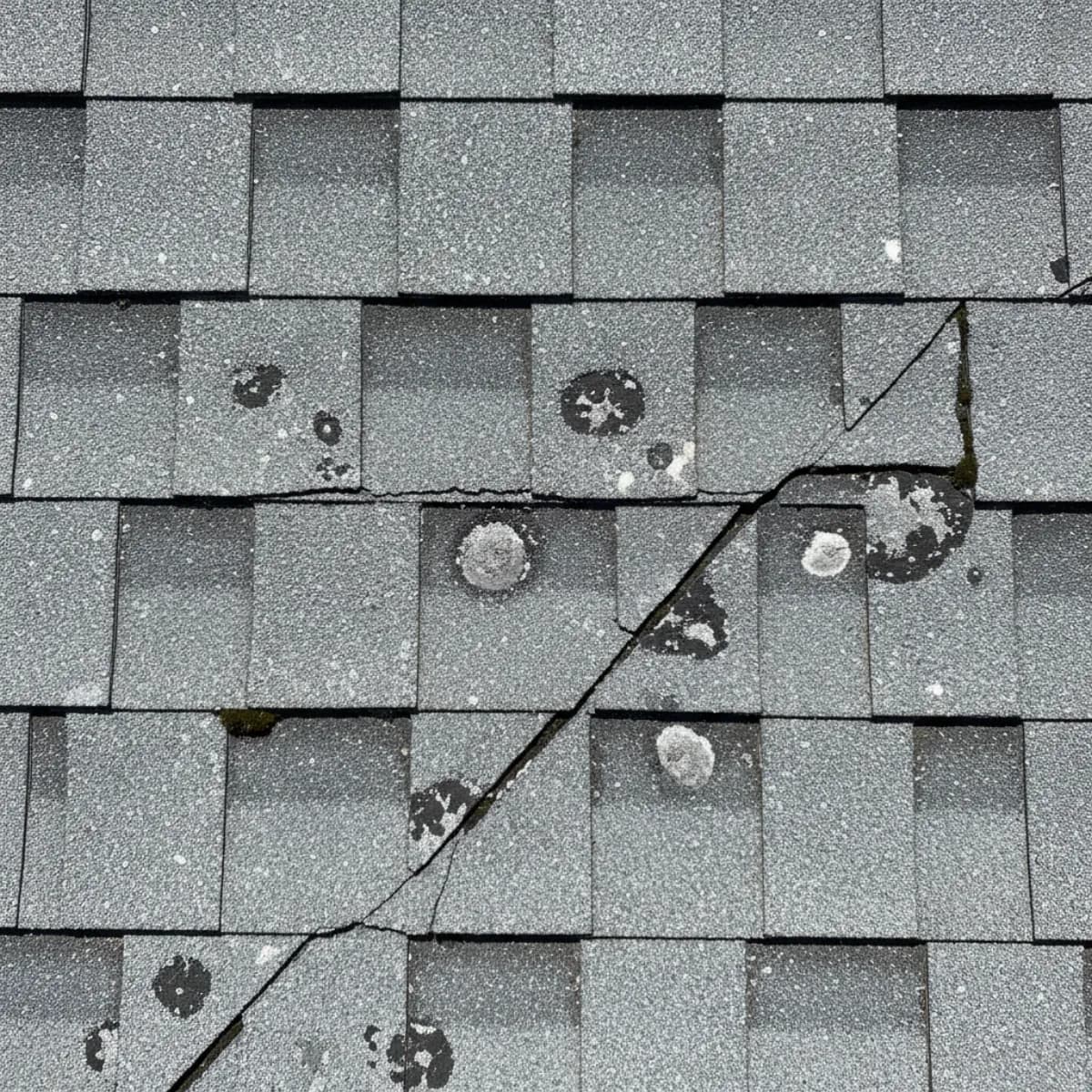
Hail Damage Patterns in New Jersey
New Jersey is not a top-tier hail state like Texas or Colorado, but damaging hail does occur every summer, concentrated in the northwest counties: Sussex, Warren, Hunterdon, Morris, and northern Somerset. Hail damage to NJ roofs is most often caused by 1 to 2.5 inch diameter stones falling at terminal velocities of 50-110 mph during severe summer thunderstorms (June-August). Smaller hail (under 1 inch) typically does not damage modern asphalt shingles; stones above 2.5 inches can cause significant structural damage to even Class 4 impact-resistant shingles.
Identifying hail damage requires looking for specific patterns: circular bruises (dime to quarter sized dark spots where the asphalt has been impact-damaged), granule loss(exposed black asphalt mat where the protective ceramic granules have been knocked off), soft spots (areas that feel mushy when pressed because the underlying mat fibers are damaged), andcracked or split shingle tabs. Damage is typically random in distribution and concentrated on slopes that faced the storm direction. Look at non-roof surfaces (gutters, AC fins, siding, vehicles) for corroborating dents.
Hail damage often degrades over time even when initial damage seems minor. Exposed asphalt mat is vulnerable to UV degradation and water intrusion, so a roof that looked fine right after a hailstorm can fail within 1-3 years if the underlying matrix damage was not addressed. File a claim within 30-60 days of a known hail event to avoid disputes over delayed damage.
How to File a NJ Hail Damage Roof Claim
- Confirm the hail event date using NWS storm reports, news coverage, or NOAA hail history. Save documentation.
- Get a free inspection from a NJ-licensed contractor (not a door-to-door storm chaser). Document with photos and a written damage report.
- Contact your insurance carrier within 30-60 days. Request a claim number and ask for your specific deductible structure.
- Schedule the insurance adjuster inspection. Have your contractor present if possible to ensure all damage is documented.
- Review the adjuster scope and estimate. Compare against your contractor estimate. Negotiate scope if items are missing.
- If your policy is RCV, you typically receive ACV (depreciated) payment first, then the depreciation holdback after work is completed and invoices submitted.
- If denied or scope is inadequate, request re-inspection, hire a NJ-licensed public adjuster, or invoke the appraisal clause in your policy.
- NJ DOBI complaint — if your carrier acts in bad faith, file a complaint with the NJ Department of Banking and Insurance at dobi.nj.gov.
ACV vs RCV: Which NJ Policy Pays More?
RCV (Replacement Cost Value)
Pays full replacement cost minus deductible. Initial check is ACV; depreciation holdback paid after work is done.
Example: 15-year-old roof, $20,000 replacement, $1,500 deductible. RCV pays $18,500 total ($8,500 ACV upfront + $10,000 holdback after invoice).
ACV (Actual Cash Value)
Pays depreciated value of roof at time of damage. No depreciation holdback; you absorb the difference.
Example: Same 15-year-old roof, $20,000 replacement, $1,500 deductible. ACV pays $8,500 - $1,500 = $7,000 total. You cover $13,000 out of pocket.
Many NJ carriers have shifted newer policies to mandatory ACV endorsements for roofs older than 15-20 years. Read your policy declarations page carefully and ask your agent in writing whether your roof is ACV or RCV before storm season.
Class 4 Impact-Resistant Shingle Discount
UL 2218 Class 4 impact-resistant shingles (GAF Timberline AS II, CertainTeed Landmark IR, Owens Corning Duration FLEX, Malarkey Vista) qualify for premium discounts of 10-30% with most major NJ carriers. The discount terms vary:
- NJM: Discount available; verify with your agent.
- State Farm: Typically 10-25% wind/hail discount on roof portion of premium.
- Allstate: Discount varies by region; verify with your agent.
- Plymouth Rock: Discount available; verify with your agent.
- Liberty Mutual, Geico, Travelers: Most major NJ writers offer some Class 4 discount.
The Class 4 shingle upgrade typically costs $1.50-$3.00 more per sqft installed than standard architectural, roughly $2,700-$5,400 on a 1,800 sqft roof. Annual premium savings of $100-$400 means payback in 7-15 years. Class 4 is most worthwhile in northwest NJ where hail incidence is highest. Always confirm the discount and required documentation in writing before specifying Class 4.
NJ Hail Risk by County
Highest Risk: Sussex, Warren, Hunterdon, Morris Counties
Northwest NJ highlands experience the most damaging summer thunderstorms. Newton, Hackettstown, Flemington, Morristown historically among highest hail incidence areas. Class 4 shingles strongly recommended.
Moderate Risk: Somerset, Mercer, Middlesex, Union, Bergen Counties
Periodic hail events, typically smaller stones (0.75-1.25 inch). Class 4 shingles offer modest payback; standard architectural with proper installation is acceptable.
Lower Risk: Coastal & South NJ Counties
Cape May, Atlantic, Ocean, Monmouth, Burlington, Camden, Gloucester. Tropical air masses favor wind over hail. Class 4 may not justify cost; focus instead on 130 mph wind ratings.
Hail Damage Roof Claim in New Jersey: Frequently Asked Questions
How do I identify hail damage on my New Jersey roof?
Hail damage on asphalt shingles appears as circular bruises (dark spots roughly the size of a dime to a quarter), granule loss exposing the black asphalt underneath, soft spots that indent when pressed, and cracked or broken shingle tabs. The damage pattern is typically random and on slopes facing the storm direction. On metal roofs, hail leaves visible dents. Wood shakes show splits along the grain. To confirm hail vs. other damage, look at non-roof surfaces: dented gutters, dinged outdoor AC fins, dented siding, and damaged car panels are corroborating evidence. NJ hail damage is most common in northwest counties (Sussex, Warren, Hunterdon, Morris) where summer thunderstorms produce the largest stones.
How long do I have to file a hail damage claim in New Jersey?
NJ insurance regulations and most homeowners policies allow up to 1 year from the date of the hail event to file a claim, but reporting within 30-60 days is strongly recommended. Hail damage often gets worse over time as exposed asphalt degrades from UV and weather, and insurers may dispute coverage for damage that aging or other weather events could have caused later. File as soon as you suspect hail damage; you can withdraw the claim if inspection shows damage is below your deductible. Document the date of the hail event from local NWS reports and news coverage to support your claim.
Will my NJ homeowners insurance pay for a full roof replacement after hail?
Whether your NJ insurance pays for full replacement vs. partial repair depends on three factors: (1) extent of damage (typically 8+ damaged shingles per 100 sqft slope qualifies for full slope replacement; 25%+ of total roof area qualifies for full replacement); (2) policy type (RCV pays full replacement cost minus deductible; ACV pays depreciated value); (3) shingle matching (if damaged shingles cannot be matched, full slope or full roof replacement is often required). NJ carriers including NJM, Plymouth Rock, Allstate, and State Farm follow industry standard practice but can dispute scope. Get a written damage assessment from a NJ-licensed contractor to support full replacement.
What is the difference between ACV and RCV for NJ hail claims?
ACV (Actual Cash Value) policies pay the depreciated value of your roof at the time of damage. A 15-year old roof with a 25-year useful life is depreciated 60%, so a $20,000 replacement would pay only $8,000 (minus deductible). RCV (Replacement Cost Value) policies pay the full replacement cost minus deductible, often in two installments: ACV upfront, then the remaining depreciation holdback once you complete the work and submit receipts. RCV is the better policy type for older NJ roofs but typically costs 10-20% more in annual premium. Many NJ carriers have moved newer policies to ACV roof endorsements for roofs over 15-20 years old; check your declarations page.
Will Class 4 impact-resistant shingles lower my NJ insurance premium?
Most major NJ homeowners insurance carriers (NJM, Allstate, State Farm, Plymouth Rock, Liberty Mutual, Geico) offer 10-30% premium discounts for roofs installed with Class 4 impact-resistant shingles (UL 2218 Class 4 rating). The discount varies by carrier and policy. The shingle upgrade typically costs $1.50-$3.00 more per sqft installed than standard architectural; for a 1,800 sqft roof that is roughly $2,700-$5,400 added cost. Annual premium savings of $100-$400 means payback in roughly 7-15 years depending on home and carrier. Class 4 shingles are particularly worthwhile in northwest NJ counties (Sussex, Warren, Hunterdon, Morris) where summer hail is most common. Always confirm the discount in writing from your carrier before specifying Class 4.
Should I get a roof inspection before filing a NJ hail claim?
Yes. Get a free professional roof inspection from a licensed NJ contractor before contacting your insurance carrier. The inspector documents the damage with photos, identifies the hail event date based on weather records, and provides a written damage assessment that supports your claim scope. Reputable NJ contractors do not pressure you to file a claim; they tell you whether damage is real, what the likely scope is, and let you decide. Avoid contractors who go door-to-door offering free inspections after a hailstorm: these are often storm chasers from out of state who file aggressive claims and disappear after the work is done. RoofVista pre-vets local NJ contractors with documented hail experience.
What is a public adjuster and should I hire one in NJ?
A public adjuster is a licensed professional who represents the homeowner (not the insurance company) in negotiating an insurance claim. NJ requires public adjusters to be licensed by the NJ Department of Banking and Insurance (NJ DOBI). They typically charge 10-20% of the final claim payout and can be valuable when (1) the insurance adjuster severely undercuts your scope, (2) your claim exceeds $25,000-$50,000, or (3) you face a denial or reduced settlement. For straightforward hail claims under $15,000 with cooperative insurance carriers, a public adjuster may not be cost-justified. Verify NJ licensure at dobi.nj.gov before hiring any public adjuster.
Where in New Jersey is hail damage most common?
NJ hail damage concentrates in northwest counties where summer thunderstorms produce the largest stones: Sussex, Warren, Hunterdon, Morris, and northern Somerset. Newton, Hackettstown, Flemington, and Morristown are historically high-incidence areas. Smaller hailstorms affect all NJ counties periodically, but the storms producing damaging 1+ inch hail (the threshold for typical roof damage) are concentrated in the higher elevations and rural areas. The Jersey Shore (Cape May, Atlantic, Monmouth, Ocean) sees less hail because tropical air masses there favor wind events over hail-producing thunderstorms.
Get Free Hail Damage Inspection in NJ
Pre-vetted NJ contractors can document hail damage to support your insurance claim. Free instant inspection request based on your address.
No spam. No phone calls. Free inspection from vetted local contractors.