In This Guide
Why Tile Roofing Dominates Florida
Drive through any neighborhood south of Orlando and tile roofs define the skyline. More than 60% of homes in South Florida use tile roofing, and the material's dominance is not accidental — it is the product of climate, building code evolution, and long-term economics. Understanding why tile became Florida's default roofing material helps explain why it remains the best choice for most homeowners in the state despite its higher upfront cost compared to asphalt shingles.
Climate Compatibility
Florida's combination of extreme UV radiation, intense heat, high humidity, salt air exposure, and frequent hurricane-force winds creates one of the most demanding environments for roofing materials in the United States. Asphalt shingles in Florida degrade two to three times faster than they do in northern climates — a 30-year shingle often lasts only 12 to 18 years in South Florida. Tile, by contrast, is inherently resistant to every one of these environmental stressors. Clay and concrete do not degrade under UV exposure, they are impervious to salt air corrosion, they do not absorb moisture, and their mass provides exceptional thermal performance in hot climates. The thermal mass of tile roofing absorbs heat slowly during the day and releases it slowly at night, reducing cooling loads by 15 to 25 percent compared to asphalt shingles.
Post-Hurricane Andrew Building Standards
Hurricane Andrew in 1992 devastated South Florida and exposed catastrophic failures in residential construction, including roofing. The post-Andrew building code reforms — which eventually became the Florida Building Code in 2002 — dramatically increased wind-resistance requirements for all roofing materials. Tile roofing, with its individual mechanical attachment points and heavy dead load, proved to perform well under the new standards. Post-Andrew analysis showed that properly attached tile roofs suffered significantly less wind damage than stapled shingle roofs, and the new codes mandated attachment methods (mortar set plus mechanical fasteners) that leveraged tile's inherent wind-resistance advantages. This code evolution accelerated tile adoption throughout the state, particularly in coastal and high-wind zones.
Long-Term Cost Economics
While tile roofing costs two to three times more than asphalt shingles upfront, the lifecycle cost tells a different story. A clay tile roof installed for $40,000 that lasts 75 years costs approximately $533 per year. An asphalt shingle roof installed for $15,000 that lasts 15 years in Florida costs $1,000 per year — and requires a full replacement every 15 years with the associated disruption, permit costs, and disposal fees. Over a 60-year period, a homeowner who installs shingles will spend approximately $60,000 on four roof replacements, while the tile homeowner will spend $40,000 for the initial installation plus $20,000 to $25,000 for one underlayment replacement at the 20 to 25 year mark. Factor in insurance premium reductions and energy savings from tile's thermal mass, and the economic case for tile in Florida is compelling.
Types of Roof Tile: Concrete, Clay, Barrel, Flat & S-Tile
Not all tile roofs are the same. The material (concrete vs clay) and the profile (barrel, flat, or S-curve) affect cost, performance, aesthetics, and code compliance. Each combination has different weight, wind resistance characteristics, and installation requirements under the Florida Building Code.
Concrete Tile
Concrete tiles are manufactured from Portland cement, sand, water, and iron oxide pigments. They are the most common tile roofing material in Florida due to their lower cost compared to clay. Concrete tiles are available in virtually every profile — flat, low-profile, medium-profile, high-profile barrel, and S-curve — and can be colored to mimic the appearance of clay, slate, or wood shake.
Key characteristics: Weighs 900 to 1,100 pounds per roofing square. Lifespan of 30 to 50 years. Surface color coating can fade over 10 to 20 years of UV exposure and may need recoating. Absorbs more moisture than clay (2 to 5% absorption rate), which can promote algae growth in humid environments. Cost: $12 to $18 per square foot installed. Concrete tile is manufactured by companies including Boral, Eagle Roofing Products, and Entegra Roof Tile, all of which produce Florida-specific product lines with FBC and HVHZ approvals.
Clay Tile
Clay tiles are made from natural clay that is shaped and kiln-fired at temperatures exceeding 2,000 degrees Fahrenheit. The firing process creates a vitrified surface that is extremely durable and resistant to color change — unlike concrete, the color in clay tile runs through the entire body of the tile, so it does not fade or require recoating. Clay tile is the premium option in Florida and is particularly popular in high-end communities, historic districts, and Mediterranean-style architecture.
Key characteristics: Weighs 600 to 900 pounds per roofing square (lighter than concrete). Lifespan of 50 to 100 years. Near-zero moisture absorption rate (less than 1%), making it highly resistant to algae, mold, and freeze-thaw damage. Superior color permanence. Cost: $15 to $25 per square foot installed. Leading manufacturers for the Florida market include MCA Clay Roof Tile, Ludowici Roof Tile, and US Tile by Boral.
Barrel Tile (High-Profile)
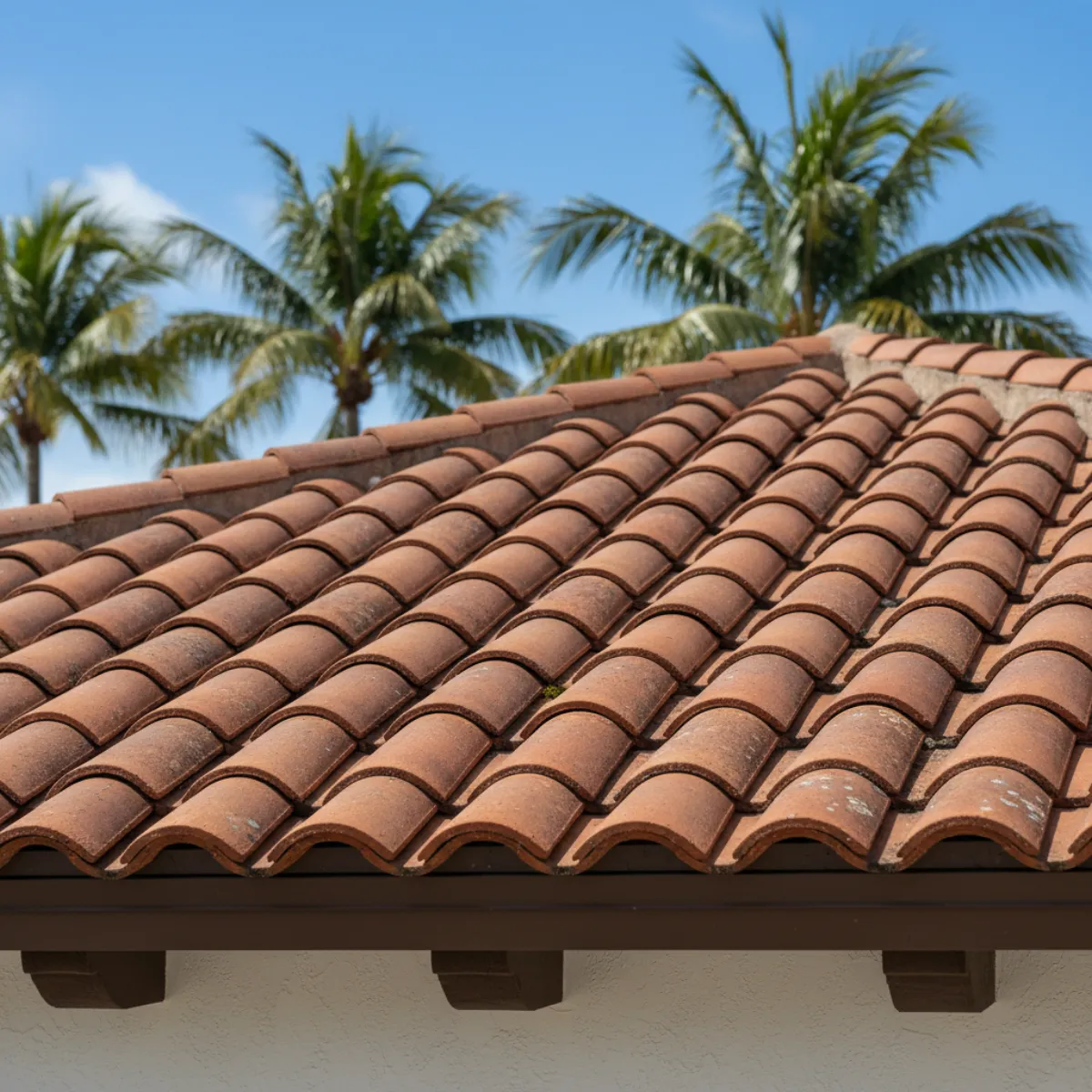
Barrel tile is the iconic half-cylinder profile most associated with Florida's Mediterranean and Spanish-Colonial architecture. Available in both clay and concrete, barrel tiles create a dramatic shadow line and distinctive wave pattern on the roof surface. Installation is more labor-intensive than flat or S-tile profiles because each tile must be individually aligned and the alternating convex/concave pattern requires careful mortar set at the head and hip closures. Barrel tiles provide excellent ventilation beneath the tile surface due to the large air channels created by the curved profile, which improves thermal performance. However, these same air channels can create wind-uplift vulnerability if tiles are not properly attached, which is why the FBC requires enhanced attachment (mortar plus mechanical fasteners) for barrel tile in high-wind zones. Cost premium: 10 to 15 percent over flat profile tiles.
Flat Profile Tile
Flat profile tiles (also called shake or slate profile depending on the surface texture) provide a sleek, modern appearance. They lie flatter on the roof deck than barrel or S-tile, which gives them better wind-uplift resistance because there is less surface area exposed to wind loading. Flat tiles are also lighter than equivalent barrel tiles because there is less material in each tile. Installation is faster and less labor-intensive, which reduces installed cost. Flat tiles are increasingly popular in contemporary Florida architecture and are available in concrete and, less commonly, clay. Their lower profile means less air circulation beneath the tiles, so they rely more on the underlayment and ventilation system for moisture management.
S-Tile (Medium Profile)
S-tile, named for its S-shaped cross-section, is a medium-profile tile that bridges the gap between flat and barrel profiles. It provides more visual dimension than flat tile without the full height and installation complexity of barrel tile. S-tile is one of the most popular profiles in Florida, particularly for tract housing and mid-range residential construction. Available in both concrete and clay, S-tile interlocks along its edges, which provides good wind-uplift resistance and reduces the amount of mortar required compared to barrel tile. The interlocking design also speeds installation and reduces labor costs. S-tile is often the default specification when Florida builders specify “tile roof” without designating a specific profile.
Florida Building Code Requirements for Tile Roofs (R905.3)
FBC section R905.3 is the governing code for tile roof installations throughout Florida. These requirements apply to all tile installations outside the HVHZ (Miami-Dade and Broward counties have additional requirements covered in the next section). Understanding these code provisions is essential for evaluating contractor proposals and ensuring your installation will pass inspection.
Mechanical Attachment Requirements
Every tile must be mechanically attached to the roof deck using corrosion-resistant fasteners. In standard wind zones (up to 110 mph design wind speed), a minimum of one fastener per tile is required. In enhanced wind zones (110 to 120 mph), two fasteners per tile are required for perimeter tiles and one for field tiles. Above 120 mph, all tiles require two fasteners plus adhesive or mortar set. The fasteners must penetrate the roof deck a minimum of 3/4 inch and must be corrosion-resistant — in coastal areas within 3,000 feet of saltwater, stainless steel fasteners are recommended. The FBC specifically prohibits attachment by adhesive or mortar alone — mechanical fastening is always required as the primary attachment method.
Mortar vs Adhesive Set
The FBC allows two methods for supplemental tile attachment beyond mechanical fasteners: mortar set and adhesive (foam) set. Mortar set uses a Portland cement-based mortar applied to the head (top edge) of each tile to bond it to the tile above. This is the traditional method and is particularly common with barrel tile installations. Adhesive set uses polyurethane foam adhesive applied to the underside of each tile to bond it to the underlayment or batten system.
Both methods are code-compliant when properly applied, but they have different performance characteristics. Mortar is rigid and can crack over time due to thermal cycling and structural movement, potentially losing its bond strength. Adhesive foam remains flexible and maintains its bond longer, but it is a newer technology with a shorter track record in Florida. The FBC requires that the first three rows of tiles from all edges, hips, and ridges use both mechanical fasteners and mortar or adhesive set regardless of wind zone, because perimeter tiles experience the highest wind-uplift pressures.
Underlayment Requirements
Under standard FBC (non-HVHZ), tile roof underlayment must be a minimum of one layer of ASTM D226 Type II (No. 30) felt or an approved synthetic underlayment meeting ASTM D4869 Type III or Type IV. In wind zones above 120 mph, a secondary water barrier is required using either self-adhering modified bitumen underlayment or a mechanically attached synthetic with sealed seams. For new construction in wind zones above 140 mph, a sealed roof deck using self-adhering underlayment is required throughout the roof, matching the HVHZ standard. The underlayment must extend over the drip edge at eaves and beneath the drip edge at rakes, and all penetrations must be properly flashed and sealed. Underlayment installation is inspected before tile installation can proceed.
Structural Load Requirements
The FBC requires that the roof structure be designed to support the dead load of the tile system in addition to live loads (maintenance workers), wind loads, and any applicable rain loads. Tile roofing dead loads range from 600 to 1,100 pounds per roofing square depending on material (clay vs concrete) and profile. The structural design must be documented by a Florida-licensed engineer or architect and submitted as part of the permit application. For conversions from shingle to tile roofing, a structural analysis is mandatory because the existing truss or rafter system may not be designed for the additional 300 to 800 pounds per square of dead load that tile adds over shingles.
HVHZ Tile Requirements: Miami-Dade Product Approval & TAS Testing
The High Velocity Hurricane Zone — covering all of Miami-Dade County and Broward County — imposes requirements on tile roofing that go well beyond the standard FBC. Every tile product, every underlayment, every fastener, and every adhesive must hold a valid Notice of Acceptance (NOA) from the Miami-Dade County Product Control Division. These products must pass TAS (Testing Application Standards) protocols that simulate Category 5 hurricane conditions.
TAS 101: Tile Wind Uplift Resistance
TAS 101 tests the ability of individual tile products to resist wind uplift forces under simulated hurricane conditions. The test subjects tile specimens to cyclic positive and negative air pressure differentials that replicate the rapid pressure fluctuations a roof experiences during a hurricane. The tile must maintain its attachment through thousands of pressure cycles at design pressures that exceed 185 mph equivalent wind speeds. TAS 101 results determine the maximum design pressure rating for each tile product and dictate the required attachment method (fastener count, mortar or adhesive requirements) for different locations on the roof (field, perimeter, corner).
TAS 108: Wind-Driven Rain Resistance
TAS 108 evaluates the tile roofing system's resistance to water intrusion during wind-driven rain conditions. The test applies water spray at the exterior surface while simultaneously applying negative air pressure (suction) at the underside, simulating how hurricane winds drive rain underneath and between tiles. The complete assembly — tiles, underlayment, battens, and fasteners — must prevent water from reaching the roof deck. This test is critical because tile roofing is not inherently waterproof; individual tiles overlap but do not seal, so the system relies on the tile profile, overlap geometry, and underlayment working together to shed water. Products that fail TAS 108 may require additional underlayment layers or modified installation details to achieve compliance.
TAS 114 & TAS 115: Impact and Debris Resistance
TAS 114 tests impact resistance from wind-borne debris using both large missile (9-pound 2x4 lumber at 34 mph) and small missile (steel ball bearings at 130 feet per second) protocols. For tile roofing, TAS 114 acknowledges that the tile itself may break upon large missile impact — the critical test is whether the underlayment system beneath prevents penetration to the roof deck. This is why the sealed roof deck requirement works in concert with tile: if impact debris shatters tiles, the sealed underlayment maintains the water barrier.
TAS 115 evaluates the tile attachment system's resistance to progressive failure — testing whether the loss of one tile causes adjacent tiles to detach in a chain reaction. This is particularly important for barrel and S-tile profiles where interlocking patterns mean that the failure of one tile can affect the stability of surrounding tiles. TAS 115 results determine the minimum attachment requirements needed to prevent cascade failure during sustained hurricane-force winds.
NOA Product Approval for Tile
Every tile product used in the HVHZ must carry a valid Notice of Acceptance (NOA) issued by the Miami-Dade County Product Control Division. The NOA specifies exactly how the product may be installed, including approved substrate types, required fastener specifications, minimum mortar or adhesive requirements, and maximum design pressure ratings by roof zone (field, perimeter, corner, ridge, hip). Using a tile product without a valid NOA in the HVHZ is a code violation that results in a failed inspection. You can verify any product's NOA status through the Miami-Dade County product search database. Each NOA has an expiration date and must be renewed by the manufacturer — always confirm the NOA is current before your contractor begins installation. For a comprehensive overview of HVHZ requirements, see our Miami-Dade HVHZ Roofing Requirements guide.
Cost Breakdown: Concrete Tile vs Clay Tile
Tile roofing costs in Florida vary significantly based on the material (concrete vs clay), profile (flat vs barrel), location (standard FBC vs HVHZ), and condition of the existing roof structure. The following cost ranges reflect 2026 pricing for the Florida market and include tear-off, underlayment, tile installation, flashings, ridge caps, and cleanup.
Concrete Tile: $12 to $18 Per Square Foot Installed
| Component | Cost/SqFt |
|---|---|
| Tear-off & disposal | $1.50 – $3.00 |
| Underlayment (synthetic/felt) | $0.50 – $1.50 |
| Concrete tile material | $3.00 – $5.50 |
| Labor (installation) | $5.00 – $7.00 |
| Flashings, ridge caps, trim | $1.00 – $2.00 |
| Total installed | $12.00 – $18.00 |
For a typical 2,000-square-foot Florida home, a concrete tile re-roof costs $24,000 to $36,000. The lower end represents flat-profile concrete tile in standard FBC zones with a straightforward tear-off. The higher end reflects barrel-profile concrete tile, complex roof geometry, or locations where the existing deck requires significant repair.
Clay Tile: $15 to $25 Per Square Foot Installed
| Component | Cost/SqFt |
|---|---|
| Tear-off & disposal | $1.50 – $3.00 |
| Underlayment (synthetic/felt) | $0.50 – $1.50 |
| Clay tile material | $5.00 – $10.00 |
| Labor (installation) | $6.00 – $9.00 |
| Flashings, ridge caps, trim | $1.00 – $2.50 |
| Total installed | $15.00 – $25.00 |
For a typical 2,000-square-foot Florida home, a clay tile re-roof costs $30,000 to $50,000. Clay tile labor costs run higher because the material is more fragile during handling and installation, and barrel-profile clay tiles require more precise alignment and mortar work than concrete equivalents.
HVHZ Cost Premium
Tile roof installations within the Miami-Dade/Broward HVHZ cost 15 to 30 percent more than equivalent installations in standard FBC zones. The premium comes from NOA-approved products (higher manufacturer pricing), sealed roof deck underlayment (adds $1.50 to $3.00 per square foot), enhanced fastener schedules, and the three mandatory inspections. For a 2,000-square-foot home in the HVHZ, the premium adds $5,000 to $12,000 to the total project cost depending on the tile material and profile selected. See our HVHZ roofing guide for a detailed breakdown of these additional requirements.
Tile Roof Lifespan and Longevity
Tile roofing is one of the longest-lasting roofing materials available, but the tiles and the underlayment beneath them have very different lifespans. Understanding this distinction is critical for Florida homeowners because it determines what actually needs replacing and when.
Clay Tile: 50 to 100 Years
Clay tiles are among the most durable roofing materials ever developed. Kiln-fired clay is essentially a ceramic product that does not degrade under UV radiation, does not absorb meaningful moisture, does not support biological growth, and maintains its structural integrity for generations. Many buildings in the Mediterranean, Middle East, and Asia have clay tile roofs that have been in service for centuries. In Florida, properly manufactured clay tiles from reputable producers can reasonably be expected to last the entire useful life of the structure. The primary failure modes for clay tiles are impact damage (from fallen branches, foot traffic, or wind-borne debris), structural movement that cracks tiles at attachment points, and manufacturing defects in lower-quality imported tiles.
Concrete Tile: 30 to 50 Years
Concrete tiles have a significantly shorter lifespan than clay, primarily because Portland cement is more porous and susceptible to long-term moisture absorption and surface erosion. Over 30 to 50 years in Florida, concrete tiles gradually lose surface coating (the color layer), develop surface porosity that encourages algae and moss growth, and can become brittle as the cement matrix degrades. High-quality concrete tiles from major manufacturers with proper surface treatments may reach 50 years, while lower-quality or improperly stored tiles may begin showing significant deterioration at 25 to 30 years. When concrete tiles reach end of life, they become noticeably soft and crumbly, break easily when walked on, and may show visible erosion of the surface coating and the tile body itself.
Underlayment: 20 to 25 Years
The underlayment beneath tile roofing — whether traditional felt, synthetic, or self-adhering modified bitumen — has a much shorter lifespan than the tiles themselves. In Florida's extreme heat (roof surface temperatures regularly exceed 160 degrees Fahrenheit in summer), the oils and binders in felt underlayment dry out and become brittle over 20 to 25 years. Synthetic underlayments can last slightly longer (25 to 30 years) but are also subject to heat degradation. When the underlayment fails, water penetrates past the tiles to the roof deck, causing rot, mold, and interior water damage. This is why most tile roof “replacements” in Florida are actually underlayment replacements — the tiles are removed, the underlayment is replaced, and the original tiles are reinstalled.
Weight Considerations and Structural Requirements
Tile roofing is heavy. This is simultaneously one of its advantages (mass contributes to wind resistance and thermal performance) and one of its challenges (the roof structure must be designed to carry the load). For Florida homeowners considering tile — particularly those converting from shingle to tile — the structural question is critical.
Weight Comparison by Material
| Roofing Material | Weight per Square |
|---|---|
| 3-Tab asphalt shingles | 200 – 250 lbs |
| Architectural asphalt shingles | 250 – 350 lbs |
| Standing seam metal | 100 – 175 lbs |
| Clay tile (flat profile) | 600 – 750 lbs |
| Clay tile (barrel profile) | 750 – 900 lbs |
| Concrete tile (flat profile) | 850 – 950 lbs |
| Concrete tile (barrel profile) | 950 – 1,100 lbs |
One roofing “square” = 100 square feet of roof area.
Structural Assessment for Tile Conversion
If your Florida home currently has a shingle roof and you want to convert to tile, a structural engineering assessment is mandatory under the FBC. A Florida-licensed Professional Engineer (PE) must evaluate the existing truss or rafter system, connections, bearing walls, and foundation to determine whether the structure can support the additional dead load of tile roofing. Most Florida homes built after the mid-1980s in South Florida were designed with tile-rated trusses because tile was already the dominant roofing material in the region. However, homes in Central and North Florida, and older homes statewide, may require truss reinforcement. Common reinforcement methods include sister rafters (adding a second rafter alongside each existing rafter), gusset plates at critical connections, and intermediate support beams. Reinforcement costs range from $3,000 to $10,000 depending on the extent of modifications required.
Hurricane Performance: Tile vs Shingles
Hurricane performance is the defining consideration for roofing material selection in Florida. How tile and shingle roofs perform under hurricane conditions differs significantly, and the comparison involves more nuance than simply stating one is “better” than the other.
Wind Uplift Resistance
Properly attached tile roofing with mechanical fasteners plus mortar or adhesive set provides exceptional wind-uplift resistance. The heavy dead load of tile (600 to 1,100 pounds per square) inherently resists uplift forces that wind exerts on the roof surface. When combined with code-compliant mechanical attachment and supplemental mortar or adhesive set, tile roofs can withstand sustained winds exceeding 180 mph. By comparison, asphalt shingles rely entirely on adhesive strip bonding and nail attachment, with rated wind resistance of 110 to 130 mph for most products (some premium architectural shingles are rated to 150 mph). In post-hurricane damage assessments, properly installed tile roofs consistently show lower rates of complete covering loss than shingle roofs at equivalent wind speeds.
Debris Impact Vulnerability
This is where shingles have an advantage over tile. When struck by wind-borne debris, shingles flex and absorb impact energy without shattering. Tile, being rigid, shatters on impact. A flying tree branch that would dent a shingle will break a tile. However, the broken tile exposes the underlayment, and if the underlayment is intact (especially a sealed roof deck), no water enters the structure. The broken tiles can be individually replaced after the storm. With shingles, impact damage may not be immediately visible but can compromise the waterproofing layer through micro-fractures in the fiberglass mat. The HVHZ addressed this with TAS 114, which tests the entire tile-plus-underlayment system for debris impact resistance rather than just the tile alone.
Secondary Water Barrier Performance
The combination of tile roofing with a sealed roof deck provides the best hurricane water-intrusion resistance available for residential construction. If tiles are lost to wind or debris during a hurricane, the sealed deck prevents water from entering the structure until repairs can be made. Post-hurricane damage surveys consistently show that homes with tile-over-sealed-deck experience 70 to 90 percent less interior water damage than homes with shingle roofing when both lose their primary covering. This is why insurance companies offer significant premium discounts for tile roofs with verified secondary water barriers. For details on sealed roof deck requirements, see our Florida Sealed Roof Deck Guide.
Tile as Debris Source
One concern with tile roofing in dense neighborhoods is that broken or displaced tiles can become wind-borne debris that damages adjacent structures. A concrete tile weighing 8 to 12 pounds, propelled by 130+ mph winds, is a serious projectile. This is precisely why the FBC and HVHZ attachment requirements are so stringent — not just to protect the building with the tile roof, but to prevent tiles from becoming hazards to surrounding structures. Improperly attached tile roofs (particularly older installations that predate current code requirements) can shed tiles during hurricanes, creating a cascading damage pattern through neighborhoods. When evaluating your tile roof before hurricane season, check for loose tiles, deteriorated mortar, and missing mechanical fasteners — these are the failure points that lead to tile loss during storms.
Insurance Benefits of Tile Roofs in Florida
Florida's homeowners insurance market is in crisis, with premiums increasing 50 to 100 percent in many areas over the past five years. Tile roofing — particularly when combined with a code-compliant secondary water barrier — qualifies for significant wind mitigation credits that can substantially reduce insurance costs. Understanding these credits is essential for calculating the true lifecycle cost of a tile roof.
Wind Mitigation Inspection Credits
Florida law requires insurers to provide premium discounts for homes that meet specific wind-resistance criteria documented in a wind mitigation inspection (OIR-B1-1802 form). A tile roof with mechanical attachment qualifies for a “Roof Covering” credit, and when combined with a secondary water barrier (sealed deck or self-adhering underlayment), qualifies for additional credits in the “Roof Deck Attachment” and “Secondary Water Resistance” categories. Total annual premium reductions from these combined credits range from $500 to $3,000 depending on the insurer, coverage amount, and property location. Over the 50+ year lifespan of a clay tile roof, these cumulative savings can exceed $50,000 to $100,000 in present-value terms. For a deeper analysis of the Florida insurance landscape, see our Florida Insurance Crisis and Roofing Guide.
Roof Age and Insurability
Many Florida insurers now refuse to write or renew homeowners policies on homes with roofs older than 15 to 20 years, regardless of the roofing material. However, some insurers make exceptions for tile roofs because the tile material itself does not degrade the way shingles do. If your tile roof has had its underlayment replaced within the past 20 years and the tiles are in good condition, some insurers will consider the roof “age” as the date of the most recent underlayment replacement rather than the original tile installation date. This can save homeowners from unnecessary full roof replacements driven solely by insurance age requirements. Document your underlayment replacement with permit records, inspection reports, and contractor invoices to support this position with your insurer.
Citizens Property Insurance Tile Credits
Citizens Property Insurance Corporation, Florida's state-backed insurer of last resort, provides specific premium credits for tile roofing with verified wind mitigation features. Citizens' credit structure is published and transparent, making it a useful benchmark for evaluating the insurance value of tile roofing. As of 2026, Citizens provides credits for: concrete or clay tile roof covering (vs asphalt shingles); mechanical attachment method (clips, direct fastening, or full mortar/adhesive set); secondary water resistance (self-adhering underlayment); and roof-to-wall connection method (clips, straps, or structural connections). The combined annual savings for a tile roof with all available credits on a $300,000 dwelling policy can exceed $2,500 compared to a standard shingle roof without wind mitigation features.
Maintenance: Common Problems and Repair Costs
Tile roofs are low-maintenance compared to other roofing materials, but they are not maintenance-free. Regular inspection and prompt repair of common issues extends the lifespan of both the tiles and the underlayment, prevents costly interior water damage, and maintains the roof's wind-resistance performance.
Cracked and Broken Tiles
Cracked tiles are the most common tile roof problem in Florida. Causes include impact from fallen branches, foot traffic (HVAC technicians, satellite installers, and pressure washers are frequent culprits), thermal expansion and contraction, and settling of the roof structure. A single cracked tile does not necessarily cause a leak because the underlayment provides a secondary water barrier, but multiple cracked tiles or tiles with displaced fragments can allow water to pool against the underlayment and accelerate its degradation. Individual tile replacement costs $15 to $50 per tile depending on the profile, material, and accessibility. The challenge is often finding replacement tiles that match the existing installation, particularly for discontinued colors or profiles. Keep a supply of spare tiles from the original installation for future repairs.
Loose or Deteriorated Mortar
Mortar set on barrel tile roofs degrades over time due to Florida's heat cycling, UV exposure, and moisture. As the mortar dries, cracks, and separates from the tile surfaces, it loses its supplemental holding power and can leave tiles vulnerable to wind uplift. Mortar deterioration is most common at ridge caps, hip closures, and the first few courses at roof edges — precisely the areas that experience the highest wind-uplift pressures. Mortar re-pointing (removing and replacing deteriorated mortar) costs $3 to $8 per linear foot for ridge and hip work. A full mortar re-set on a barrel tile roof costs $2,000 to $5,000 depending on roof size and complexity. Do not delay mortar repairs — loose ridge cap tiles are among the first components to fail during hurricanes.
Underlayment Failure
Underlayment failure is the most expensive maintenance issue for tile roofs because it requires removing all tiles to access and replace the underlayment layer. Signs of underlayment failure include: water stains on interior ceilings or walls during heavy rain, especially if there are no visible broken or displaced tiles; musty odors in the attic; visible daylight through the roof deck when viewed from inside the attic; sagging or soft spots in the roof deck; and mold or mildew on the underside of the deck sheathing. An underlayment replacement on a tile roof costs 40 to 60 percent of a full tile roof replacement because the labor-intensive tile removal and reinstallation process accounts for most of the cost, while the tiles themselves are reused. For a 2,000-square-foot roof, an underlayment replacement typically costs $12,000 to $22,000.
Algae and Biological Growth
Concrete tiles are more susceptible to algae, moss, and lichen growth than clay tiles due to their higher moisture absorption rate. Biological growth on tile roofs is primarily a cosmetic issue — it does not damage the tile material — but it can retain moisture against the tile surface and accelerate mortar deterioration. Pressure washing is the most common cleaning method but must be done carefully to avoid breaking tiles and forcing water under the tile overlap where it can reach the underlayment. Soft washing (low-pressure chemical treatment) is the preferred method for tile roofs. Professional soft washing costs $0.25 to $0.50 per square foot. Never allow a contractor to walk on your tile roof during cleaning — this breaks tiles and creates more problems than it solves.
When to Replace Underlayment vs the Tiles Themselves
One of the most common — and most expensive — mistakes Florida homeowners make is replacing an entire tile roof when only the underlayment needs replacement. Conversely, some homeowners delay necessary tile replacement by repeatedly patching underlayment under tiles that have reached end of life. Understanding when each component needs replacement saves thousands of dollars and ensures your roof system performs as designed.
Replace Underlayment Only (Tile Re-Lay)
A tile re-lay — removing tiles, replacing underlayment, and reinstalling the original tiles — is appropriate when the tiles are in good condition but the underlayment has reached end of life. This is the most common major maintenance operation for tile roofs in Florida and typically occurs at the 20 to 25-year mark.
Indicators for underlayment-only replacement: Roof is leaking during rain but tiles appear intact and properly positioned; roof age is 20+ years with original underlayment; attic inspection reveals daylight, moisture, or mold on the deck underside; tiles are structurally sound (do not crumble when handled) and maintain their original profile shape; and more than 85% of the original tiles can be salvaged for reinstallation. Cost: $12,000 to $22,000 for a 2,000-square-foot roof, or roughly 40 to 60 percent of a full replacement.
Replace Both Tiles and Underlayment (Full Re-Roof)
A full re-roof with new tiles and underlayment is necessary when the tiles themselves have reached end of life or when the homeowner wants to change the tile profile, color, or material. Full re-roof is also required when more than 15 to 20 percent of tiles are broken or deteriorated beyond salvage.
Indicators for full replacement: Concrete tiles are soft, crumbly, or break apart when handled; surface erosion has exposed the aggregate throughout the tile; tiles are significantly faded or stained and the homeowner wants to update the appearance; the tile profile has been discontinued and replacement tiles are unavailable; structural repairs require a different (lighter) tile system; or the homeowner is converting from one tile type to another. Cost: $24,000 to $50,000 for a 2,000-square-foot roof depending on concrete vs clay and the selected profile. For a comprehensive comparison of all roofing materials available in Florida, see our Best Roofing Materials for Florida guide.
Getting a Professional Assessment
Before committing to either underlayment replacement or full re-roofing, get a professional inspection from a licensed Florida roofing contractor. The inspector should examine both the exterior tile condition and the interior attic/deck condition. Request a written report that documents: the percentage of tiles that are cracked, broken, or deteriorated; the condition of mortar and fasteners; visible underlayment condition at penetrations and edges; deck condition (rot, delamination, fastener withdrawal); and a clear recommendation with itemized cost comparison for underlayment replacement vs full re-roof. Get estimates from at least three contractors to compare approaches and pricing.
Florida Tile Roofing: Frequently Asked Questions
How long does a tile roof last in Florida?
Clay tile roofs in Florida typically last 50 to 100 years when properly maintained, making them one of the longest-lasting roofing materials available. Concrete tile roofs have a shorter but still impressive lifespan of 30 to 50 years. However, the underlayment beneath the tiles has a much shorter lifespan of 20 to 25 years in Florida's heat and humidity. This means most tile roof "replacements" in Florida are actually underlayment replacements where the existing tiles are carefully removed, the underlayment is replaced, and the original tiles are reinstalled. The tiles themselves rarely need replacement unless they are broken by impact damage, foot traffic, or structural movement.
How much does a tile roof cost in Florida?
Concrete tile roofing in Florida costs $12 to $18 per square foot installed, while clay tile ranges from $15 to $25 per square foot installed. For a typical 2,000-square-foot Florida home, a concrete tile roof runs $24,000 to $36,000 and a clay tile roof costs $30,000 to $50,000. These prices include removal of the existing roof, new underlayment, tile installation, flashings, and cleanup. Barrel tile and S-tile profiles tend to cost 10 to 15 percent more than flat profile tiles due to additional labor for proper alignment and mortar set. In the Miami-Dade HVHZ, add 15 to 30 percent for NOA-approved products, sealed roof deck requirements, and the additional inspections.
What is the difference between clay and concrete roof tiles?
Clay tiles are kiln-fired from natural clay and maintain their color permanently because the pigment runs through the entire body of the tile. They are lighter than concrete (about 600 to 900 pounds per square vs 900 to 1,100 for concrete), more resistant to color fading, and last longer (50 to 100 years vs 30 to 50 years). Concrete tiles are made from Portland cement, sand, and water, with color applied as a surface coating that can fade over 10 to 20 years of UV exposure. Concrete tiles cost less upfront but may need recoating or replacement sooner. Both materials perform similarly in hurricane resistance when properly installed to FBC standards, and both provide excellent thermal mass benefits in Florida's climate.
Can my home support the weight of a tile roof?
Tile roofing weighs 900 to 1,100 pounds per roofing square (100 square feet) for concrete tiles, and 600 to 900 pounds per square for clay tiles. By comparison, asphalt shingles weigh only 200 to 350 pounds per square. Most Florida homes built after the 1980s were designed with roof structures capable of supporting tile weight, since tile roofing is so prevalent in the state. However, if your home was originally built with shingle roofing and you want to convert to tile, a structural engineer must evaluate the roof framing and potentially the foundation. Reinforcing trusses or rafters to handle the additional 500 to 800 pounds per square adds $3,000 to $10,000 to the project cost depending on the scope of structural modifications required.
How often does tile roof underlayment need to be replaced in Florida?
In Florida, tile roof underlayment typically needs replacement every 20 to 25 years. The intense UV radiation, heat cycling (roof surfaces regularly exceed 160 degrees Fahrenheit in summer), and moisture exposure degrade the underlayment much faster than the tiles above it. Signs that underlayment has failed include interior water stains during heavy rain, visible daylight through the roof deck from inside the attic, and tiles that appear to be lifting or shifting. An underlayment replacement involves carefully removing all tiles (many can be reused), removing the old underlayment, inspecting and repairing the roof deck, installing new code-compliant underlayment, and reinstalling the tiles. This typically costs 40 to 60 percent of a full tile roof replacement since the tiles themselves are reused.
Do tile roofs qualify for insurance discounts in Florida?
Yes, tile roofs can qualify for significant wind mitigation insurance credits in Florida. Under the Florida wind mitigation inspection form (OIR-B1-1802), a properly installed tile roof with mechanical attachment (clips or direct application) and a code-compliant secondary water barrier qualifies for premium reductions. The exact discount varies by insurer and location, but annual savings of $500 to $3,000 are common. In the HVHZ, tile roofs with NOA-approved products and sealed roof decks receive the highest possible wind mitigation credits. Some insurers also offer additional premium reductions for impact-rated tile products that have passed TAS 114 large and small missile testing. Request a wind mitigation inspection after any tile roof installation to ensure you are receiving all applicable credits.
What are the Florida Building Code requirements for tile roofs?
The Florida Building Code section R905.3 governs tile roof installations. Key requirements include: tiles must be mechanically attached with corrosion-resistant fasteners (minimum one fastener per tile in standard zones, enhanced patterns in higher wind zones); underlayment must be a minimum of one layer of ASTM D226 Type II felt or ASTM D4869 Type III/IV synthetic, with self-adhering modified bitumen required in the HVHZ; tiles in the first three rows from all edges and ridges must have enhanced attachment including both mechanical fasteners and adhesive or mortar set; and the roof structure must be engineered to support the dead load of the tile system. In wind zones above 120 mph, all tiles must be attached with both mechanical fasteners and mortar or adhesive set. The HVHZ adds requirements for Miami-Dade product approval (NOA), TAS testing compliance, and sealed roof deck underlayment.
Should I repair or replace my tile roof after hurricane damage?
The answer depends on the extent of damage and the condition of the underlayment. If less than 25 percent of the tiles are broken or displaced and the underlayment beneath is intact, repair is usually more cost-effective. Individual tiles can be replaced for $15 to $50 per tile depending on the profile and availability of matching tiles. However, if the damage is widespread, or if the impact that broke the tiles also compromised the underlayment, a full re-roofing may be necessary. If your tile roof is over 15 years old and has hurricane damage, have the underlayment inspected before deciding on repair vs replacement. Damaged underlayment that is patched rather than fully replaced often fails within a few years, leading to interior water damage during future storms. Insurance adjusters should be aware that tile roofs require underlayment assessment as part of any hurricane damage claim.