In This Guide
What Is a Sealed Roof Deck?
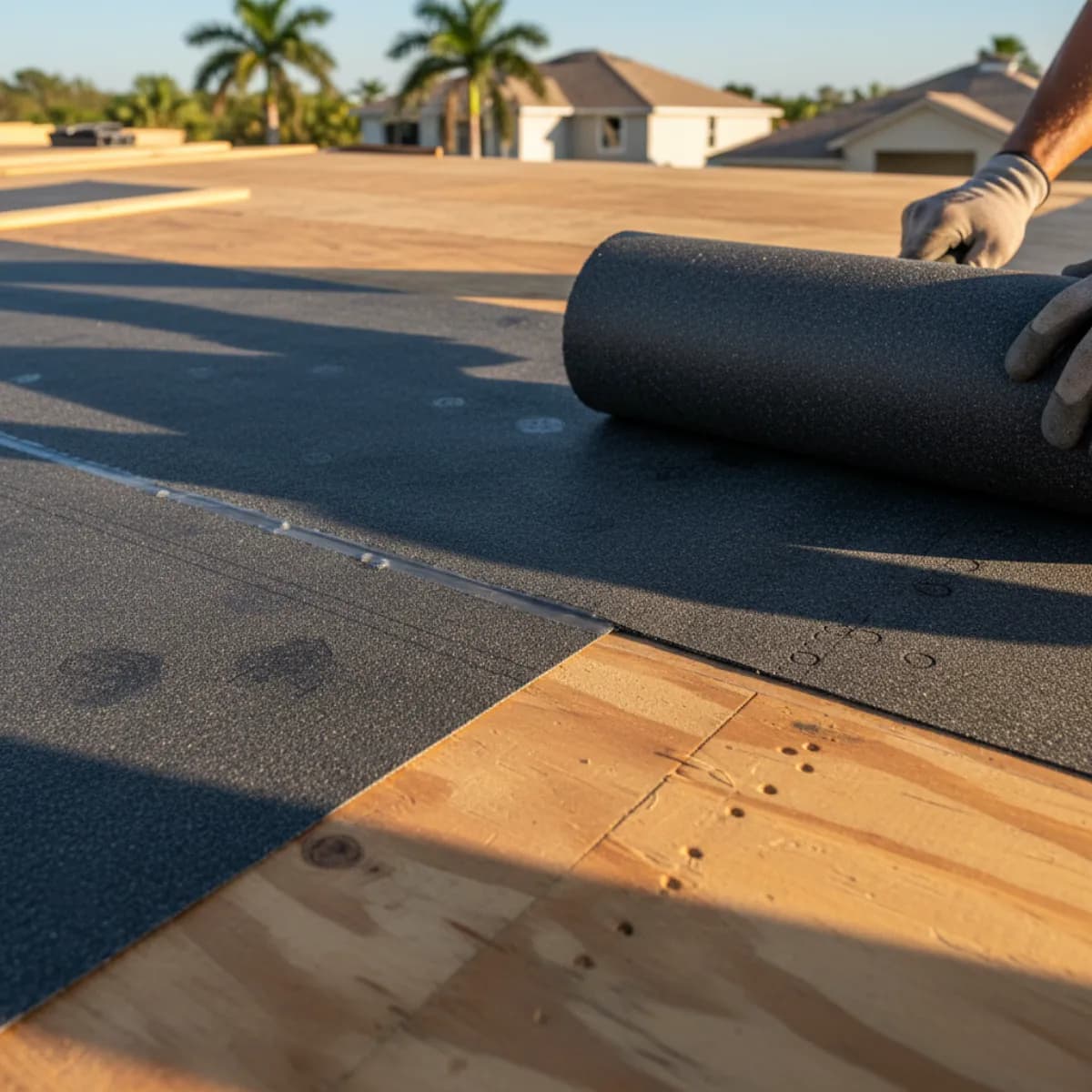
A sealed roof deck is a secondary water barrier created by installing self-adhering modified bitumen underlayment — commonly called peel-and-stick — directly onto the plywood or OSB roof deck sheathing. Unlike traditional roofing underlayment that is stapled or nailed through the material (creating thousands of puncture points that compromise waterproofing), self-adhering underlayment uses a factory-applied adhesive backing that bonds directly to the wood surface. The result is a continuous, waterproof membrane that remains intact even when the primary roof covering above it — shingles, tiles, or metal panels — is completely removed by hurricane-force winds.
The Two-Layer Defense Concept
Every properly constructed roof system has two water barriers. The primary barrier is the outermost roof covering — asphalt shingles, concrete or clay tiles, metal panels, or flat roofing membranes. The secondary barrier is the underlayment installed beneath the primary covering, directly on top of the roof deck sheathing. In a sealed roof deck system, this secondary barrier is designed to function as a standalone waterproof membrane. If a Category 4 hurricane strips every shingle from your roof, the sealed deck underneath should keep rain out of your home for days or even weeks until the primary covering can be replaced. This is not a theoretical benefit — it has been documented extensively after every major Florida hurricane since the sealed deck requirement was codified. Homes with sealed decks that lost their shingles in Hurricane Irma (2017) and Hurricane Ian (2022) consistently showed minimal interior water damage compared to homes with standard mechanically attached underlayment.
What “Sealed” Actually Means
The term “sealed” refers to the continuous bond between the underlayment and the roof deck surface. When self-adhering underlayment is properly installed, there are no mechanical fasteners penetrating the membrane, no gaps between the underlayment and the wood, and no seams that can peel up under wind pressure. The adhesive backing creates a chemical bond with the deck that resists the negative pressure (uplift) generated by hurricane winds passing over the roof surface. Standard felt or synthetic underlayment, by contrast, is attached with staples or cap nails spaced every 6 to 12 inches. Each fastener creates a hole in the underlayment, and when wind forces pull upward on the material, these holes allow water to pass through to the deck below. Additionally, mechanically attached underlayment can tear at the fastener points when subjected to the dynamic pressure cycling that occurs during a hurricane, where wind gusts create rapid alternating positive and negative pressure on the roof surface.
Why Florida Requires Sealed Roof Decks
Florida's sealed roof deck requirement exists because of decades of hurricane damage data showing that the single largest source of insured losses in residential buildings is not structural collapse — it is water intrusion through compromised roof systems. When the primary roof covering is removed by wind, the speed at which water enters the building determines whether the home suffers minor cosmetic damage or total interior destruction.
Lessons from Hurricane Andrew (1992)
Hurricane Andrew devastated South Florida in August 1992, destroying over 63,000 homes and damaging 124,000 more. The post-disaster investigations conducted by the Building Performance Assessment Team (BPAT) revealed that many homes with intact structural framing suffered total interior losses because the roof covering failed and there was no effective secondary water barrier. Standard #15 or #30 felt underlayment, stapled to the deck, tore away within minutes of the primary covering failure. Rain driven horizontally by sustained winds exceeding 140 mph saturated insulation, drywall, flooring, electrical systems, and personal property. These findings were the catalyst for the HVHZ sealed roof deck mandate and eventually influenced the statewide Florida Building Code to adopt similar requirements for the Wind-Borne Debris Region.
Post-Irma and Post-Ian Data
Hurricane Irma (2017) and Hurricane Ian (2022) provided large-scale validation of the sealed roof deck requirement. Insurance claims data analyzed by the Florida Office of Insurance Regulation showed that homes with verified sealed roof decks (documented on wind mitigation inspection forms) had average interior water damage claims 60% to 75% lower than comparable homes with standard underlayment, even when both groups experienced similar primary covering losses. In the Fort Myers area after Hurricane Ian, entire neighborhoods lost their shingle coverings. Homes with sealed decks that were tarped within 72 hours showed minimal interior damage, while adjacent homes with mechanically attached underlayment experienced complete saturation of the building interior. The insurance industry now considers the sealed roof deck one of the most cost-effective loss mitigation measures for hurricane-prone properties.
The Financial Case for the Requirement
Florida's property insurance market has been in crisis, with major carriers leaving the state and premiums doubling or tripling for coastal homeowners. The sealed roof deck requirement is part of the state's strategy to reduce aggregate insured losses, which in turn helps stabilize the insurance market. Every home with a sealed deck that avoids a $50,000 to $150,000 interior water damage claim reduces the pressure on the insurance system. This is why insurers offer significant premium credits for verified sealed decks — the actuarial data clearly shows that the secondary water resistance provided by a sealed deck dramatically reduces the probability and severity of large claims.
The FBC Code Requirement: R905.2.8.1
Section R905.2.8.1 of the Florida Building Code — Residential (8th Edition, 2023) establishes the specific requirements for secondary water resistance on roof decks. This section applies to all buildings located within the Wind-Borne Debris Region as defined by FBC Section R301.2.1.2, and separately, the High Velocity Hurricane Zone has its own sealed deck provisions that exceed the standard FBC requirements.
FBC R905.2.8.1 — Secondary Water Barrier (Summary)
In the Wind-Borne Debris Region, roof deck underlayment for asphalt shingles shall consist of an approved self-adhering polymer-modified bitumen underlayment complying with ASTM D1970, applied directly to the roof deck. The underlayment shall be applied in shingle fashion with a minimum 4-inch side (horizontal) lap and a minimum 6-inch end (vertical) lap. The underlayment shall be fully adhered to the roof deck and all laps shall be sealed. All penetrations through the underlayment shall be sealed to maintain the integrity of the secondary water barrier.
Key Code Requirements
- 1.ASTM D1970 Compliance:The self-adhering underlayment must meet ASTM D1970, the Standard Specification for Self-Adhering Polymer Modified Bituminous Sheet Materials Used as Steep Roofing Underlayment for Ice Dam Protection. Despite the standard's name referencing ice dams, it is the applicable performance standard for self-adhering underlayment used as a secondary water barrier in Florida.
- 2.Full Deck Coverage:The entire roof deck must be covered with the self-adhering underlayment. Partial coverage — such as applying SA underlayment only at eaves, valleys, and penetrations with standard felt elsewhere — does not meet the sealed deck requirement.
- 3.Lap Dimensions: Minimum 4-inch horizontal (side) laps and minimum 6-inch vertical (end) laps. These dimensions ensure that water flowing down the roof surface cannot wick under the lap seams even under wind-driven rain conditions.
- 4.Full Adhesion: The underlayment must be fully bonded to the roof deck. No wrinkles, bubbles, or fish-mouths are permitted. Areas that do not fully adhere create channels for wind-driven water to migrate beneath the membrane.
- 5.Penetration Sealing:All roof penetrations — plumbing vents, exhaust fans, electrical masts, skylights — must be sealed to maintain the continuous secondary water barrier. This typically involves cutting the underlayment around the penetration and applying additional SA material or compatible sealant to create a watertight transition.
HVHZ Enhanced Requirements
Within the High Velocity Hurricane Zone (all of Miami-Dade and Broward counties), the sealed roof deck requirement is even more stringent. In addition to ASTM D1970 compliance, the underlayment product must carry a valid Notice of Acceptance (NOA) from the Miami-Dade County Product Control Division, confirming it has been tested to TAS (Testing Application Standards) protocols specific to extreme hurricane conditions. The HVHZ also mandates a specific inspection of the sealed deck before any primary covering is installed — this is a separate hold-point inspection that does not exist under standard FBC in all jurisdictions. For complete HVHZ requirements, see our Miami-Dade HVHZ Roofing Requirements Guide.
Self-Adhering vs Mechanically Attached Underlayment
Understanding the fundamental difference between self-adhering and mechanically attached underlayment is critical for understanding why Florida mandates the sealed deck. These are not interchangeable products — they perform differently under normal conditions and their performance diverges dramatically under hurricane conditions.
Self-Adhering (Peel-and-Stick) Underlayment
Self-adhering underlayment consists of a polymer-modified bitumen (asphalt) membrane with a factory-applied adhesive on the bottom surface, protected by a release liner that is removed during installation. The adhesive bonds directly to the roof deck sheathing (plywood or OSB), creating a continuous seal. There are no mechanical fasteners required — the adhesive bond alone holds the material to the deck and resists wind uplift. Common brands used in Florida include GAF WeatherWatch, CertainTeed WinterGuard, Owens Corning WeatherLock, and Polyglass Polystick.
Advantages for Florida:
- Zero penetrations through the waterproof membrane
- Self-seals around nail punctures from primary covering installation
- Resists wind uplift through continuous adhesive bond
- Functions as standalone water barrier when primary covering is lost
- Qualifies for SWR insurance credit on OIR-B1-1802 form
Mechanically Attached Underlayment
Mechanically attached underlayment — whether traditional #15 or #30 organic felt, fiberglass-reinforced felt, or modern synthetic underlayment — is secured to the roof deck with staples, cap nails, or plastic-cap fasteners. Each fastener creates a penetration through the underlayment. On a typical 2,000-square-foot roof, mechanically attached underlayment has 3,000 to 5,000 fastener penetrations. Under normal weather conditions, these penetrations are inconsequential because the primary roof covering above sheds water before it reaches the underlayment. Under hurricane conditions, however, these penetrations become water entry points once the primary covering is compromised.
Limitations in hurricane conditions:
- Thousands of fastener penetrations allow water passage
- Can tear at fastener points under dynamic wind pressure
- Does not self-seal around nail holes from primary covering
- Can be lifted and peeled by wind entering through gaps
- Does NOT qualify for SWR insurance credit
Side-by-Side Comparison
| Feature | Self-Adhering (Sealed Deck) | Mechanically Attached |
|---|---|---|
| Material cost (per sqft) | $1.00–$2.00 | $0.15–$0.40 |
| Installed cost (per sqft) | $1.50–$3.00 | $0.30–$0.75 |
| Fastener penetrations | Zero | 3,000–5,000 per roof |
| Wind uplift resistance | Continuous adhesive bond | Point-loaded at fasteners |
| Self-sealing at nail holes | Yes | No |
| FBC sealed deck compliant | Yes | No |
| SWR insurance credit | Yes (2%–8%) | No |
| ASTM standard | ASTM D1970 | ASTM D226 / D4869 |
Which Florida Counties Require Sealed Roof Decks
The sealed roof deck requirement is determined by two overlapping geographic designations in the Florida Building Code: the High Velocity Hurricane Zone (HVHZ) and the Wind-Borne Debris Region (WBDR). If your property is located in either zone, a sealed roof deck is mandatory for new construction and qualifying re-roofs.
High Velocity Hurricane Zone (Always Required)
The HVHZ covers all of Miami-Dade County and all of Broward County. Every roofing project in these two counties requires a sealed roof deck with NOA-approved self-adhering underlayment — no exceptions, no grandfathering for existing structures.
HVHZ Counties:
Miami-Dade, Broward
Wind-Borne Debris Region (Required in Most Coastal Areas)
The Wind-Borne Debris Region is defined in FBC Section R301.2.1.2 and covers two categories of locations: (1) areas within one mile of the coast where the basic wind speed is 130 mph or greater, and (2) all areas where the basic wind speed is 140 mph or greater regardless of distance from the coast. In practice, this encompasses virtually every coastal county in Florida and extends significantly inland in South Florida.
Coastal Counties in the Wind-Borne Debris Region:
Southeast Coast: Palm Beach, Martin, St. Lucie, Indian River, Brevard
Central East Coast: Volusia, Flagler, St. Johns, Duval, Nassau
Southwest Coast: Monroe, Collier, Lee, Charlotte, Sarasota, Manatee
Central West Coast: Hillsborough, Pinellas, Pasco, Hernando, Citrus, Levy
Panhandle Coast: Bay, Gulf, Franklin, Wakulla, Taylor, Dixie, Okaloosa, Walton, Santa Rosa, Escambia
Inland Counties: Check Your Wind Speed Zone
Most inland Florida counties fall outside the Wind-Borne Debris Region, meaning sealed roof decks are not mandated by the FBC. Counties such as Alachua, Marion, Polk, Lake, Orange, Osceola, Sumter, and most of the northern interior typically have basic wind speeds below 130 mph and are more than one mile from the coast. However, there are two important caveats. First, specific parcels near the WBDR boundary may fall inside or outside the zone depending on their exact coordinates — your building department makes the final determination. Second, even where not required by code, many insurance companies offer premium credits for voluntarily installing a sealed roof deck, and some contractors recommend it as a best practice for any Florida home within 50 miles of the coast.
Cost Comparison: Sealed vs Standard Underlayment
The sealed roof deck adds meaningful cost to a roofing project, but the premium is often overstated by contractors who lack experience with the product or are padding their bids. Below is a realistic breakdown based on current 2026 Florida material and labor pricing.
Cost per Square Foot by Underlayment Type
| Underlayment Type | Material | Installed | Meets FBC R905.2.8.1? |
|---|---|---|---|
| #30 Felt (organic) | $0.15–$0.25 | $0.30–$0.50 | No |
| Synthetic (mechanically attached) | $0.20–$0.40 | $0.35–$0.75 | No |
| SA peel-and-stick (standard) | $0.85–$1.50 | $1.50–$2.50 | Yes |
| SA peel-and-stick (high-temp / HVHZ) | $1.25–$2.00 | $2.00–$3.00 | Yes |
| SA cap sheet (low-slope) | $1.50–$3.00 | $2.50–$4.50 | Yes |
Total Project Impact by Roof Size
The following estimates show the additional cost of a sealed roof deck over standard synthetic underlayment for common Florida home sizes:
1,500 sqft roof
$1,800–$3,375
additional cost
2,000 sqft roof
$2,400–$4,500
additional cost
3,000 sqft roof
$3,600–$6,750
additional cost
Why the Cost Varies
Several factors influence the installed cost of a sealed roof deck. Roof complexity matters: hips, valleys, dormers, and numerous penetrations require more cutting, fitting, and sealing work. Deck condition is another factor — self-adhering underlayment requires a clean, dry, smooth substrate. If the existing deck has rough surfaces, old adhesive residue, or minor delamination, the contractor may need to apply a primer or replace deck sections to achieve proper adhesion. Florida's heat adds a complication because high-temperature SA products (designed not to slide or blister on decks reaching 150+ degrees Fahrenheit in direct sun) cost more than standard SA products but are necessary for reliable long-term performance in the Florida climate. Finally, the HVHZ premium: in Miami-Dade and Broward counties, the underlayment must carry an NOA, and NOA-approved products typically cost 10% to 20% more than equivalent products with only a Florida Product Approval.
Insurance Discount Benefits (Up to 8% on Windstorm)
One of the most compelling financial arguments for a sealed roof deck is the wind mitigation insurance credit it unlocks. Florida law requires all property insurers to offer premium discounts for homes with verified wind mitigation features, and the sealed roof deck qualifies as Secondary Water Resistance (SWR) — one of the most valuable individual credits on the wind mitigation inspection form.
The OIR-B1-1802 Wind Mitigation Form
The Florida Office of Insurance Regulation (OIR) requires insurers to use the OIR-B1-1802 Uniform Mitigation Verification Inspection Form to determine wind mitigation discounts. This form evaluates seven categories of wind resistance features, and the SWR (Secondary Water Resistance) designation is one of them. A licensed inspector examines the roof and verifies whether a sealed roof deck is present. The inspector documents their finding on the form, which the homeowner submits to their insurance company. The form is valid until a new roof is installed or the insurance company requests a new inspection. The inspection typically costs $75 to $150, and many roofing contractors include the cost of a wind mitigation inspection in their re-roof proposal.
How Much Can You Save?
The SWR credit alone typically reduces windstorm premiums by 2% to 8%, depending on the insurer and policy structure. For coastal Florida homeowners paying elevated windstorm premiums, the dollar savings can be significant:
Annual premium: $4,000
SWR credit (2%–8%): $80–$320/year
25-year savings: $2,000–$8,000
Annual premium: $8,000
SWR credit (2%–8%): $160–$640/year
25-year savings: $4,000–$16,000
Stacking Credits: Total Wind Mitigation Savings
The SWR credit is just one of seven wind mitigation categories on the OIR-B1-1802 form. When combined with credits for roof shape (hip roof), roof covering (FBC equivalent or Miami-Dade approved), roof-to-wall connections (clips, single wraps, or double wraps), roof deck attachment (8d nails at 6 inches on center), opening protection (impact-rated windows and doors), and wall construction type, the total wind mitigation discount can reach 40% to 60% of the windstorm premium. For a homeowner paying $8,000 annually in windstorm coverage, stacked credits could save $3,200 to $4,800 per year. A complete re-roof with a sealed deck is the single project that improves the most categories simultaneously: roof covering, roof deck attachment, and secondary water resistance. For more on wind mitigation inspections and credits, see our Florida Wind Mitigation Inspection Guide.
Installation Process and Materials
Proper installation of a sealed roof deck requires specific materials, conditions, and techniques. Self-adhering underlayment is not a forgiving product — once the release liner is removed and the material contacts the deck, repositioning is nearly impossible without damaging the adhesive. Understanding the installation process helps you evaluate contractor competence and identify potential issues.
Step 1: Deck Preparation
The roof deck must be clean, dry, and structurally sound before self-adhering underlayment is applied. All old roofing material, nails, staples, and debris must be removed from the deck surface. Any plywood or OSB panels with rot, delamination, or structural damage must be replaced. The deck surface must be swept clean because dust, dirt, and wood particles interfere with adhesive bonding. In the HVHZ, this stage requires a deck inspection before the underlayment is installed. Some SA underlayment products require a primer on certain deck materials — particularly on aged or rough-sawn plywood and on OSB panels that have been exposed to moisture. The primer creates a smoother bonding surface and improves long-term adhesion. Always follow the manufacturer's installation instructions for primer requirements, as failure to use primer when specified can void the product warranty and fail inspection.
Step 2: Starting the Installation
Installation begins at the lowest point of the roof — typically the eave edge. The first course of SA underlayment is positioned to overhang the drip edge by approximately 1/4 to 3/8 inch, creating a clean transition from deck to fascia. The installer peels back a portion of the release liner, positions the material carefully (since repositioning is difficult once adhesive contacts wood), and presses the material firmly onto the deck surface. The material is then progressively unrolled and pressed down, working from one end to the other while removing the release liner as the roll advances. A roller is used to apply firm, uniform pressure across the entire surface to ensure full contact between the adhesive and the deck.
Step 3: Lap Seaming and Coverage
Each subsequent course overlaps the previous course by a minimum of 4 inches at the horizontal (side) laps and 6 inches at the vertical (end) laps, as required by FBC R905.2.8.1. Many installers use a chalk line to mark the overlap position before applying each course. The laps must be fully sealed — meaning the adhesive at the overlap creates a watertight bond between the two layers of material. Any wrinkles, bubbles, or fish-mouths (where the material folds over itself at a lap) must be cut, flattened, and patched with additional SA material. Valleys, hips, and ridges require special attention: valley underlayment is typically installed first as a continuous strip, with the field courses overlapping onto it by at least 6 inches on each side.
Step 4: Penetration and Edge Sealing
Every roof penetration — plumbing vent pipes, exhaust fan ducts, electrical masts, satellite dish mounts, skylights — must be sealed to maintain the continuous secondary water barrier. The installer cuts the SA underlayment to fit tightly around each penetration and then applies additional patches of SA material or compatible mastic sealant to create a watertight collar around the penetration base. At roof edges, the underlayment must extend over the drip edge and be sealed at rake edges (gable ends) to prevent wind-driven rain from entering beneath the membrane at the roof perimeter. These edge and penetration details are the most common failure points found during sealed deck inspections, so experienced installers pay particular attention to these areas.
Materials: Peel-and-Stick Products for Florida
Not all self-adhering underlayments are appropriate for Florida. The intense heat requires high-temperature (HT) formulations that resist softening, sliding, and blistering when roof deck surface temperatures exceed 150 degrees Fahrenheit. Standard SA products designed for northern climates (primarily for ice dam protection) may fail prematurely in Florida's heat. Look for products specifically marketed for Florida or southern climate installations. Common products used by Florida contractors include:
- •GAF WeatherWatch / StormGuard: ASTM D1970 compliant, available in high-temperature formulation, widely available in Florida
- •Polyglass Polystick TU Plus: High-temperature SA underlayment with SBS modified bitumen, popular in the HVHZ with Miami-Dade NOA
- •CertainTeed WinterGuard HT: High-temperature version specifically designed for hot climates, ASTM D1970 compliant
- •Owens Corning WeatherLock / ProArmor HT: SBS polymer modified with granulated or smooth surface options
- •Boral TileSeal HT: Designed specifically for tile roofing installations in hot climates, common in South Florida
Temperature and Weather Considerations
Self-adhering underlayment requires minimum deck temperatures for proper adhesion — most products specify a minimum of 40 degrees Fahrenheit. While this is rarely an issue in Florida, early morning installations in the winter months (December through February) in North Florida can occasionally approach this threshold. The more common Florida issue is excessive heat: deck temperatures exceeding 140 degrees Fahrenheit can cause standard SA products to become overly soft and difficult to handle. Experienced Florida installers often begin work early in the morning and complete underlayment installation before the peak heat of the afternoon, especially during the summer months. Rain is the other critical factor — the deck must be dry for the adhesive to bond properly. Any moisture on the deck surface will prevent adhesion and can lead to blistering and delamination after installation.
Get an Instant Sealed Roof Deck Estimate
Compare quotes from pre-vetted Florida contractors experienced with sealed roof deck installations. Instant satellite-based estimates with FBC-compliant material options.
How Sealed Roof Decks Prevent Water Intrusion During Hurricanes
The sealed roof deck is not a luxury or an over-engineered requirement — it is the last line of defense between a hurricane and the interior of your home. Understanding exactly how it works under extreme conditions helps explain why the Florida Building Code mandates it and why insurance companies reward it with premium credits.
The Wind-Driven Rain Problem
During a hurricane, rain does not fall vertically. Wind speeds of 100 to 175 mph drive rain horizontally or even upward against the roof surface. This wind-driven rain penetrates gaps, seams, and nail holes that would never leak under normal rainfall conditions. When the primary roof covering is intact, the overlap pattern of shingles or tiles directs water downslope and off the roof. But when even a few shingles are lifted or removed, wind-driven rain enters from the side and from beneath the remaining coverings. Standard mechanically attached underlayment provides limited protection in this scenario because the same wind forces that removed the shingles can lift the underlayment at its fastener points, and wind-driven rain can be forced through the thousands of fastener holes.
The Self-Sealing Property
One of the most valuable characteristics of self-adhering modified bitumen underlayment is its ability to self-seal around fastener penetrations. When shingles or tiles are installed over the sealed deck, the nails or screws used to attach the primary covering penetrate through the underlayment into the deck below. In standard felt or synthetic underlayment, each of these nail holes is a permanent water entry point. In SA underlayment, the modified bitumen flows around the nail shank under the heat of the Florida sun, effectively sealing the penetration. When a hurricane removes the shingles, it either pulls the nails out with the shingles (and the bitumen closes around the hole) or shears the nails at the deck surface (and the bitumen remains sealed around the remaining nail shank). Either way, the sealed deck maintains its waterproof integrity even at the thousands of nail penetration points created during primary covering installation.
Real-World Performance: Hurricane Ian (2022)
Hurricane Ian made landfall in Southwest Florida on September 28, 2022, as a high-end Category 4 storm with sustained winds of 150 mph. The storm devastated Lee, Charlotte, and Collier counties, destroying thousands of homes and causing over $110 billion in damages. In the aftermath, insurance adjusters and FEMA damage assessment teams documented a consistent pattern: homes with sealed roof decks that lost their primary covering had significantly less interior water damage than homes with standard underlayment. In Cape Coral and Fort Myers, neighborhoods where every home lost shingles, the homes that had been re-roofed with sealed decks after the 2004 hurricane season showed dramatically less interior damage than homes with older, non-sealed roof systems. This real-world data continues to reinforce the actuarial basis for the SWR insurance credit.
When a Sealed Roof Deck Is Required
The sealed roof deck requirement is not triggered by every roofing project. Understanding when it applies helps you plan your project budget and timeline accurately.
New Construction
All new residential construction within the Wind-Borne Debris Region and the HVHZ must include a sealed roof deck. This has been the standard since the Florida Building Code adopted the secondary water resistance requirement. There are no exceptions for building type or size — single-family homes, townhomes, duplexes, and low-rise multifamily buildings all must comply. The sealed deck is installed during the roofing phase of construction and is inspected as a separate line item on the building permit.
Complete Re-Roofs (Tear-Off to Deck)
Any complete re-roof where the existing roof covering is removed down to the deck triggers the sealed roof deck requirement in the WBDR and HVHZ. This is the most common scenario for existing homes. When a roofing contractor strips your old shingles or tiles, exposing the plywood or OSB deck beneath, a sealed roof deck must be installed before the new primary covering is applied. There is no grandfathering provision — a home built in 1975 with original #15 felt underlayment must receive a sealed deck when re-roofed in 2026, regardless of the condition of the original underlayment.
Repairs Exceeding 25% of the Roof Area
When a roof repair or partial replacement exceeds 25% of the total roof covering area, the entire roof must be brought into compliance with current FBC requirements, including the sealed roof deck. This threshold is particularly relevant after storm damage: if a hurricane damages more than a quarter of your roof covering, the repair project triggers a full sealed deck installation on the entire roof, not just the damaged section. In some jurisdictions, this 25% threshold is cumulative over a rolling period (typically 12 months), meaning multiple smaller repairs that together exceed 25% can trigger the requirement. Contact your local building department for their specific interpretation of the 25% rule.
When It Is NOT Required
Minor repairs covering less than 25% of the roof area in a single project do not trigger the sealed roof deck requirement. Additionally, homes located outside the Wind-Borne Debris Region and outside the HVHZ are not subject to the mandatory sealed deck requirement under the FBC, though they may benefit from voluntary installation for insurance credits. Overlay (recover) projects where a new layer of shingles is installed over the existing layer without removing the old covering do not typically trigger the sealed deck requirement since the deck is never exposed. However, overlays have their own limitations under the FBC — no more than two layers of asphalt shingles are permitted, and overlays are not allowed over certain existing roof types including wood shingles, tile, and metal.
Sealed Roof Deck: Frequently Asked Questions
What is a sealed roof deck and why does Florida require it?
A sealed roof deck is a secondary water barrier created by installing self-adhering (peel-and-stick) modified bitumen underlayment directly onto the roof deck sheathing. Unlike mechanically attached felt or synthetic underlayment that can tear away when shingles or tiles are blown off, a sealed deck bonds to the plywood and creates a continuous waterproof membrane. Florida requires sealed roof decks under FBC R905.2.8.1 because the state is uniquely exposed to hurricanes that can strip primary roof coverings within minutes. Post-hurricane studies consistently show that homes with sealed roof decks experience dramatically less interior water damage even when all shingles are removed, because the self-adhering underlayment prevents rain from reaching the interior. The requirement is mandatory in the entire High Velocity Hurricane Zone (Miami-Dade and Broward counties) and in the Wind-Borne Debris Region, which covers most of coastal Florida.
How much does a sealed roof deck cost compared to standard underlayment?
A sealed roof deck using self-adhering modified bitumen underlayment costs approximately $1.50 to $3.00 per square foot for material and installation, compared to $0.30 to $0.75 per square foot for standard mechanically attached synthetic underlayment. For a typical 2,000-square-foot Florida roof, the sealed deck adds $2,400 to $4,500 in additional cost over standard underlayment. However, this cost is partially offset by wind mitigation insurance credits. Homeowners with a verified sealed roof deck (documented on the OIR-B1-1802 wind mitigation inspection form as SWR - Secondary Water Resistance) can receive 2% to 8% annual premium reductions on windstorm coverage. Over the 20 to 30-year lifespan of a roof, the insurance savings frequently exceed the upfront cost difference.
Which Florida counties require a sealed roof deck?
All of Miami-Dade County and all of Broward County require sealed roof decks as part of the High Velocity Hurricane Zone (HVHZ) mandate. Beyond the HVHZ, the Florida Building Code requires sealed roof decks throughout the Wind-Borne Debris Region, which includes all areas within one mile of the coast where the basic wind speed is 130 mph or greater, and all areas where the basic wind speed is 140 mph or greater regardless of distance from the coast. In practice, this covers virtually every coastal county in Florida including Monroe, Palm Beach, Martin, St. Lucie, Indian River, Brevard, Volusia, Flagler, St. Johns, Duval, Nassau, Collier, Lee, Charlotte, Sarasota, Manatee, Hillsborough, Pinellas, Pasco, Hernando, Citrus, Levy, Bay, Okaloosa, Santa Rosa, and Escambia. Some inland counties such as Hendry, Glades, and Okeechobee may not require sealed decks in all areas, but any location within the Wind-Borne Debris Region as defined by the FBC wind speed map must comply.
Is a sealed roof deck required for roof repairs, or only full replacements?
The sealed roof deck requirement applies to new construction, complete re-roofs, and any roof repair or replacement that exceeds 25% of the total roof area. If you are replacing less than 25% of your roof covering, the repair materials must still meet current FBC standards, but you are not required to install a sealed roof deck on the entire roof. However, once the 25% threshold is crossed, the entire roof deck must be sealed, not just the repaired section. This threshold is cumulative within certain timeframes in some jurisdictions, meaning multiple smaller repairs that together exceed 25% can trigger the full sealed deck requirement. For re-roofs where the existing roof is stripped to the deck, the sealed deck requirement always applies in the HVHZ and Wind-Borne Debris Region regardless of the percentage being replaced.
What is the difference between self-adhering underlayment and SA cap sheet?
Self-adhering (SA) modified bitumen underlayment and SA cap sheet are both peel-and-stick products, but they serve different roles in the roofing system. SA underlayment (also called peel-and-stick underlayment) is a thinner product, typically 40 to 60 mils thick, used as the secondary water barrier beneath shingles, tiles, or metal roofing. It meets ASTM D1970 standards and creates the sealed roof deck required by the FBC. SA cap sheet is a thicker product, typically 90 to 180 mils thick, used as the primary roof covering on flat and low-slope roofs (below 2:12 pitch). SA cap sheet meets ASTM D1951 or D6164 standards and serves as both the waterproof membrane and the weather surface. On steep-slope roofs where shingles or tiles are the primary covering, SA underlayment is the correct product for sealed roof deck compliance. On low-slope roofs, SA cap sheet functions as the entire roofing system.
How does a sealed roof deck affect my homeowners insurance premium?
A sealed roof deck qualifies as Secondary Water Resistance (SWR) on the Florida OIR-B1-1802 wind mitigation inspection form, which is used by all Florida insurers to calculate wind mitigation discounts. The SWR credit is one of the most valuable individual credits on the form. Depending on your insurer and policy, the SWR credit can reduce your windstorm premium by 2% to 8%. For a Florida homeowner paying $4,000 to $8,000 annually for windstorm coverage (common in coastal areas), the SWR credit alone can save $80 to $640 per year. Combined with other wind mitigation features like hip roof shape, impact-rated roof covering, and reinforced roof-to-wall connections, the total wind mitigation discount can reach 40% to 60% of the wind premium. To claim the credit, you must have a licensed inspector complete the OIR-B1-1802 form and verify the SWR designation. The inspection typically costs $75 to $150 and is valid until a new roof is installed.
Can I install a sealed roof deck myself, or does it require a licensed contractor?
In Florida, any roofing work that requires a building permit must be performed by a licensed roofing contractor (CCC license) or certified general contractor (CGC license). Since sealed roof deck installation is part of a re-roof or new construction project that requires a permit, it must be done by a licensed contractor. Attempting to install a sealed roof deck without a permit and licensed contractor can result in fines, required removal and reinstallation, voided manufacturer warranties, and inability to obtain wind mitigation insurance credits. Additionally, self-adhering underlayment installation requires specific skills: the material bonds permanently on contact with the deck, so repositioning is extremely difficult once the release liner is removed. Improper installation with wrinkles, bubbles, or inadequate lap overlaps will fail inspection and compromise the water barrier. Licensed contractors experienced in sealed deck installations understand the temperature requirements (most SA underlayments require deck temperatures above 40 degrees Fahrenheit for proper adhesion), primer requirements for certain deck materials, and the sequencing needed to achieve a wrinkle-free installation.
What happens during the sealed roof deck inspection?
The sealed roof deck inspection is a mandatory hold-point inspection that occurs after the self-adhering underlayment is installed and before any primary roof covering (shingles, tiles, or metal) is applied. The building inspector verifies several critical elements: that the underlayment product matches the NOA (Notice of Acceptance) or Florida Product Approval specified in the permit application; that the material is fully adhered to the deck with no wrinkles, bubbles, or fish-mouths; that side laps meet the minimum 4-inch overlap requirement; that end laps meet the minimum 6-inch overlap requirement; that all roof penetrations (plumbing vents, exhaust fans, skylights) are properly sealed; that valley and edge details are correctly executed; and that the overall coverage is continuous with no exposed deck areas. If the inspection fails, the contractor must correct the deficiencies and schedule a re-inspection before proceeding. Work cannot continue past this stage until the sealed deck passes inspection.