In This Guide
Why Metal Roofing Is Ideal for Florida Hurricanes
Florida averages a hurricane landfall every three years and sits in the most active hurricane corridor in the continental United States. The roofing material you choose is your home's first line of defense against 100+ mph sustained winds, wind-driven rain, and flying debris. Metal roofing — specifically standing seam systems with concealed clip attachment — has emerged as the highest-performing residential roofing option for hurricane zones, and the data from recent major storms confirms that performance advantage.
Wind Resistance
Standing seam metal roofs achieve tested wind ratings of 140 to 180 mph depending on panel profile, clip spacing, and panel gauge. This exceeds Category 4 hurricane conditions (130–156 mph sustained winds) and approaches Category 5 territory. By comparison, even premium architectural shingles carry maximum wind warranties of 110 to 130 mph, and concrete tile systems rely on mechanical attachment or adhesive that can fail under dynamic wind cycling. The concealed clip system used in standing seam panels allows thermal expansion and contraction without compromising the seal, while the interlocking panel design creates a continuous surface that resists wind uplift across the entire roof plane rather than at individual attachment points.
Impact Resistance
Metal roofing panels can achieve Class 4 impact resistance (the highest rating under UL 2218), meaning they withstand a 2-inch steel ball dropped from 20 feet without cracking or penetrating. This matters in Florida hurricanes where wind-borne debris — roof tiles from neighboring properties, tree branches, construction materials — becomes projectiles at 100+ mph. While metal panels may dent on impact, they do not shatter like tile or puncture like shingles, maintaining their waterproof integrity even after significant debris strikes. This characteristic directly translates to lower post-hurricane repair costs and faster insurance claim resolution.
Water Intrusion Resistance
Hurricane damage is primarily water damage. Even when roofing materials survive the wind, horizontal rain driven by 100+ mph winds finds every gap, seam, and imperfection. Standing seam metal panels create a virtually seamless surface from ridge to eave, with raised seams that exceed the water penetration depth of even the most extreme wind-driven rain. The panels interlock mechanically (either snap-lock or mechanically seamed), creating a seal that improves under wind pressure rather than deteriorating. Combined with a sealed roof deck underlayment (required by Florida Building Code in many wind zones), metal roofing provides two independent waterproof layers.
Standing Seam vs. Exposed Fastener Metal Roofs in Hurricane Zones
Not all metal roofs are created equal when it comes to hurricane resistance. The two primary metal roof systems — standing seam and exposed fastener — differ significantly in wind performance, longevity, and suitability for Florida's hurricane zones. Understanding the difference is critical before investing in a metal roof for storm protection.
Standing Seam (Concealed Fastener)
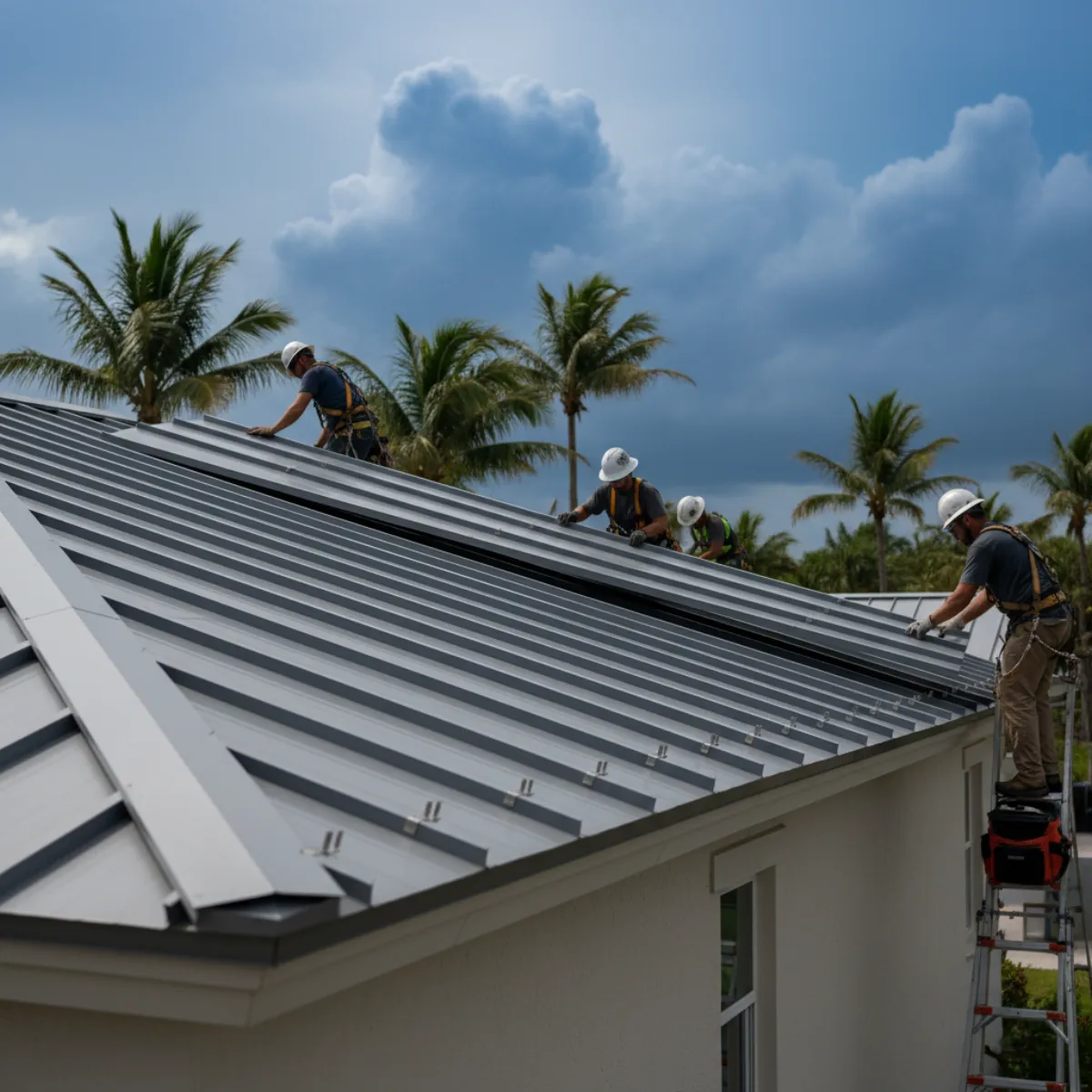
Standing seam systems use raised, interlocking seams that conceal all fasteners beneath the panel overlaps. Panels attach to the roof deck via concealed clips that grip the panel rib without penetrating the panel surface. This design means there are zero exposed penetrations across the entire roof surface — no screws, no nail holes, no potential water entry points.
- +Wind ratings of 140–180 mph (panel and clip system dependent)
- +No exposed fasteners to loosen, back out, or corrode over time
- +Allows thermal expansion/contraction without stress on the seal
- +40–60 year lifespan in Florida conditions
- +Qualifies for highest wind mitigation insurance credits
- –Higher cost: $12–$18/sq ft installed
- –Requires experienced metal roof installers
Exposed Fastener (Screw-Down)
Exposed fastener systems use self-drilling screws with neoprene washers that penetrate through the panel face directly into the roof deck or purlins. While significantly cheaper than standing seam, this design has inherent vulnerabilities in hurricane conditions and Florida's extreme climate.
- +Lower cost: $6–$10/sq ft installed
- +Simpler installation, wider contractor availability
- –Wind ratings of 110–140 mph (below Category 4)
- –Hundreds of exposed screw penetrations per roof
- –Neoprene washers degrade in Florida UV within 10–15 years
- –Thermal cycling causes screw holes to elongate (“wallowing”)
- –20–30 year realistic lifespan before fastener failure
Bottom Line for Hurricane Zones
For homes in Florida wind zones where design wind speeds exceed 130 mph (which includes most of the peninsula south of Orlando and the entire coastline), standing seam is the only metal roof system that provides true hurricane-grade protection. Exposed fastener systems are appropriate for agricultural buildings, detached structures, and inland locations with lower wind speed requirements, but they should not be marketed or installed as “hurricane-rated” roofing for residential homes in high-wind zones.
Florida Building Code Requirements for Metal Roofs (FBC R905.10)
The Florida Building Code (FBC) Section R905.10 governs metal roof panel installation statewide. Florida's code is one of the strictest in the nation due to hurricane exposure, and metal roof installations must meet specific requirements that go beyond what most other states require. Understanding these code provisions ensures your metal roof is installed to withstand Florida's wind loads and qualifies for wind mitigation insurance credits.
FBC R905.10 Key Provisions
- Product Approval: All metal roof panels, clips, fasteners, and accessories must hold a valid Florida Product Approval (FPA) or Miami-Dade NOA if installed in the HVHZ. The approval must cover the specific panel profile, gauge, and attachment method being used.
- Wind Resistance:Metal roof systems must be designed and tested to resist the design wind pressures specified in FBC Chapter 16 for the building's location, height, exposure category, and roof geometry per ASCE 7-22. Edge, corner, and field zones have different pressure requirements, with corners requiring the highest resistance.
- Deck Attachment: The roof deck (plywood or OSB) must be fastened to the structural framing per Table R803.1 with enhanced nailing schedules in high-wind zones. In wind zones above 130 mph, 8d ring-shank nails at 4 inches on center at panel edges are typical.
- Underlayment: FBC requires a minimum of one layer of ASTM D226 Type II (#30) felt or ASTM D4869 Type III/IV synthetic underlayment. In Enhanced Protection Areas and the HVHZ, a self-adhering sealed roof deck underlayment is required as a secondary water barrier.
- Corrosion Protection: Metal roofing and accessories in contact with the deck or each other must be of compatible metals or separated by approved barriers to prevent galvanic corrosion. This is especially critical in coastal Florida where salt air accelerates corrosion.
- Slope Requirements: Structural standing seam metal panels require a minimum slope of 1/4:12. Architectural standing seam and lapped panels require a minimum of 3:12. Exposed fastener panels typically require 3:12 minimum.
Permits and Inspections
All metal roof installations in Florida require a building permit. The permit application must include the Florida Product Approval number for every component, engineering documentation showing wind resistance compliance for the specific building, and the contractor's state-certified roofing contractor (CCC) or general contractor (CGC) license number. Most Florida jurisdictions require a minimum of two inspections: a dry-in inspection after underlayment installation and a final inspection after all metal panels, flashings, and trim are installed. In the Miami-Dade HVHZ, a minimum of three inspections is required.
Wind Uplift Testing and Ratings
Metal roof wind performance is verified through standardized testing protocols that simulate hurricane conditions. Three primary testing standards determine whether a metal roof system can be installed in Florida's various wind zones. Understanding these ratings helps you evaluate whether a specific metal roof product meets the requirements for your location.
UL 580 — Wind Uplift Classification
Underwriters Laboratories (UL) 580 classifies metal roof assemblies into Class 30, 60, or 90 based on their resistance to wind uplift pressure. The test applies static and dynamic uplift loads to a roof assembly specimen. Class 90 assemblies withstand the highest pressures and are required for most Florida applications. The UL 580 rating applies to the complete assembly — panels, clips, fasteners, and deck — not just the panel alone. A Class 90 panel installed with non-rated clips does not carry a Class 90 assembly rating.
FM 4471 — FM Approvals
FM Approvals (formerly Factory Mutual) standard 4471 evaluates metal roof panels for wind uplift resistance, exterior fire rating, and hail resistance. FM ratings range from 1-60 to 1-525, with higher numbers indicating greater uplift resistance. For Florida hurricane zones, FM 1-90 is the minimum practical rating, and FM 1-120 or higher is recommended for coastal and high-wind areas. FM 4471 testing includes a dynamic wind uplift component that cycles pressure loads to simulate the gusting nature of hurricane winds, making it particularly relevant for Florida applications. Many commercial and institutional projects in Florida specify FM-rated assemblies for insurance purposes.
ASTM E1592 — Structural Performance
ASTM E1592 measures the structural performance of metal roof panel systems under uniform static air pressure loads. This test determines the ultimate load capacity of the panel and clip system and is used by engineers to calculate whether a specific metal roof assembly meets the design wind pressures required by the Florida Building Code for a given building. Unlike UL 580 which classifies assemblies into discrete classes, ASTM E1592 provides specific pressure ratings in pounds per square foot (psf), allowing precise engineering analysis. For residential standing seam installations in Florida, an ASTM E1592 rating of -60 psf or higher (negative indicates uplift) is typical for inland locations, while coastal installations may require -90 psf or higher depending on building height and exposure.
TAS 110 — HVHZ Metal Roof Testing
Within the Miami-Dade High Velocity Hurricane Zone, metal roof systems must additionally pass Testing Application Standard (TAS) 110, which evaluates wind resistance of continuous roof systems under conditions that simulate South Florida's extreme hurricane environment. TAS 110 testing is more rigorous than standard UL or ASTM protocols and is required to obtain a Notice of Acceptance (NOA) for the HVHZ. Only metal roof products with a current NOA may be installed in Miami-Dade and Broward counties.
Cost Comparison: Metal vs. Tile vs. Shingles in Florida
Metal roofing has a higher upfront cost than shingles but a significantly lower total cost of ownership over the life of your home. When you factor in the 40 to 60-year lifespan, reduced insurance premiums, lower cooling costs, and minimal maintenance, metal roofing is the most cost-effective option for Florida homeowners who plan to stay in their home long-term.
Installed Cost per Square Foot (2,000 sq ft Florida Roof)
| Material | Cost/Sq Ft | Total (2,000 sf) | Lifespan | Wind Rating |
|---|---|---|---|---|
| 3-Tab Shingles | $4–$6 | $8K–$12K | 10–15 yr | 60–90 mph |
| Architectural Shingles | $5–$8 | $10K–$16K | 15–20 yr | 110–130 mph |
| Concrete Tile | $10–$16 | $20K–$32K | 25–40 yr | 125–150 mph |
| Exposed Fastener Metal | $6–$10 | $12K–$20K | 20–30 yr | 110–140 mph |
| Standing Seam Metal | $12–$18 | $24K–$36K | 40–60 yr | 140–180 mph |
| Clay Tile | $14–$22 | $28K–$44K | 50–75 yr | 125–150 mph |
40-Year Total Cost of Ownership
The true cost comparison requires looking beyond the initial installation. Over a 40-year ownership period, a Florida homeowner with architectural shingles will need two to three full replacements (at $10,000–$16,000 each, plus inflation), while a standing seam metal roof requires zero replacements. Add the annual insurance premium savings of $800–$2,500 and energy savings of $300–$600, and the 40-year math breaks down as follows:
Architectural Shingles (40 yr)
- Initial install: $13,000
- 2 replacements: $30,000–$38,000
- Insurance (no metal credit): $0 savings
- Energy (no reflective): $0 savings
- Total: $43,000–$51,000
Standing Seam Metal (40 yr)
- Initial install: $30,000
- Replacements: $0
- Insurance savings: –$32,000 to –$100,000
- Energy savings: –$12,000 to –$24,000
- Net: –$14,000 to –$94,000
Net negative cost means the metal roof pays for itself and generates additional savings. Actual figures depend on home size, location, insurer, and energy usage patterns.
Get an Instant Metal Roofing Estimate for Your Florida Home
Compare quotes from pre-vetted Florida contractors who specialize in hurricane-rated metal roof installations. Instant satellite-based estimates with standing seam and exposed fastener pricing options.
Insurance Discounts for Metal Roofs in Florida
Florida's homeowners insurance crisis makes roofing material choice a financial decision as much as a structural one. Metal roofs qualify for the largest wind mitigation credits available under Florida law, and these savings compound every year for the life of the roof. For many Florida homeowners, the insurance savings alone justify the premium cost of a metal roof over shingles.
Wind Mitigation Credits (OIR-B1-1802)
Florida law requires all insurers to offer premium discounts for verified wind mitigation features. The wind mitigation inspection (form OIR-B1-1802) evaluates seven categories of your home's wind resistance. Metal roofs earn credits in multiple categories:
- Roof Covering:Standing seam metal installed to FBC standards earns the “FBC” classification (highest credit tier). Shingle roofs more than 15 years old receive the lowest tier.
- Roof Deck Attachment: Metal roofs installed over properly fastened decking earn enhanced credits for the deck attachment method.
- Roof-to-Wall Connection: Metal roof systems with clips or single wraps connecting the roof structure to the wall earn additional credits.
- Secondary Water Barrier: Metal roofs installed with sealed roof deck underlayment earn the secondary water resistance credit.
Impact Resistance Credits
Metal roof panels that carry a UL 2218 Class 4 impact rating qualify for additional impact resistance credits with many Florida insurers. These credits are separate from wind mitigation credits and can provide an additional 5 to 15 percent premium reduction depending on the insurer. Combined with wind mitigation credits, a standing seam metal roof with Class 4 impact rating and sealed roof deck can reduce annual premiums by $800 to $2,500 or more in high-risk coastal areas. A licensed wind mitigation inspector must verify and document all qualifying features.
Insurability Advantage
Beyond premium discounts, a metal roof can be the difference between obtaining insurance coverage and being denied. Florida insurers increasingly refuse to write or renew policies on homes with shingle roofs over 10 to 15 years old. A new metal roof eliminates the “roof age” concern that causes non-renewals and makes your home attractive to preferred-market carriers who offer the lowest rates. In the current Florida insurance market, the ability to obtain coverage from a rated carrier versus being forced into Citizens (the state insurer of last resort) can save $2,000 to $5,000 per year in premiums.
Coastal Material Guide: Galvalume vs. Aluminum vs. Copper vs. Zinc
Florida has 1,350 miles of coastline, and hundreds of thousands of homes sit within the salt-air corrosion zone (generally within 3,000 feet of saltwater, though salt spray can travel further during storms). Choosing the right metal substrate is critical for longevity in coastal environments. The wrong choice can lead to premature corrosion and costly replacement well before the expected lifespan.
Metal Substrate Comparison for Florida Coastal Zones
| Material | Cost/Sq Ft | Salt Resistance | Lifespan (Coastal) | Best For |
|---|---|---|---|---|
| Aluminum | $14–$22 | Excellent | 40–60 yr | Oceanfront / <1,500 ft |
| Galvalume (AZ55) | $12–$18 | Good (with PVDF paint) | 30–50 yr | 1,500–3,000 ft from coast |
| Copper | $25–$40 | Excellent | 60–100 yr | High-end / accent panels |
| Zinc | $18–$28 | Good | 40–80 yr | Architectural / limited FL use |
| Galvanized Steel | $8–$14 | Poor | 10–20 yr | NOT recommended coastal |
Aluminum: The Coastal Gold Standard
Aluminum does not rust, corrode, or degrade from salt exposure. Unlike steel-based metals that rely on protective coatings, aluminum is inherently corrosion-resistant because it forms a natural oxide layer that protects the underlying metal. For oceanfront homes, homes on barrier islands, and any structure within 1,500 feet of saltwater, aluminum standing seam is the recommended choice. The primary trade-off is cost (15–25% more than Galvalume) and lower structural rigidity (aluminum panels are softer and may show oil-canning more readily in wider profiles). Most manufacturers offer aluminum panels in the same profiles and colors as steel.
Galvalume: Best Value for Near-Coastal
Galvalume is steel coated with an aluminum-zinc alloy (55% aluminum, 43.4% zinc, 1.6% silicon by weight). It combines the structural strength of steel with significantly better corrosion resistance than galvanized steel. For Florida homes 1,500 to 3,000 feet from the coast, Galvalume with a high-quality PVDF (Kynar 500) paint system provides excellent performance at a lower cost than aluminum. The paint system is the critical factor — Kynar 500 finishes maintain color and resist chalking for 30+ years, while cheaper SMP finishes may degrade in 10–15 years in Florida conditions. Always specify PVDF/Kynar paint for any Galvalume roof in Florida.
Galvanic Corrosion Warning
When different metals contact each other in the presence of moisture (which is constant in Florida), galvanic corrosion accelerates degradation of the less noble metal. Never mix copper flashings with aluminum panels, or galvanized accessories with Galvalume panels, without approved isolation barriers. This is a code requirement (FBC R905.10) and a common cause of premature metal roof failure in Florida coastal installations. Your contractor should specify matching or compatible metals for all components.
Common Metal Roof Myths Debunked
Metal roofing misconceptions persist despite decades of field data and scientific research disproving them. These myths prevent Florida homeowners from choosing the material best suited to protect their homes from hurricanes. Here are the three most common myths and the facts behind each.
Myth 1: Metal Roofs Attract Lightning
Fact: Metal roofs do not attract lightning. Lightning strikes the highest point in an area regardless of material composition. A metal-roofed home is no more likely to be struck than a shingle-roofed home at the same height and location.
In fact, metal roofing is safer during a lightning strike. Metal is non-combustible (Class A fire rating), so it will not ignite if struck. The metal surface disperses the electrical charge across the entire roof area rather than concentrating heat at the strike point. The Metal Construction Association, the National Fire Protection Association (NFPA), and the Lightning Protection Institute all confirm this. Florida has the highest lightning strike density in the United States, making this myth particularly relevant and particularly important to debunk.
Myth 2: Metal Roofs Are Loud in the Rain
Fact: Modern residential metal roof installations are not noticeably louder than shingle or tile roofs during rain.
The noise myth comes from agricultural barns, carports, and commercial buildings where metal panels are mounted directly on open purlins with no solid decking or insulation. In Florida residential construction, metal panels are installed over solid plywood or OSB decking plus synthetic underlayment, which provides significant sound dampening. Standard attic insulation (R-30 or higher per Florida Energy Code) further absorbs sound. Research from the Acoustic Group at the University of Lulea (Sweden) found that metal roofs over solid decking with insulation produce only 6–10 dB more than tile during heavy rain — a difference most people cannot detect. Florida's frequent afternoon thunderstorms make this a common concern, but homeowners with properly installed metal roofs consistently report no perceptible noise difference from their previous shingle or tile roof.
Myth 3: Metal Roofs Make Your House Hotter
Fact:Metal roofs with reflective coatings (cool metal roofs) actually reduce heat absorption and lower cooling costs by 20–40% compared to dark-colored shingles.
Metal is a conductor, which leads to the assumption that it would transfer more heat into the home. However, three factors make this incorrect. First, reflective metal roof coatings bounce up to 70% of solar radiation away from the roof surface, compared to 5–15% for standard dark asphalt shingles. Second, metal has low thermal mass — it heats up and cools down quickly, so it does not store and radiate heat into the attic the way that concrete tile and asphalt do for hours after sunset. Third, the ventilated air space between the metal panel and the roof deck in many standing seam systems creates an additional thermal break. The result is a measurably cooler attic and lower air conditioning costs — a significant advantage in Florida where cooling accounts for 40–50% of residential energy consumption.
Energy Efficiency: Cool Metal Roofs and Florida Cooling Costs
In Florida, where air conditioning runs 8 to 10 months per year and cooling represents 40 to 50 percent of a home's total energy bill, your roof's solar reflectance has a direct impact on your energy costs. Cool metal roofs are one of the most effective ways to reduce cooling loads and energy bills in Florida's subtropical climate.
What Makes a Metal Roof “Cool”
A cool metal roof uses specially formulated paint pigments that reflect a high percentage of solar radiation, including the infrared (heat) portion of the spectrum that conventional paints absorb. Two metrics define cool roof performance: Solar Reflectance Index (SRI), which measures the percentage of solar energy reflected, and thermal emittance, which measures how efficiently the surface releases absorbed heat. A high-performance cool metal roof achieves an SRI of 25 or higher (initial) and thermal emittance above 0.75. Even dark-colored metal panels can be “cool” with infrared-reflective pigments — a dark bronze cool metal roof may reflect 40% of solar energy compared to 5% for standard dark asphalt shingles.
Measured Energy Savings in Florida
Multiple studies confirm significant cooling energy savings from cool metal roofs in hot-humid climates like Florida:
- Oak Ridge National Laboratory (ORNL): Field studies in Florida found that reflective metal roofing reduced cooling energy consumption by 23% compared to dark asphalt shingles and 25% compared to dark concrete tile, translating to annual cooling savings of $300–$600 for a typical Florida home.
- Florida Solar Energy Center (FSEC): Research on Florida homes showed that reflective roofing reduced peak cooling demand by 20–28%, reducing attic temperatures by 20–40°F compared to dark shingle roofs. Lower peak demand also extends HVAC equipment lifespan.
- Department of Energy: Cool roof calculators estimate that a light-colored metal roof in Miami saves $0.15–$0.25 per square foot of conditioned floor area per year in cooling costs, or $300–$500 annually for a 2,000 sq ft home.
Florida Energy Code Compliance
The Florida Energy Code (based on the International Energy Conservation Code with Florida amendments) includes roof reflectance as a compliance pathway. Using a cool metal roof with high solar reflectance can offset other energy code requirements, such as allowing slightly lower attic insulation R-values when combined with a highly reflective roof. For new construction or major renovations that trigger energy code compliance, a cool metal roof provides a cost-effective path to meeting or exceeding Florida's energy requirements. Some Florida utility companies also offer rebates of $0.05–$0.10 per square foot for qualifying cool roof installations, further offsetting the initial cost premium.
Installation Considerations for Florida Metal Roofs
A metal roof is only as good as its installation. The highest-rated standing seam panel installed incorrectly will fail in conditions that a properly installed system would survive. Florida's combination of extreme wind, salt air, intense UV, and thermal cycling makes installation quality especially critical. Here are the key factors that separate a hurricane-resistant installation from a liability.
Clip Selection and Spacing
The concealed clips that attach standing seam panels to the roof deck are the most critical component for wind resistance. Clip spacing determines the wind uplift capacity of the entire system — closer spacing increases resistance. Standard residential clip spacing of 24 inches on center may be adequate for inland Florida locations, but coastal and high-wind zone installations may require 12 to 16 inches on center in field areas and 6 to 12 inches on center at edges and corners (where wind uplift pressures are highest). The clip must be the specific model tested with the panel profile — using a generic clip voids the system's tested wind rating. Fixed clips and floating clips serve different functions: floating clips allow thermal movement while fixed clips anchor the panel at a specific point. Proper placement of each type is essential.
Experienced Metal Roof Contractors
Metal roof installation requires different skills and equipment than shingle or tile work. An experienced metal roofing contractor understands panel thermal expansion calculations, clip placement engineering, proper seaming technique (for mechanically seamed panels), transition flashing fabrication, and how to detail penetrations, valleys, and wall tie-ins in metal. Many shingle contractors attempt metal installations without this specialized knowledge, and the result is premature failure. When evaluating contractors, ask for: specific metal roof project references (not just general roofing references), the manufacturer certification they hold for the panel system being installed, their years of experience specifically with standing seam metal, and photos of completed metal roof projects with detail shots of flashings and transitions. RoofVista pre-vets contractors for metal roof competency as part of our qualification process.
Panel Gauge and Profile Selection
Metal roof panels come in various gauges (thicknesses) and profiles (shapes). For Florida hurricane zones, 24-gauge steel (or 0.032” aluminum) is the minimum recommended thickness for standing seam residential roofing. Thicker panels (22-gauge steel) provide greater dent resistance and structural rigidity but cost 15–20% more. Panel profile affects both aesthetics and performance: taller seam heights (1.5” to 2”) provide greater wind uplift resistance and better water management than lower profiles. Panel width also matters — narrower panels (12” to 16”) have more clips per square foot and higher wind resistance than wider panels (18” to 24”) at the same clip spacing.
Underlayment and Deck Preparation
Even though standing seam metal provides excellent primary waterproofing, the underlayment beneath the metal is your second line of defense if panels are damaged or displaced during extreme conditions. For Florida installations, a high-temperature synthetic underlayment rated for metal roofing (minimum 240°F) is recommended because metal panels can reach 150–180°F in Florida sun, potentially degrading standard felt underlayment. In the HVHZ and other Enhanced Protection Areas, a self-adhering modified bitumen sealed roof deck underlayment is required. Proper deck preparation includes verifying that all plywood or OSB panels are securely fastened to the truss system per the enhanced nailing schedule required by the Florida Building Code for the applicable wind zone.
Post-Hurricane Performance Data
Real-world hurricane performance provides the most meaningful evidence of how metal roofs hold up under actual storm conditions. Data from FEMA, the Insurance Institute for Business and Home Safety (IBHS), and post-storm damage assessments after Florida's most destructive hurricanes confirms the performance advantage of properly installed metal roofing.
Hurricane Ian (2022) — Category 4 (150 mph)
Hurricane Ian made landfall at Cayo Costa, Florida on September 28, 2022 with sustained winds of 150 mph. The storm devastated Fort Myers, Cape Coral, and surrounding Lee County communities. Post-storm damage assessments by FEMA and the IBHS found that standing seam metal roofs had significantly lower failure rates than asphalt shingles and concrete tile in the same wind speed zones. Common shingle failures included full panel blow-off, seal strip failure, and wind-driven rain intrusion. Tile roofs experienced individual tile displacement, broken tiles from debris impact, and underlayment exposure. Standing seam metal roofs in the same areas showed primarily cosmetic damage (denting from debris) with the waterproof integrity of the panel system remaining intact in the majority of inspected installations. The most common metal roof failure was at improperly detailed flashings and transitions — reinforcing that installation quality is the decisive factor.
Hurricane Irma (2017) — Category 4 (130 mph at FL landfall)
Hurricane Irma crossed the Florida Keys as a Category 4 storm and traveled up the Florida peninsula as a Category 3 and then Category 2 storm, affecting virtually the entire state. FEMA Mitigation Assessment Team (MAT) reports noted that metal roof systems performed well relative to other materials when properly attached, particularly in the Keys and Southwest Florida where wind speeds were highest. Failures observed were predominantly in older exposed fastener systems where screws had backed out or neoprene washers had deteriorated prior to the storm. Standing seam systems with concealed clips showed the highest survival rate among all roofing materials evaluated in the post-Irma assessments in Monroe and Collier counties.
Hurricane Andrew (1992) — Category 5 (165 mph)
Hurricane Andrew remains the benchmark storm for evaluating building performance in South Florida. While modern standing seam metal roofing systems were not widely installed on residential homes in 1992, Andrew's destruction was the direct catalyst for the enhanced Florida Building Code and the Miami-Dade HVHZ requirements that now govern roofing in South Florida. The metal-clad commercial and industrial structures that survived Andrew with the least damage were those with mechanically attached (standing seam) systems. Andrew demonstrated that continuous panel systems with concealed attachments outperformed discontinuous systems (tiles, shingles) in extreme wind conditions — a finding that drove the subsequent adoption of standing seam metal for hurricane-resistant residential construction. Post-Andrew building code changes also established the testing protocols (TAS standards) that metal roof products must now pass for Florida approval.
IBHS Research Center Findings
The Insurance Institute for Business & Home Safety operates a full-scale wind research facility in Richburg, South Carolina that tests complete residential structures under simulated Category 5 conditions. IBHS testing has consistently shown that standing seam metal roof systems with proper clip attachment maintain structural integrity at wind speeds that cause significant damage to shingle and tile roof systems. IBHS FORTIFIED Home standards — which provide a voluntary framework for enhanced wind resistance — recognize standing seam metal as a qualifying roof covering for the highest designation levels. These FORTIFIED designations are increasingly accepted by Florida insurers for additional premium credits beyond standard wind mitigation discounts.
Florida Metal Roofing: Frequently Asked Questions
Can a metal roof withstand a Category 5 hurricane in Florida?
Standing seam metal roofs with concealed clips and properly engineered attachment systems are rated for wind speeds up to 180 mph, which exceeds Category 4 conditions (157 mph) and approaches Category 5 territory (157+ mph). During Hurricane Ian in 2022, standing seam metal roofs in Fort Myers and Cape Coral showed significantly lower failure rates than asphalt shingle and tile roofs. However, no roofing system is guaranteed to survive every Category 5 scenario — performance depends on proper installation, clip spacing, panel gauge, and the structural integrity of the roof deck and framing beneath. Exposed fastener metal roofs have lower wind ratings (typically 110-140 mph) and are not recommended for high-wind hurricane zones.
How much does a metal roof cost in Florida compared to shingles?
In Florida, standing seam metal roofing typically costs $12 to $18 per square foot installed, compared to $5 to $8 per square foot for architectural shingles and $10 to $16 for concrete tile. For a 2,000-square-foot roof, that translates to $24,000 to $36,000 for standing seam metal versus $10,000 to $16,000 for shingles. However, the 40 to 60-year lifespan of metal versus 15 to 20 years for shingles in Florida means you would replace a shingle roof two to three times during the life of one metal roof. When you factor in insurance premium reductions of $800 to $2,500 per year and energy savings of $300 to $600 annually from reflective metal panels, the total cost of ownership over 40 years heavily favors metal roofing.
Do metal roofs attract lightning in Florida?
No. Metal roofs do not attract lightning and do not increase the risk of a lightning strike. Lightning strikes the highest point in an area regardless of material — a metal roof is no more likely to be struck than a shingle, tile, or flat roof at the same height. In fact, metal roofing is actually safer during a lightning strike because metal is non-combustible and disperses the electrical charge across the entire roof surface rather than concentrating it. The Metal Construction Association, the National Fire Protection Association, and the Lightning Protection Institute all confirm that metal roofing does not increase lightning risk. Florida has the highest lightning density in the United States, so this is a common and understandable concern, but it is not supported by physics or field data.
What is the best metal roofing material for Florida coastal homes?
For coastal Florida homes within 3,000 feet of saltwater, aluminum is the top choice because it does not corrode from salt air exposure. Aluminum standing seam panels require no protective coating to resist saltwater corrosion, making them virtually maintenance-free in coastal environments. Galvalume (steel coated with an aluminum-zinc alloy) is a strong second option and costs less than aluminum, but it requires a high-quality paint system (typically PVDF/Kynar 500) in coastal zones to protect the steel core from salt-spray corrosion. Copper is excellent for salt resistance and develops a distinctive green patina over time, but at $25 to $40 per square foot installed it is typically reserved for accents or high-end homes. Zinc performs well in coastal environments but is rare in the Florida market. Galvanized steel is NOT recommended for coastal Florida — the zinc-only coating degrades rapidly in salt air.
How much can I save on insurance with a metal roof in Florida?
Florida homeowners with qualifying metal roofs can save $800 to $2,500 per year on homeowners insurance premiums, and in some cases more. The savings come from two primary credits: wind mitigation credits for the roof-to-deck attachment method (metal roofs with clips or standing seam systems earn the highest "FBC" or "Non-FBC" credits on the OIR-B1-1802 wind mitigation form), and impact resistance credits if the metal panels carry a Class 4 impact rating. A licensed wind mitigation inspector must complete the form for your insurer. Some insurers offer additional discounts for metal roofs due to their non-combustible rating and hail resistance. Over a 40-year roof lifespan, insurance savings alone can total $32,000 to $100,000 — often exceeding the premium you paid for metal over shingles.
Are metal roofs noisy during Florida rainstorms?
Modern metal roof installations are not noticeably louder than shingle or tile roofs during rain. The noise concern comes from older agricultural and commercial metal buildings where metal panels were attached directly to open purlins with no insulation or solid decking beneath. In residential Florida construction, metal panels are installed over solid plywood or OSB roof decking, plus underlayment, which provides substantial sound dampening. Adding standard attic insulation (R-30 or higher, as required by the Florida Energy Code) further reduces rain noise to levels comparable to other roofing materials. Studies by the Acoustic Group at the University of Lulea in Sweden found that metal roofs over solid decking with insulation produce only 6 to 10 dB more sound than tile roofs during heavy rain — a difference most occupants cannot detect.
What wind uplift testing standards apply to metal roofs in Florida?
Metal roofs installed in Florida must meet wind uplift resistance requirements verified through one or more of three primary testing standards: UL 580 (Underwriters Laboratories), which classifies panels as Class 30, 60, or 90 based on uplift pressure resistance; FM 4471 (FM Approvals, formerly Factory Mutual), which rates assemblies from 1-60 to 1-525 based on wind uplift and resistance to exterior fire and hail; and ASTM E1592, which measures structural performance under uniform static air pressure loads. For the Florida Building Code, metal roof systems must demonstrate compliance with the design wind pressures calculated for the specific building location, height, and exposure category per ASCE 7. In the Miami-Dade HVHZ, metal roofing must also hold a valid Notice of Acceptance (NOA) based on TAS 110 testing. The required rating depends on your location — coastal and high-rise installations require higher uplift ratings than inland single-story homes.
How long does a metal roof last in Florida compared to other materials?
Standing seam metal roofs in Florida typically last 40 to 60 years with proper installation and minimal maintenance. This compares to 15 to 20 years for asphalt shingles (accelerated deterioration from UV exposure and heat), 25 to 40 years for concrete tile (subject to cracking from thermal cycling and wind uplift), and 50+ years for clay tile (excellent longevity but vulnerable to impact damage). The key factor for metal roof longevity in Florida is the coating system — PVDF (Kynar 500) painted finishes hold color and resist chalking for 30+ years, while cheaper SMP (silicone modified polyester) finishes may fade within 10 to 15 years in Florida UV conditions. For coastal locations, aluminum substrates outlast Galvalume by avoiding the salt-corrosion risk entirely. Stone-coated metal tiles offer the aesthetic of traditional tile with 40 to 50-year metal durability but cost 20 to 30 percent more than standard standing seam.