In This Guide
1. NJ Energy Code: R-49 Insulation Requirement
The 2021 NJ Energy Subcode, adopted under the NJ Uniform Construction Code, requires R-49 attic insulation throughout most of NJ. The code reflects national consensus that R-49 represents the cost-optimal level of attic insulation for the climate, balancing heating-and-cooling savings against installation cost.
Climate zone breakdown: NJ falls into two IECC climate zones. Zone 4 (R-49 required) covers most of the state including Newark, Jersey City, Trenton, all coastal counties, and the Pinelands. Zone 5 (R-60 required) covers higher-elevation areas in Sussex, Warren, and parts of Morris, Hunterdon, and Passaic counties (typically above 1,000 feet elevation). Verify your specific zone with the NJ Department of Community Affairs energy code map or your local building department.
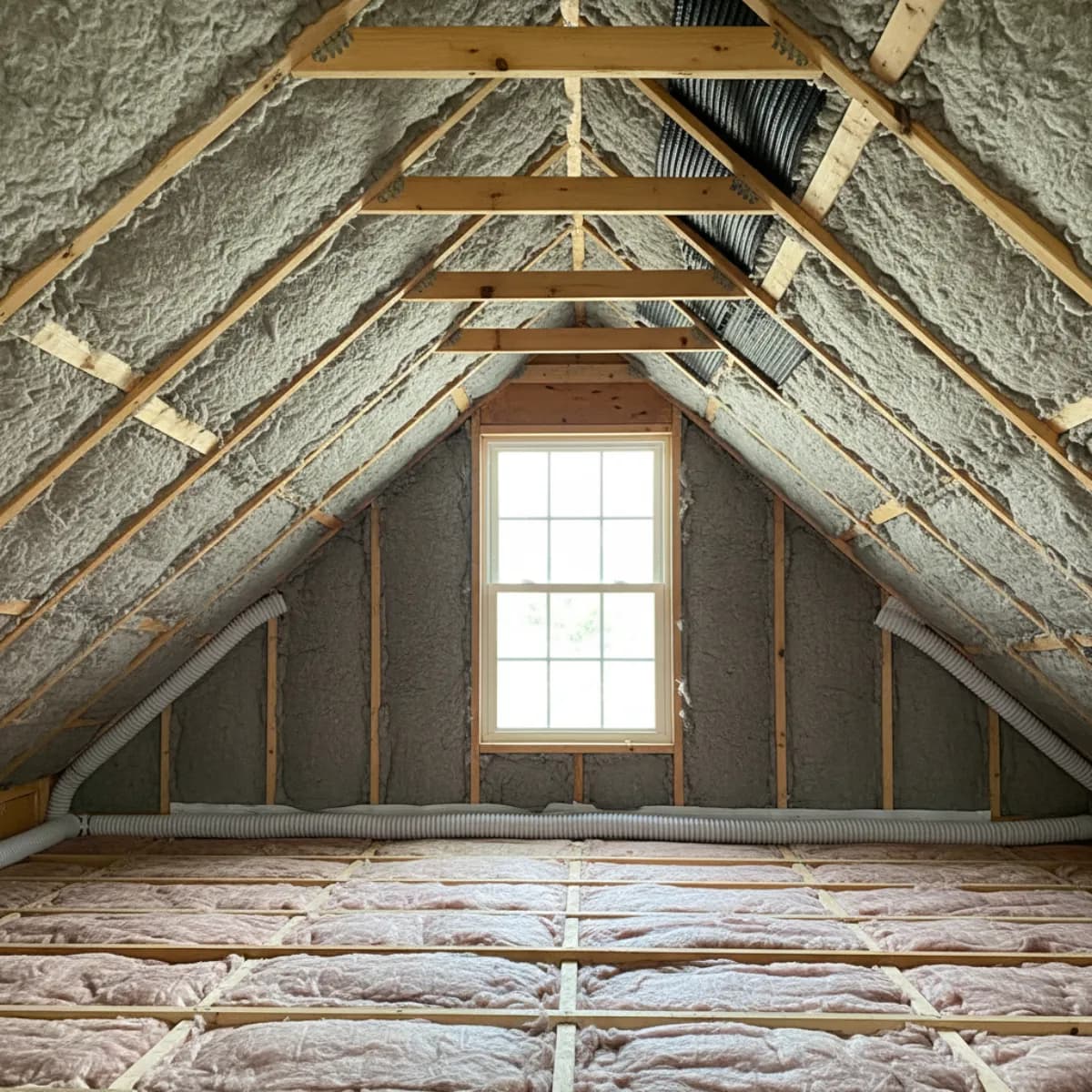
Common insulation materials and R-values: Loose-fill cellulose (most common NJ retrofit, recycled paper treated with borates) achieves R-3.5 per inch, requiring 14 inches of depth for R-49. Loose-fill fiberglass achieves R-2.5 per inch, requiring 20 inches for R-49. Spray foam (closed-cell, most expensive) achieves R-6.5 per inch, requiring 7.5 inches for R-49. Most NJ retrofit projects use cellulose blown-in insulation because it provides the best price-per-R, fills cavities completely (eliminating cold spots that batt insulation creates), and qualifies for NJ Clean Energy Program rebates.
Existing-home enforcement: NJ does not require existing homes to retrofit to R-49 unless triggered by major renovation. However, several incentives push toward upgrade: reduced heating and cooling costs (typical $300 to $700 annual savings), reduced ice dam formation (the highest-ROI side benefit for older NJ homes), longer roof life (R-49 with proper ventilation extends NJ roof life by 5 to 8 years), and NJ Clean Energy Program rebates for qualifying air sealing and insulation work.
What most NJ homes actually have: NJ housing stock built before 2000 typically has R-19 to R-30 attic insulation; before 1980, often R-11 to R-19. The single most cost-effective home improvement available to most NJ homeowners is bringing attic insulation up to current code, paired with air sealing and balanced ventilation.
2. The 1:300 Ventilation Calculation
NJ code (per IRC R806 as adopted) requires attic ventilation at a ratio of 1 square foot of net free vent area per 300 square feet of attic floor area, when the ventilation is balanced approximately 50/50 between intake (low, typically soffits) and exhaust (high, typically ridge or gable). For unbalanced ventilation, the requirement increases to 1:150.
Worked example for a typical 1,500 sq ft NJ ranch attic: 1,500 / 300 = 5 sq ft total net free vent area, divided as 2.5 sq ft soffit intake and 2.5 sq ft ridge exhaust (50/50). Converting to common product specifications: continuous 8-inch perforated soffit vent provides about 9 sq in of net free area per linear foot. So 2.5 sq ft = 360 sq in / 9 = 40 linear feet of soffit venting. A typical ranch has 100+ linear feet of soffit, so soffit venting is rarely the binding constraint as long as the existing soffits are not blocked by paint, debris, or insulation. Continuous ridge venting provides about 12 to 18 sq in of net free area per linear foot. So 2.5 sq ft = 360 sq in / 14 = 26 linear feet of ridge venting. A typical ranch ridge runs 50 to 70 feet, so a continuous ridge vent easily exceeds the requirement.
Common ventilation failures in NJ homes: Soffit vents painted shut during repaint projects (most common; check by examining a sample soffit vent for paint flow into the perforations); soffit vents blocked by attic insulation that has settled or been pushed into the eave (fix with insulation baffles, $1 to $3 each, installed at every rafter bay); inadequate ridge vent length (often only 20 to 30 percent of the ridge has venting; should be continuous over the full ridge); incompatible mixing of ridge vents and gable vents (creates short-circuit airflow that bypasses the soffit-to-ridge convective path); and accidental blockage from new construction (HVAC contractors sometimes block ridge vents with ductwork, electricians block soffit channels with wire chases).
Ridge vs. gable venting: Modern NJ best practice favors continuous ridge venting paired with continuous soffit venting over gable vents because ridge venting provides more uniform attic-volume exhaust. If your NJ home has gable vents and you are adding ridge venting during a roof replacement, plan to seal the gable vents at the same time. Mixing creates short-circuit airflow that reduces overall effectiveness.
3. Ice Dam Prevention: How Attic Detailing Helps
Ice dams are NJ winter biggest preventable roof problem. The mechanism is well-understood: warm air leaking from the heated living space into the attic melts snow on the roof, the meltwater runs down the slope to the cold eave (which sits over the unheated soffit), refreezes there, and creates a dam that backs up subsequent meltwater under the shingles.
The visible result is icicles hanging from the eaves and gutters, sometimes accompanied by water stains on interior walls and ceilings near the eaves. The hidden damage is far worse: water pushed under the shingles by the dam soaks the underlayment, the deck, and the wall framing below, causing $3,000 to $30,000 of damage per event in severe cases.
The full ice dam prevention package for NJ:
- R-49 to R-60 attic insulation: Prevents heat transfer from the heated living space below into the attic. Without adequate insulation, even perfect ventilation cannot keep the attic cold enough to prevent snow melt.
- Air sealing of all attic floor penetrations: Recessed lights, plumbing vent stacks, electrical wire chases, the attic hatch, top plates of interior walls. Air leakage is often more important than R-value because moving warm air carries heat directly into the attic.
- Balanced 1:300 attic ventilation: Soffit-to-ridge convective flow carries away any heat that does reach the attic, keeping the deck cold.
- Ice and water shield at eaves: NJ code requires self-adhered ice and water shield from the eave 24 inches inside the warm wall line, plus all valleys. Best practice extends to 36+ inches in regions prone to ice dams (Sussex, Warren, Morris, Bergen highlands).
- Heated cables (last resort): Self-regulating heat cables installed along eaves and in gutters can prevent ice dams when the underlying insulation and ventilation problems cannot be fully fixed. Treat as a band-aid; the root cause is heat loss from the living space.
Skipping any element reduces effectiveness. The most common NJ failure pattern is upgrading insulation without air sealing or ventilation, which often makes ice dams worse by trapping warm moist air in the attic.
4. Mold Prevention & Moisture Management
Mold in NJ attics is overwhelmingly driven by chronic moisture from inadequate ventilation combined with air leakage from the heated living space below. Visible signs include dark staining on the deck underside (particularly on the north-facing slope and in the eave areas), musty odor in the attic, and frost on the underside of the deck in winter.
The moisture mechanism: Warm moist interior air (kitchens, bathrooms, dryer vents, normal occupant respiration and perspiration) leaks into the cold attic through ceiling penetrations. The moisture condenses on the cold underside of the roof deck, the rafters, and any exposed cold metal (nail tips, vent boots). The persistent damp conditions support Cladosporium and Stachybotrys mold colonization within 6 to 18 months. North-facing slopes are colder and stay damp longer, so mold typically appears there first.
Three required prevention elements:
- Proper ventilation (1:300 balanced): Carries away moisture before it condenses. Without ventilation, no amount of insulation can prevent attic moisture problems.
- Air sealing of all attic floor penetrations: Stops moisture entry from below. The single highest-leverage moisture intervention; air sealing alone often resolves mild attic moisture problems.
- Ducting all bathroom fans, kitchen exhaust, and dryer vents to the outside: Not into the attic. This is a code violation under both the NJ UCC and IMC, but it remains shockingly common in NJ homes built before 1990. The fix is straightforward: extend the duct through a roof or sidewall vent to the outside.
Existing mold remediation: If mold is established on the deck or rafters, remediation is required before any new roof installation. Light surface mold can be cleaned with biocide treatments ($500 to $1,500 for typical NJ attic). Heavier infestation may require encapsulation or partial deck replacement ($2,000 to $8,000+). NJ does not require state-licensed mold remediation contractors for residential work, but choosing an EPA-trained contractor is recommended for confidence in the result.
Verification after remediation: After completing the air seal, ventilation, and remediation work, check the attic in the next winter for frost patterns and condensation. A properly detailed NJ attic should show no frost on the deck underside and no condensation droplets even on the coldest days. If problems persist, additional air sealing work is typically needed.
5. Air Sealing: The Missing Step
Air sealing is the application of caulk, foam, weatherstripping, and other materials to close gaps and penetrations between the heated living space and the attic. It is the single most under-appreciated step in NJ attic improvement and the highest-ROI intervention available to most NJ homeowners.
Common air leakage points in NJ homes: Recessed light cans (especially older incandescent IC-rated and non-IC-rated cans; modern LED retrofits include sealed gaskets); plumbing vent stacks (3 to 4 inch PVC or cast iron pipes penetrating the attic floor; seal with high-temp foam at the penetration); electrical wire chases (any wire passing through the attic floor; seal each penetration with foam or fire-rated caulk); ductwork penetrations (HVAC ducts entering or exiting the attic; seal with mastic and foil tape); the attic access hatch (the largest single air leak in most NJ homes; install weatherstripping and an insulating cover); top plates of interior walls (the joint between the wall framing and the attic floor; seal the gap with caulk); and chimney chases (the framed cavity around an interior chimney; seal the floor penetration with high-temp materials).
Quantifying leakage: A typical NJ home built before 1990 has 200 to 600 square inches of cumulative air leakage at the attic floor — equivalent to leaving a window cracked open year-round. A blower-door test ($300 to $600) measures total home air leakage and identifies the highest-flow paths. Most NJ Clean Energy Program incentive programs require pre-and-post blower-door testing to verify performance.
Air sealing sequence: The standard NJ retrofit sequence is: (1) blower-door test to identify leakage; (2) air sealing of identified penetrations ($500 to $2,000 for typical NJ home); (3) R-49 insulation install ($1,500 to $4,000); and (4) post-work blower-door verification. The full sequence typically takes 1 to 2 days of contractor work.
DIY scope: Many air-sealing tasks are accessible to DIY: weatherstripping the attic hatch, foaming around plumbing vents, caulking top plates. Save spray foam, recessed light retrofits, and chimney chase work for professionals. Even partial DIY air sealing typically reduces heating costs by 5 to 15 percent.
6. Cost, NJ Clean Energy Rebates & ROI
A complete NJ attic improvement project typically pays back in 4 to 8 years through energy savings alone, plus another 3 to 5 years of value through extended roof life. With incentives, the payback period is even shorter.
| Component | Cost | Annual Savings | Notes |
|---|---|---|---|
| Air sealing only | $500–$2,000 | $150–$400 | Highest ROI; enables insulation effectiveness |
| R-19 to R-49 cellulose | $1,500–$4,000 | $200–$500 | Most common NJ upgrade |
| Ridge vent install (during reroof) | $400–$1,000 | indirect | Adds 5-8 yrs roof life |
| Soffit vent retrofit | $300–$1,500 | indirect | Often required to balance ridge vent |
| Bathroom fan duct to outside | $200–$600 each | indirect | Resolves moisture; code compliance |
| FULL PACKAGE | $2,500–$7,500 | $300–$700 | Plus 5-8 yrs roof life |
NJ Clean Energy Program rebates: The NJ Clean Energy Program (NJCEP) provides rebates of $150 to $400 for qualifying air sealing and insulation projects on existing NJ single-family homes. Eligibility typically requires pre-and-post blower-door testing performed by a NJCEP-approved contractor and verification that the work meets specific R-value and air-sealing standards. Check the current program at NJCleanEnergy.com for exact rebate amounts and eligibility, which change periodically.
Federal Energy Efficient Home Improvement Credit (25C): The federal credit allows up to 30 percent of qualifying costs for insulation, air sealing, and certain HVAC components, capped at $1,200 per year for the building envelope category. The credit is claimed on IRS Form 5695 with the homeowner annual tax return.
Coordinated roof and attic timing: The most cost-effective time to address attic ventilation is during a planned roof replacement. The contractor is already on-site, ridge vent installation is integrated into the shingle install, and the homeowner avoids paying for two separate mobilizations. If you are planning a NJ roof replacement, request a separate line-item quote for ridge venting, soffit venting upgrade, and any related work; the marginal cost during the roof project is significantly lower than a stand-alone visit.
Get Your NJ Roof & Attic Estimate
Enter your NJ address for satellite-measured roofing pricing including ridge venting, soffit venting upgrades, and ice and water shield to current NJ code. Coordinate with attic insulation upgrades for maximum savings.
NJ Attic Ventilation & Insulation FAQ
What is the NJ attic insulation code requirement?
The 2021 NJ Energy Subcode (which adopts the 2021 IECC with state amendments) requires R-49 attic insulation in climate zone 4 (most of NJ, including Newark, Jersey City, Trenton, and most coastal counties) and R-60 in climate zone 5 (Sussex, Warren, and the higher-elevation Highlands). The code is enforced under the NJ Uniform Construction Code (UCC) and is verified at certificate of occupancy and at any major renovation that triggers code compliance. Most NJ homes built before 2010 have R-19 to R-30 attic insulation, well below current code. While existing homes are not required to retrofit, several incentives push toward upgrade: NJ Clean Energy Program rebates ($150 to $400 for qualifying air-sealing and insulation projects), reduced heating costs (typical R-19 to R-49 upgrade saves $300 to $700 per year on a NJ home), and reduced ice dam formation (the highest-ROI side benefit). Most NJ insulation contractors recommend R-49 as the minimum target for any retrofit, with R-60 in the higher-elevation North Jersey counties.
How much attic ventilation does a NJ home need?
NJ code requires 1 square foot of net free vent area per 300 square feet of attic floor when the ventilation is balanced 50/50 between intake (low) and exhaust (high). For unbalanced ventilation, the requirement increases to 1:150. The math for a typical 1,500 square foot attic floor: 1,500 / 300 = 5 square feet of total net free vent area, split as 2.5 sq ft of soffit intake and 2.5 sq ft of ridge or upper-roof exhaust. In real numbers, a continuous 8-inch soffit vent provides roughly 8 to 12 sq in per linear foot of net free area; a continuous ridge vent provides roughly 12 to 18 sq in per linear foot. So a typical NJ ranch with 60 linear feet of ridge needs approximately 50 to 80 linear feet of continuous soffit venting (covered by typical eave length on most homes) and a full ridge vent. Most NJ homes built before 2000 are under-vented; adding ridge venting and unblocking soffit vents during the next roof replacement is the highest-value attic upgrade for extending roof life.
How does NJ attic ventilation prevent ice dams?
Ice dams form when warm air leaking from the heated living space into the attic melts snow on the roof, the meltwater runs down the slope to the cold eave (which sits over unheated soffit), refreezes there, and creates a dam that backs up subsequent meltwater under the shingles. The dam itself sits at the eave; the resulting interior leak typically appears at exterior walls or ceilings near the eaves. Proper attic ventilation breaks the cycle by maintaining the attic temperature within 5 to 10 degrees of outdoor ambient. Cold attic air = no snow melt = no ice dam. The full ice dam prevention package for NJ requires three coordinated elements: R-49 to R-60 attic insulation (prevents heat transfer from living space to attic); air sealing of all penetrations through the attic floor (recessed lights, plumbing stacks, wire chases, attic hatch); and balanced 1:300 ventilation (carries away any heat that does reach the attic). Skipping any element reduces effectiveness; the combination is reliably effective for NJ winter conditions.
How does NJ attic ventilation prevent mold?
Mold in NJ attics is overwhelmingly driven by chronic moisture from inadequate ventilation combined with air leakage from the heated living space below. The mechanism: warm moist interior air (kitchens, bathrooms, dryer vents) leaks into the cold attic through ceiling penetrations; the moisture condenses on the cold underside of the roof deck, the rafters, and any exposed cold metal (nail tips, vent boots); and the persistent damp conditions support Cladosporium and Stachybotrys mold colonization within 6 to 18 months. The visible result is dark staining on the deck underside, particularly on the north-facing slope and in the eave areas. Prevention requires three elements: (1) proper ventilation to carry away moisture before it condenses (1:300 balanced); (2) air sealing all attic floor penetrations to stop moisture entry from below; and (3) ensuring all bathroom fans, kitchen exhaust, and dryer vents discharge outside the building (not into the attic, a violation that is shockingly common in NJ homes built before 1990). Once mold is established, remediation costs $500 to $5,000+ depending on extent.
What is air sealing and why does it matter for NJ attics?
Air sealing is the application of caulk, foam, weatherstripping, and other materials to close gaps and penetrations between the heated living space and the attic. Common air leakage points in NJ homes: recessed light cans, plumbing vent stacks, electrical wire chases, ductwork penetrations, the attic access hatch, top plates of interior walls, and chimney chases. A typical NJ home built before 1990 has 200 to 600 square inches of cumulative air leakage at the attic floor — equivalent to leaving a window cracked open year-round. Air sealing dramatically reduces heat loss, moisture migration, and ice dam formation. The standard NJ retrofit sequence is: blower-door test ($300 to $600) to identify and quantify leakage; air sealing ($500 to $2,000 for typical NJ home, often eligible for NJ Clean Energy Program incentives); R-49 insulation install ($1,500 to $4,000); and post-work blower-door verification. Total cost typically $2,500 to $7,000 with payback through energy savings of 4 to 8 years and added roof life of 3 to 5 years.
Does my NJ attic need a ridge vent if I have gable vents?
Best practice in NJ is to use either ridge venting OR gable venting as the exhaust component, not both simultaneously. Mixing the two creates short-circuit airflow patterns where outside air enters through one gable, exits through the other gable, and bypasses the soffit-to-ridge convective path that actually removes heat and moisture from the full attic volume. The result is uneven attic temperatures, dead spots where moisture accumulates, and reduced overall ventilation effectiveness. Modern NJ best practice favors continuous ridge venting (paired with continuous soffit venting) over gable vents because ridge venting provides more uniform attic-volume exhaust and integrates cleanly with shingle installation. If your NJ home has gable vents and you are adding ridge venting during a roof replacement, plan to seal the gable vents at the same time. Some older NJ homes with limited soffit area benefit from a hybrid approach with gable-mounted powered fans, but powered ventilation should be a last resort due to mechanical maintenance and energy use concerns.
How much does a NJ attic insulation and ventilation upgrade cost?
Typical 2026 pricing for a NJ home (1,500 to 2,500 sq ft attic floor): air sealing alone $500 to $2,000; R-19 to R-49 cellulose blow-in insulation $1,500 to $4,000; ridge vent installation (during roof replacement) $400 to $1,000; soffit vent retrofit $300 to $1,500 depending on existing conditions; full package (air seal + R-49 + ridge vent + soffit) $2,500 to $7,500. Available incentives in NJ include the NJ Clean Energy Program HVAC and Insulation Rebate ($150 to $400 for qualifying air sealing and insulation work), the federal Energy Efficient Home Improvement Credit (25C, up to 30 percent of cost capped at $1,200 per year for insulation and air sealing), and some utility-specific rebate programs. Pure energy savings payback is typically 4 to 8 years; roof-life extension adds another 3 to 5 years of value.