In This Guide
1. Lifespan by Material — Full NJ Reference Table
The single biggest driver of NJ roof lifespan is material choice. The table below reflects realistic, in-service lifespans observed across NJ housing stock, not the optimistic warranty length printed on the manufacturer wrapper. Inland NJ values assume Bergen, Morris, Sussex, Hunterdon, Warren, or northern Mercer location with adequate attic ventilation; shore values assume within 1 mile of the Atlantic.
| Material | Inland NJ Life | Shore Life | Manufacturer Warranty |
|---|---|---|---|
| 3-Tab Asphalt Shingle | 15–20 yrs | 12–15 yrs | 20–25 yrs |
| Architectural (Dimensional) Asphalt | 25–30 yrs | 18–22 yrs | 30–Lifetime |
| Premium / Designer Asphalt | 30–40 yrs | 22–28 yrs | Lifetime |
| Cedar Shake | 25–30 yrs | 30–35 yrs (with SS fasteners) | 25 yrs |
| Synthetic Slate / Shake | 40–50 yrs | 40–50 yrs | 50 yrs |
| Aluminum Standing Seam | 50–70 yrs | 50+ yrs | 40 yrs (paint) |
| Galvanized Steel Metal | 40–50 yrs | 20–30 yrs | 30–40 yrs |
| Galvalume Steel Metal | 50–60 yrs | 30–40 yrs | 40–45 yrs |
| Copper Standing Seam | 75–100+ yrs | 75–100+ yrs | 50–70 yrs |
| Natural Slate | 75–125+ yrs | 75–125+ yrs | 75 yrs |
| Clay Tile (rare in NJ) | 50–75 yrs | 50–75 yrs | 50 yrs |
| EPDM Rubber (flat) | 20–30 yrs | 15–20 yrs | 20–30 yrs |
| TPO Membrane (flat) | 15–25 yrs | 12–20 yrs | 20 yrs |
The most consequential observation: standard architectural shingles (the dominant NJ residential choice) deliver roughly 80 to 90 percent of the manufacturer warranty in inland NJ but only 60 to 75 percent on the shore. Premium synthetic and metal materials deliver close to or above their warranted life because the warranties are calibrated to coastal-grade conditions.
2. Lifespan by NJ Region
NJ has three distinct roofing climate zones that produce noticeably different lifespan outcomes for identical materials.
North Jersey (Bergen, Morris, Sussex, Hunterdon, Warren, Passaic, Essex, Hudson): The most favorable climate for roof longevity in the state. Mature tree canopy filters UV, moderate humidity (60 to 70 percent), and protection from coastal salt all extend service life. Architectural shingles routinely reach 27 to 30 years here when properly installed and ventilated. The primary stressors are heavy snowfall in Sussex, Warren, and the Highlands (40 to 60 inches annually), ice dam formation on older homes with inadequate insulation, and occasional severe convective storms with hail. North Jersey homes with cedar shake or slate routinely cross the century mark.
Central Jersey (Mercer, Middlesex, Somerset, Union, Hunterdon south, Burlington north): Moderate climate with slightly elevated thermal cycling near urban centers (Newark heat island effect, Trenton, New Brunswick). Architectural shingles average 25 to 28 years. Annual snowfall drops to 20 to 30 inches (vs. 40 to 60 in the north), reducing ice dam pressure but also reducing the natural snow-load test of new installations. The Pinelands transition zone in southern Mercer and northern Burlington has high humidity from the cedar swamps that accelerates algae growth on north-facing slopes.
South Jersey & Pinelands (Burlington south, Camden, Gloucester, Salem, Cumberland, inland Atlantic, inland Cape May): Hottest summer attic temperatures in the state (140 to 160 degree peaks vs. 130 to 145 in the north), highest UV exposure inland (less tree cover than North Jersey), and Pinelands humidity. Architectural shingle life trends toward the lower end of the inland range, 22 to 26 years. Hail events from Atlantic-spawned summer storms are more frequent here than in North Jersey.
Jersey Shore (coastal Atlantic, Cape May, Monmouth, Ocean within 3 miles of the Atlantic): The most aggressive roof environment in NJ. Salt aerosol, persistent humidity, lack of tree cover, and exposure to nor easter winds compress lifespans by 25 to 35 percent vs. inland. Refer to our dedicated NJ Shore Salt Damage Roofing guide for detailed material recommendations and replacement cycles.
3. The Four NJ Climate Stresses That Age a Roof
NJ roofs experience four climate stresses that compound to determine actual service life. Understanding which stress dominates your specific location helps prioritize maintenance and material upgrades.
Thermal cycling (130 freeze-thaw cycles per year): Newark to Atlantic City annual temperature swings range from -5 to 95 degrees ambient. Attic temperatures cycle from -10 to 160 degrees. Each freeze-thaw cycle expands and contracts shingles, sealant, and flashing by 0.5 to 1.5 percent in linear dimension. Over 25 years of 130 cycles per year (3,250 cycles), sealant joints fatigue and shingle tabs lose adhesion. Asphalt sealant is the first failure component; once sealant breaks, wind uplift accelerates dramatically. Mitigation: balanced attic ventilation reduces extreme temperature spikes by 25 to 40 degrees.
UV photodegradation (2,500 sun hours per year): NJ receives roughly 2,500 hours of direct sunlight annually, slightly above the US average of 2,300. South-facing slopes age 20 to 30 percent faster than north-facing slopes on the same roof for this reason. Asphalt binders break down under UV, releasing the granules that protect them; once granule loss exceeds 30 percent, the asphalt itself is exposed and fails rapidly. Mitigation: choose shingles with high UV resistance ratings (most premium architectural shingles), and consider lighter colors in South Jersey to reduce surface temperature.
Precipitation (45 to 50 inches rain plus 20 to 60 inches snow): NJ averages 45 to 50 inches of annual rainfall, with snowfall totals ranging from 12 inches at Cape May to 60 inches in the Sussex highlands. Wet-dry cycling drives water into any unsealed gap or failed flashing detail; freeze-thaw expansion of trapped water cracks underlayment, lifts shingles, and bursts metal seams. Snow load creates structural stress on framing and accelerates ice dam formation along eaves of inadequately insulated attics. Mitigation: full-perimeter ice and water shield (NJ code requires 24 inches inside the warm wall line; best practice doubles this), R-49 attic insulation, and balanced ventilation.
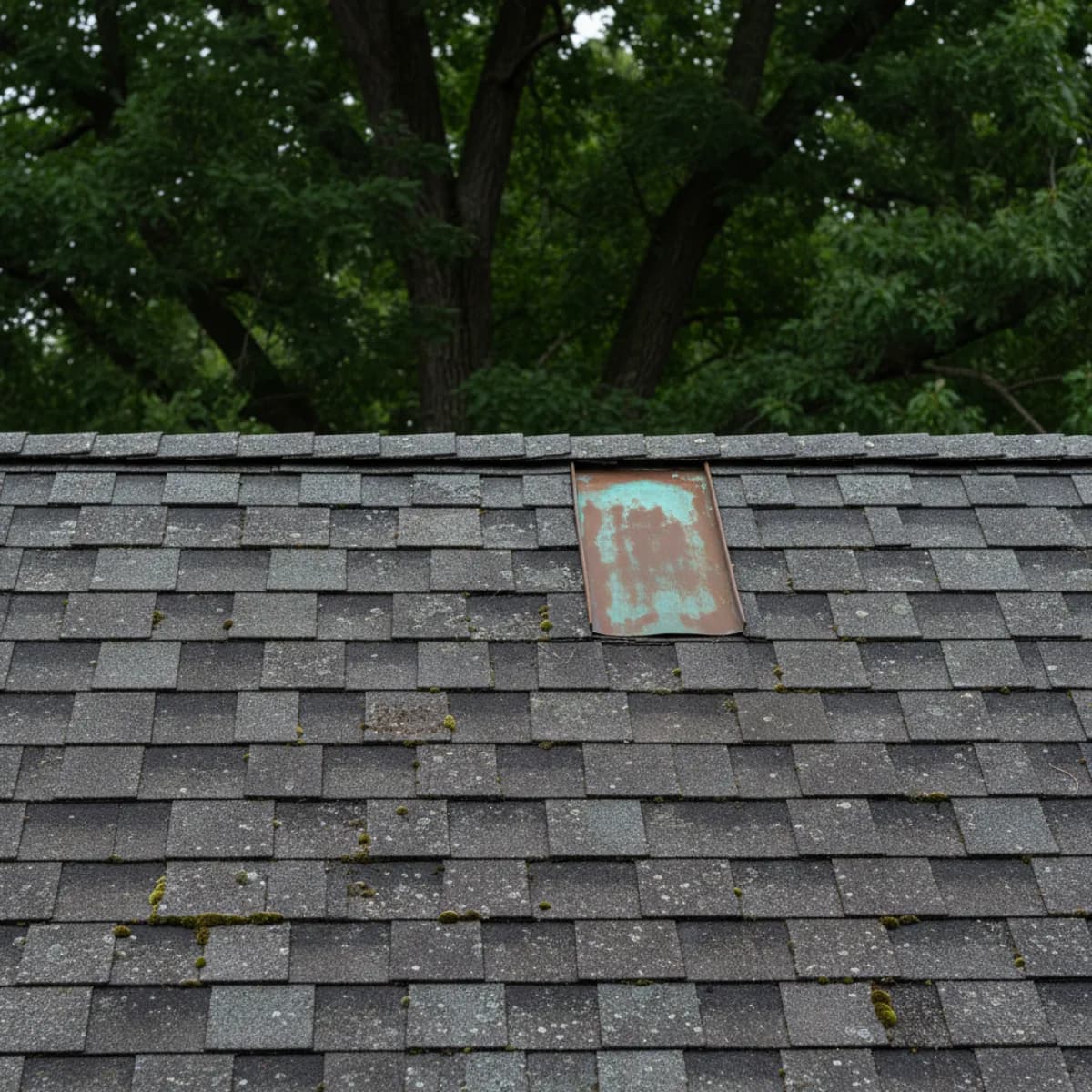
Biological growth (Gloeocapsa magma algae and moss): The humid Northeast climate is ideal for algae and moss colonization, particularly on north-facing slopes and shaded areas under tree canopy. Algae itself is cosmetic but holds moisture against shingles and accelerates granule loss. Moss is more destructive: its rhizoids penetrate beneath shingle tabs and lift them. Mitigation: algae-resistant (AR) shingles with 3M-CR copper-containing granules suppress algae for 15+ years; biocidal soft-wash treatments every 5 to 7 years remove existing colonization without damaging shingles.
4. Warning Signs & When to Schedule Replacement
NJ roofs typically give 18 to 36 months of advance warning before catastrophic failure. The earlier you recognize the warning signs, the more time you have to schedule replacement during the favorable spring or fall windows when contractor pricing and availability are best.
Visible from the ground: Curl or cupping at shingle edges (south-facing slopes typically show this first); pile of granules at downspout outlets or in gutter cleanouts; shiny black asphalt visible on shingles where granules have been lost; algae streaks more than 5 years old; rust streaks below flashing on chimneys, vents, or skylights; visible sag in the ridge line.
Visible from inside the attic: Water stains or active drips on rafters or insulation; daylight visible at any roof penetration (ridge vent, plumbing vent, chimney flashing); frost on the underside of the roof deck in winter (indicates inadequate ventilation, drives premature failure); rusted or pitted nails protruding from the underside of the deck; sagging or springy roof deck when walked.
Triggers for immediate replacement: Active leak that recurs after spot repair; failed insurance inspection (carrier non-renews or surcharges); blow-off of more than 5 percent of shingles in a single storm; visible structural damage to decking; or any leak that has caused interior drywall or insulation damage.
Optimal replacement timing in NJ: April through June and September through early November are the prime windows. Pricing is typically 5 to 15 percent below summer peak; contractor availability is best; and shingle sealant adhesion is optimal in 50 to 80 degree ambient temperatures. Avoid December through February except for emergency replacements; cold-weather installs use modified asphalt sealant that takes 3 to 6 weeks of warm sun to fully bond, leaving a brief vulnerability window.
5. How to Extend the Life of Your NJ Roof
A well-maintained NJ roof can outlast an identical neglected roof by 5 to 8 years. Five maintenance practices have the highest return on investment.
1. Annual professional inspection ($200 to $400): A qualified inspector checks flashing condition, identifies failing sealant, removes leaf and pine needle accumulation from valleys, and documents condition for insurance purposes. The single highest-value annual maintenance investment.
2. Maintain 1:300 attic ventilation ratio: NJ code requires one square foot of net free vent area per 300 square feet of attic floor, balanced 50/50 between intake (soffit vents) and exhaust (ridge vents or gable vents). Inadequate ventilation is the single largest preventable cause of premature roof failure in NJ. Symptoms include high attic temperatures (above 130 degrees on hot summer days vs. 100 to 120 in well-vented attics), winter frost on the deck underside, and ice dams along eaves. Adding soffit and ridge venting on a 2,000 sq ft NJ attic typically costs $1,500 to $3,500 and pays back in 5 to 8 years of extended roof life.
3. R-49 attic insulation per NJ energy code: The 2021 NJ energy code requires R-49 attic insulation in climate zone 4 (most of NJ) and R-60 in zone 5 (Sussex, Warren highlands). Most NJ homes built before 2010 have R-19 to R-30. Upgrading to R-49 reduces winter heat loss that melts snow on the roof and triggers ice dams; typical cost $1,500 to $4,000 for a 2,000 sq ft attic, with ROI through reduced heating costs of 3 to 6 years and added roof life of 3 to 5 years.
4. Trim overhanging tree branches 6+ feet from the roof line: Branches abrade shingles in wind, drop debris that holds moisture in valleys, and provide squirrel and raccoon access to attic vents. Trimming costs $300 to $1,500 depending on tree size and access; pays back in 2 to 4 years of extended roof life and reduced gutter cleaning.
5. Algae-resistant (AR) shingles at next replacement: Modern AR shingles include 3M-CR copper-containing granules that suppress Gloeocapsa magma growth for 15+ years. The cost premium over non-AR shingles is $0.10 to $0.30 per square foot, recovered many times over in extended life and avoided cleaning costs.
6. NJ Insurance & Roof Age — The 12/15/20 Year Cliffs
NJ homeowner insurance has tightened significantly since 2022, particularly for older roofs. Understanding the age cliffs can save NJ homeowners $10,000 to $30,000 over the life of a single roof.
Year 12 (Jersey Shore properties): Many coastal NJ carriers (Plymouth Rock, Allstate coastal, NJM coastal endorsement) shift roofs from RCV to ACV at year 12 on shore properties. ACV depreciates the roof at 5 to 6 percent per year of age, so a 12-year roof gets 65 to 75 percent of replacement cost; a 15-year roof gets 50 to 60 percent.
Year 15 (most NJ inland carriers): NJM (the largest NJ carrier), Plymouth Rock inland, and most regional carriers shift inland NJ roofs from RCV to ACV at year 15 to 17. State Farm and Travelers tend to be more generous (year 18 to 20). Allstate is more restrictive (year 12 to 15 even inland).
Year 20 (non-renewal threshold): Most NJ carriers actively non-renew or sharply surcharge roofs above 20 years regardless of condition, forcing the homeowner to either replace or move to the NJ FAIR Plan (which is more expensive and offers narrower coverage).
Practical playbook: At year 10 to 12, get a written roof condition report from a qualified contractor and share it with your insurance agent. If your roof is in good condition, ask for written confirmation that your RCV coverage continues. At year 15, plan and budget for replacement within the next 3 to 5 years. At year 18 on the shore or year 22 inland, replace before non-renewal triggers. Document the new roof installation thoroughly with photos and itemized invoices to support full RCV coverage on the new roof.
Get Your NJ Roof Estimate
Enter your address for satellite-measured pricing on architectural shingles, metal, slate, and synthetic materials — calibrated to your specific NJ region and climate exposure.
NJ Roof Lifespan FAQ
What is the average roof lifespan in New Jersey?
For a standard architectural asphalt shingle roof in New Jersey, the realistic average lifespan is 22 to 27 years statewide. The wide range reflects three regional sub-climates: inland North Jersey (Bergen, Morris, Sussex, Hunterdon, Warren) typically delivers the full 25 to 30 years because of moderate humidity, full tree cover, and protection from coastal salt; Central Jersey (Mercer, Middlesex, Somerset, Union) averages 22 to 27 years with slightly more thermal cycling near urban heat islands like Newark and Jersey City; and the Jersey Shore (Atlantic, Cape May, Monmouth, Ocean) compresses the lifespan to 18 to 22 years due to salt aerosol, persistent humidity, and direct UV exposure on coastal-facing slopes. These ranges assume the roof was installed correctly with proper ventilation, ice-and-water shield, and code-compliant fastener patterns. A poorly installed roof or one with inadequate attic ventilation may fail 5 to 10 years earlier than the regional average.
How long does a metal roof last in New Jersey?
Standing seam aluminum metal roofs in New Jersey typically last 50 to 70 years, with paint finishes (PVDF/Kynar 500) lasting 30 to 40 years before fade or chalking becomes noticeable. Galvanized steel metal roofs last 40 to 50 years inland but only 20 to 30 years on the Jersey Shore due to salt corrosion. Galvalume (aluminum-zinc coated steel) lasts 50 to 60 years inland and 30 to 40 years near the coast. Copper standing seam, the most durable option, lasts 75 to 100+ years anywhere in NJ; many original copper roofs on Cape May Victorian homes and Princeton-area estates installed in the late 1800s are still functioning. Stone-coated steel (Decra, Boral) lasts 40 to 50 years in NJ but is less common than standing seam.
How does the New Jersey climate affect roof lifespan?
New Jersey roofs experience four climate stresses that compound to shorten material life: thermal cycling (summer attic temperatures of 130 to 160 degrees followed by winter lows of -5 to 15 degrees create roughly 130 freeze-thaw cycles per year that fatigue shingle sealant and flash); UV exposure (NJ averages 2,500 sun hours per year, with the Jersey Shore receiving an additional 200 hours due to lack of tree cover); precipitation cycling (45 to 50 inches of annual rainfall plus 20 to 30 inches of snow creates wet-dry cycles that accelerate granule loss and underlayment degradation); and biological growth (the humid Northeast climate fuels Gloeocapsa magma algae and moss colonization, particularly on north-facing slopes). The cumulative effect is that NJ roofs typically achieve 75 to 85 percent of the manufacturer warranty period for asphalt and 90 to 100 percent for premium materials like metal, slate, and synthetic.
Should I replace my New Jersey roof at 20 years or wait until it leaks?
Most NJ homeowners should replace at 20 to 22 years for standard architectural shingle, before significant leaks develop. Three reasons: insurance coverage (NJM, Plymouth Rock, Allstate, and most NJ carriers shift to actual cash value depreciation for roofs older than 15 to 20 years; replacing proactively preserves replacement cost value coverage); cascade damage (a single ignored leak typically causes $3,000 to $15,000 of interior drywall, insulation, and structural damage that is not covered if the roof itself was over its useful life); and contractor scheduling (NJ roofing contractors are heavily booked April through November; emergency repairs in winter cost 30 to 50 percent more and offer fewer material choices). The exception is a roof that has been impeccably maintained, has no visible granule loss, no curling or cupping, no algae streaks, and has full attic ventilation; in that case, you may safely extend to 25 years before replacement.
What signs indicate my New Jersey roof needs immediate replacement?
The clearest replacement signals visible from the ground or driveway are: visible curl or cupping at shingle edges (especially on south-facing slopes, indicates 80+ percent UV degradation); granule loss (look for piles of granules in gutters or at downspout outlets, or shiny black asphalt patches visible on shingles); active algae streaks more than 5 years old (the streak itself is cosmetic but indicates trapped moisture and accelerated aging beneath); flashing rust or staining around chimneys, vents, and skylights (corroded flashing is the most common leak source on 15+ year NJ roofs); and visible sag in the roof deck or ridge line (indicates structural decking failure, often from chronic moisture). Signs visible from inside the attic are equally important: water stains on rafters or insulation, daylight visible at any roof penetration, and frost on the underside of the roof deck in winter (indicates inadequate ventilation that drives premature failure).
Does NJ insurance cover roof replacement based on age?
NJ homeowner insurance policies vary significantly by carrier, but the dominant trend since 2022 has been tighter age-based restrictions. NJM (the largest NJ carrier by market share) and Plymouth Rock typically offer full replacement cost value coverage on roofs under 15 years old, transition to actual cash value (depreciated payout) at 15 to 20 years, and may non-renew or surcharge above 20 years. Allstate, State Farm, Travelers, and Liberty Mutual follow similar patterns with carrier-specific thresholds typically 1 to 3 years more or less generous. Coastal NJ shore properties face stricter limits: many carriers move to ACV at 12 years on shore properties. The practical takeaway: get a roof age and condition appraisal from your contractor at year 12, share it with your carrier or agent, and schedule replacement before the ACV trigger to avoid losing $10,000 to $25,000 of replacement value coverage.
How can I make my New Jersey roof last longer?
Five proven steps extend NJ roof life by 3 to 7 years vs. baseline: (1) Annual professional inspection and cleaning (typically $200 to $400, removes leaf and pine needle accumulation that holds moisture against shingles and identifies failing flashing before it leaks); (2) Maintain 1:300 attic ventilation ratio (one square foot of net free vent area per 300 square feet of attic floor, balanced 50/50 between intake at the soffits and exhaust at the ridge; inadequate ventilation is the single largest preventable cause of premature NJ roof failure); (3) R-49 attic insulation per NJ energy code (prevents heat loss that melts snow on the roof and triggers ice dams along eaves); (4) Trim back overhanging tree branches at least 6 feet from the roof line (prevents abrasion damage from wind movement and reduces leaf accumulation); and (5) Install algae-resistant shingles at the next replacement (modern Class A AR shingles include 3M-CR copper-containing granules that suppress algae growth for 15+ years).