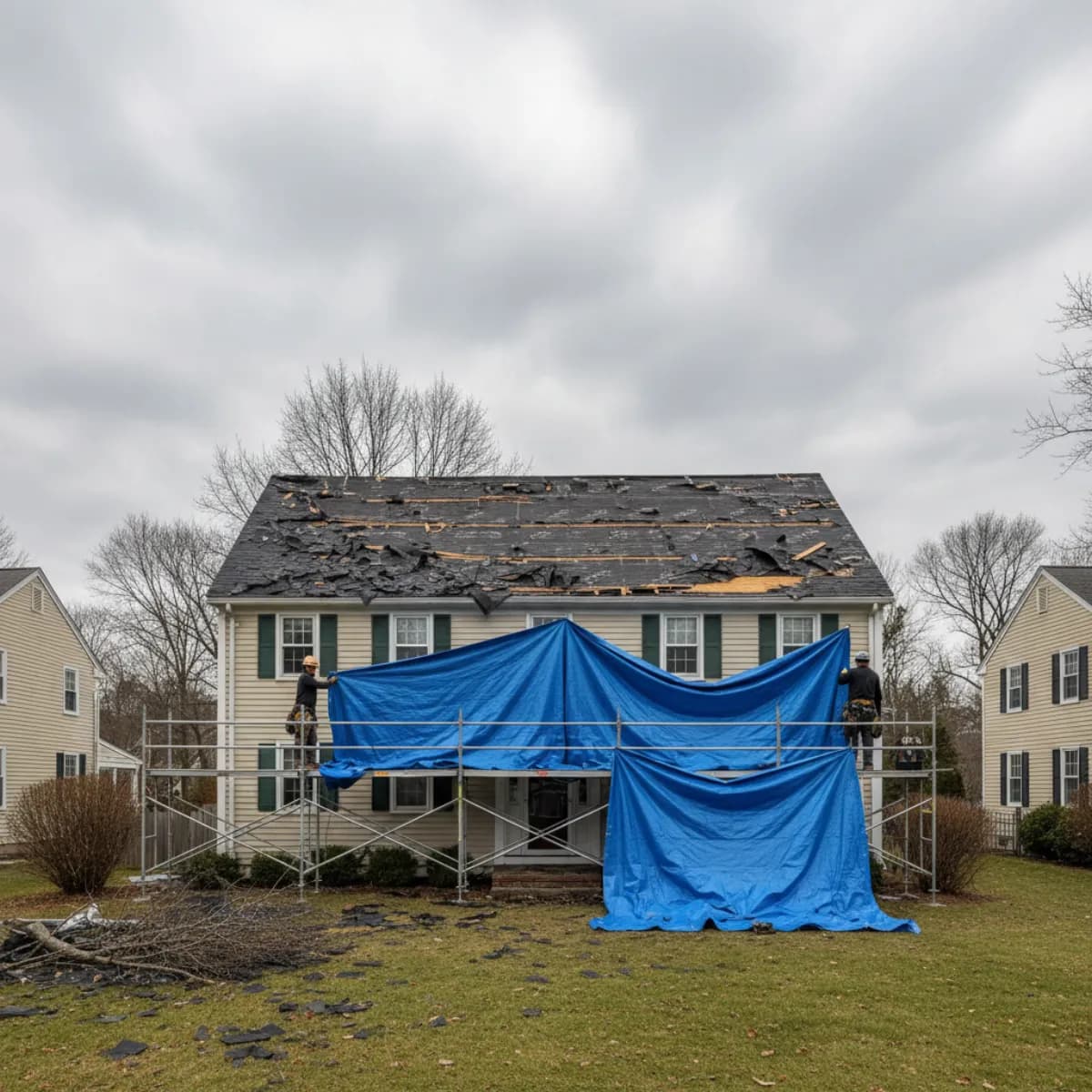
Massachusetts homeowners face one of the most punishing climates for residential roofing in the entire United States. The Commonwealth's unique geographical position — where cold Arctic air masses collide with warm, moist air from the Atlantic — produces a relentless cycle of nor'easters, ice storms, coastal wind events, summer thunderstorms, and the occasional hurricane remnant that tests every roofing system in the state. The result is that storm damage is not a question of if, but when and how severe.
Each winter season brings an average of 2 to 3 major nor'easters capable of tearing shingles off in sheets, collapsing gutters under ice weight, and driving water through the smallest gaps in flashing and sealant. Between storms, the freeze-thaw cycle creates ice dams that silently force water into the building envelope, causing thousands of dollars in hidden interior damage before homeowners even realize there is a problem. And from June through November, hurricane remnants and severe thunderstorms bring their own brand of concentrated destruction — high winds, fallen trees, and the occasional microburst capable of stripping an entire roof in minutes.
This guide is written specifically for Massachusetts homeowners dealing with active or recent storm damage. It covers every major storm type that affects Bay State roofs, exactly what to do step by step after damage occurs, current repair costs in the Massachusetts market, the insurance claim process under Massachusetts law, how to protect yourself from storm chaser scams, and when temporary repairs are sufficient versus when full replacement is necessary. Whether you are staring at a tarp-covered roof after last night's nor'easter or planning ahead for the next storm season, this resource will help you make informed decisions and get fair pricing from qualified contractors. For related information, see our Massachusetts emergency roofing guide and Massachusetts ice dam repair page.
Massachusetts Storm Threats: What Damages Your Roof
Each storm type causes different damage patterns and requires different repair approaches. Understanding what hit your roof helps you communicate with contractors and insurers more effectively.
Nor'easters
Extreme RiskPeak Season: October - April
Nor'easters are Massachusetts' single greatest storm threat and the leading cause of residential roof damage across the Commonwealth. These massive coastal storms bring sustained winds of 60 to 80 mph with gusts exceeding 90 mph, heavy snowfall of 12 to 30 inches per event, wind-driven rain, and rapid barometric pressure drops that create tremendous stress on roofing systems. Massachusetts averages 2 to 3 major nor'easters per winter season, though some years bring 5 or more. The heavy, wet snow characteristic of coastal nor'easters — often called "heart attack snow" because of its density — can add 20 to 30 pounds per square foot of load to a roof, well beyond the design capacity of many older Massachusetts homes. The 2015 winter brought a record-breaking sequence of nor'easters that dumped over 110 inches of snow on the Boston metro area, causing widespread roof collapses, structural failures, and ice dam emergencies from the Cape to the Berkshires.
Common Damage Types
- Shingle blow-off and lifting across large roof sections
- Flashing separation at chimneys, skylights, and dormers
- Ridge vent and roof cap damage from sustained wind pressure
- Gutter destruction under ice and snow weight
- Structural sagging or collapse from accumulated snow loads
- Wind-driven rain infiltration through compromised seals
Hurricane Season Remnants
High RiskPeak Season: June - November
While Massachusetts is not in the traditional hurricane strike zone, the state regularly experiences the destructive remnants of Atlantic hurricanes and tropical storms that push up the Eastern Seaboard. Hurricane Bob struck Massachusetts directly in August 1991, causing over $1.5 billion in damage with 100+ mph winds across Cape Cod and the South Shore. Hurricane Sandy's remnants in October 2012 brought 70 mph wind gusts and coastal flooding to eastern Massachusetts. Tropical Storm Irene (2011) and the remnants of Tropical Storm Ida (2021) both caused significant wind and water damage across the state. Even tropical storms that make landfall far to the south can deliver damaging winds of 40 to 70 mph and torrential rainfall to Massachusetts as they track northward, particularly along the coast and in southeastern Massachusetts.
Common Damage Types
- Widespread shingle blow-off from sustained high winds
- Fallen trees and large branches puncturing through roofing
- Torrential rain overwhelming flashing and drainage systems
- Coastal flooding damaging low-elevation roof structures
- Flying debris impact damage to roofing surfaces
- Extended power outages delaying emergency repairs
Ice Dams
Extreme RiskPeak Season: December - March
Ice dams are the most insidious form of storm-related roof damage in Massachusetts because they develop slowly and cause damage from the inside out. They form during the freeze-thaw cycle when heat escaping through a poorly insulated or ventilated attic melts snow on the upper roof. The meltwater runs down to the colder eaves, where it refreezes and creates a growing ridge of ice. Water pools behind this dam and is forced backward under shingles, past the ice and water shield, and into the building envelope. Massachusetts' constant winter temperature oscillation between 15 and 40 degrees Fahrenheit makes the state exceptionally prone to repeated ice dam formation. A single ice dam event can cause $5,000 to $20,000 in interior damage including ruined ceilings, saturated insulation, warped framing, and mold growth that begins within 24 to 48 hours of water intrusion. The problem is compounded by Massachusetts' abundant older housing stock — homes built before modern insulation and ventilation standards are the most vulnerable.
Common Damage Types
- Water infiltration under shingles causing ceiling and wall damage
- Insulation saturation reducing thermal performance
- Mold and mildew growth in walls, attic spaces, and ceilings
- Structural wood rot in rafters, sheathing, and fascia
- Gutter damage and separation from fascia under ice weight
- Paint peeling and drywall deterioration on interior surfaces
Severe Thunderstorms and Microbursts
Moderate RiskPeak Season: May - September
Massachusetts experiences severe thunderstorms primarily between May and September, with the most destructive events occurring in June and July. While less frequent than winter storms, summer severe weather can produce concentrated, violent damage. The June 2011 Springfield tornado — rated EF3 with 160 mph winds — cut a 39-mile path through western Massachusetts, destroying hundreds of homes and causing over $200 million in damage. Microbursts — sudden, powerful downdrafts that can produce ground-level wind speeds exceeding 100 mph in a focused area — are a particular threat in Massachusetts because they strike without the warning time that larger storm systems provide. These events can strip an entire roof in minutes, snap mature trees onto homes, and hurl debris with enough force to penetrate roofing materials. Hail accompanying severe thunderstorms, while less common than in the Midwest, can damage shingles and skylights when it occurs.
Common Damage Types
- Complete shingle stripping from microburst wind forces
- Tree and branch impact damage from snapped trunks and limbs
- Hail damage to shingles, flashing, and skylights
- Lightning strike damage to roof structures and electrical systems
- Sudden torrential rain overwhelming roof drainage capacity
- Flying debris puncturing roofing materials
Wind Events and Coastal Storms
High RiskPeak Season: Year-round (peak: Fall/Spring)
High winds do not need to reach hurricane force to cause significant roof damage in Massachusetts. Winds of 45 to 60 mph — common during spring and fall transitional storms — can lift and tear asphalt shingles, especially on roofs older than 15 years where the adhesive strip has weakened with age and thermal cycling. Coastal Massachusetts from Newburyport to Provincetown faces particularly intense wind exposure, with salt-laden ocean winds accelerating the deterioration of roofing materials and metal components. The combination of saturated soil from recent rain and high wind gusts is the primary mechanism for fallen tree damage — Massachusetts' dense hardwood canopy of oaks, maples, and pines means that virtually every residential neighborhood has mature trees within striking distance of rooftops. Every missing shingle or displaced flashing piece is an active leak waiting for the next rainfall, and in Massachusetts, the next rainfall is never far away.
Common Damage Types
- Progressive shingle blow-off starting at edges and ridgelines
- Flashing failure at chimneys, skylights, and roof-to-wall transitions
- Ridge cap and hip cap shingle loss from wind uplift
- Fallen tree limbs and branches puncturing roofing surfaces
- Gutter detachment from wind-rocked fascia boards
- Accelerated corrosion of metal components from salt-air exposure
What To Do Right Now: Step-by-Step After Storm Damage
If your Massachusetts roof has been damaged in a storm, follow these steps in order. Acting quickly limits further damage, strengthens your insurance claim, and gets you back to normal faster.
Ensure Everyone Is Safe — Stay Off the Roof
This is the most critical step. Storm-damaged roofs are structurally unpredictable — weakened decking can collapse under your weight, wet surfaces are slippery, and downed branches may be in contact with power lines. In Massachusetts, homeowner injuries from post-storm roof access are a leading cause of emergency room visits during winter months. If you see structural damage, sagging, or if a tree has impacted the roof, evacuate rooms directly beneath the damage zone. Call 911 if there are gas leaks, downed power lines, or signs of structural collapse.
Document All Damage Immediately
Before touching anything, photograph and video every piece of visible damage from multiple angles. Take wide shots showing the overall scope from ground level on all sides of the house, then close-ups of specific damage points including missing shingles, damaged flashing, fallen branches, and debris. Photograph interior damage — water stains on ceilings, wet insulation visible in the attic, damaged personal property. Document damage on gutters, downspouts, siding, windows, and vehicles. Include date-stamped photos — all Massachusetts insurers accept smartphone photos. This documentation is essential for your insurance claim and protects you if the damage worsens before repairs begin.
Contain Water Intrusion Inside the Home
Place buckets, large containers, and towels under active drips. Lay plastic sheeting or tarps over furniture, electronics, and flooring in affected rooms. If a ceiling is bulging with trapped water, carefully puncture a small hole at the center with a screwdriver to drain it into a bucket — an uncontrolled ceiling collapse causes far more damage. Move valuables and electronics out of affected rooms. Turn off electricity to any rooms where water is near electrical fixtures or outlets. These mitigation steps are covered by your homeowners insurance policy and are expected by adjusters.
Get an Instant Estimate Through RoofVista
Enter your Massachusetts address on RoofVista to get an AI-powered satellite estimate of your roof dimensions and receive repair quotes from pre-vetted local contractors who handle emergency storm damage work. Every contractor on the platform holds a Massachusetts Home Improvement Contractor (HIC) registration and Construction Supervisor License (CSL). You can compare response times, pricing, and qualifications without making a single phone call. No spam, no obligation, no storm chasers.
Contact Your Insurance Company
Call your homeowners insurance provider within 24 to 48 hours of discovering storm damage. Have your policy number, the date and description of the storm event, and your damage documentation ready. Under Massachusetts General Laws Chapter 176D Section 3(9), insurers must acknowledge your claim within 7 business days and begin investigation within 30 days. Ask about your deductible amount, whether your policy uses replacement cost value or actual cash value, and what documentation they require from contractors. File within one year of the storm event — this is the standard deadline in Massachusetts.
Authorize Emergency Temporary Repairs
Once a contractor arrives, they will likely recommend emergency tarping, board-up, or temporary leak sealing to prevent further water intrusion. Authorize these temporary measures immediately — do not wait for your insurance adjuster. Emergency mitigation is covered under virtually all Massachusetts homeowners insurance policies as "loss mitigation" or "duty to protect" expense. Keep all receipts. Temporary repairs do not require a building permit under Massachusetts regulations. The permanent repair can be scheduled after the insurance adjuster inspects and approves the claim.
Storm Damage? Get an Instant Estimate Now
Enter your address for an AI-powered satellite estimate. Compare storm damage repair quotes from pre-vetted Massachusetts contractors — no spam, no obligation, no storm chasers.
Get Your Free EstimateStorm Damage Roof Repair Costs in Massachusetts
Storm damage repair in Massachusetts costs more than scheduled maintenance work due to urgency, after-hours availability, and demand surges during active storm seasons. Here are current cost ranges across the Bay State.
| Service | Cost Range |
|---|---|
| Emergency Tarping | $200 - $600 |
| Emergency Leak Stop | $300 - $1,500 |
| Storm Damage Shingle Repair | $500 - $3,000 |
| Fallen Tree / Branch Impact Repair | $1,000 - $5,000+ |
| Ice Dam Removal (Steam) | $400 - $1,500 |
| Flashing Repair / Replacement | $200 - $1,200 |
| Full Storm Damage Replacement | $8,000 - $25,000+ |
| After-Hours / Weekend Premium | 25% - 50% above standard |
Costs are estimates based on Massachusetts market rates as of 2026. Your actual cost depends on damage severity, roof accessibility, pitch, and materials. Get an instant estimate for a quote tailored to your specific property and damage.
Temporary vs. Permanent Storm Damage Repairs
Understanding the difference between emergency temporary measures and permanent restoration is critical for both your home's protection and your insurance claim.
Temporary Repairs (Act Immediately)
Emergency measures to stop active damage. Do not wait for your insurance adjuster — authorize these immediately. Your policy covers them as loss mitigation.
- Emergency tarping: Covering exposed or damaged sections with heavy-duty tarps secured with battens
- Leak stop sealant: Temporary caulk or roofing cement applied to active leak points
- Board-up: Securing openings from fallen tree impact or large missing sections
- No permit required: Massachusetts does not require building permits for temporary protective measures
Permanent Repairs (After Adjuster)
Full restoration that brings the roof back to pre-damage condition or better. Typically scheduled after insurance approval, must meet Massachusetts building codes.
- 780 CMR compliance: Must meet the Massachusetts State Building Code for underlayment, ice shield, and wind rating
- Ice and water shield: Required along eaves for a minimum of 24 inches past the interior wall line
- 25% threshold: If damage exceeds 25% of roof area, most MA municipalities require full replacement to current code
- Building permit required: All permanent roofing work in Massachusetts requires a municipal building permit
Not sure which you need? Get an instant satellite-powered assessment through RoofVista to understand the scope of your storm damage, then compare itemized quotes from pre-vetted Massachusetts contractors who can advise on temporary measures versus permanent repair or replacement. Get your instant estimate.
Massachusetts Storm Damage Insurance Claim Process
Filing a storm damage insurance claim in Massachusetts involves specific steps, deadlines, and legal protections. Follow this process to maximize your claim and avoid common pitfalls.
Massachusetts Insurance Protections
- M.G.L. Chapter 176D: Insurers must acknowledge claims within 7 business days and begin investigation within 30 days
- Chapter 93A protection: Unfair or deceptive claims practices by insurers are actionable with triple damages and attorney fees
- Filing deadline: One year from the storm event is the standard deadline for most MA policies
- Appraisal clause: Most MA policies allow you to invoke binding appraisal if you disagree with the claim settlement amount
Typical MA Insurance Deductibles
- Standard deductible: $1,000 to $2,500 flat deductible is most common in Massachusetts
- Percentage-based: Some MA policies have wind/hail deductibles of 1-5% of the insured home value
- Covered perils: Wind, hail, fallen trees, ice storms, lightning, and fire are typically covered; wear and maintenance are excluded
- Mitigation covered: Emergency tarping and temporary repairs are covered as loss mitigation expenses separate from your deductible
Insurance Claim Documentation Checklist
Thorough documentation is the single most important factor in maximizing your storm damage insurance claim. Collect and organize all of the following before your adjuster visit.
Critical Massachusetts deadlines: File your claim within one year of the storm event. Get a professional roof inspection within 30 days while damage is fresh and attributable to the specific storm. Under M.G.L. Chapter 176D, if your insurer engages in unfair claim settlement practices, you may be entitled to triple damages under Chapter 93A. Keep detailed records of every interaction with your insurance company.
Storm Chaser Warning for Massachusetts Homeowners
After every major storm, out-of-state contractors flood Massachusetts neighborhoods. Protect yourself.
Storm chasers target Massachusetts aggressively, particularly after major nor'easters and widespread wind events. These out-of-state operators arrive within hours of a storm, going door to door in affected neighborhoods with offers of "free inspections" and promises to handle your insurance claim. They typically lack Massachusetts licensing, carry minimal insurance, and will be gone before their substandard work fails. The Massachusetts Attorney General's office has issued multiple consumer advisories about post-storm contractor fraud and actively investigates complaints.
Door-to-Door Solicitation Immediately After a Storm
Legitimate local Massachusetts contractors do not canvas neighborhoods after storms. Storm chasers arrive from out of state within hours of a major nor'easter or severe weather event, going door to door offering free inspections. Their goal is to lock you into a contract before you have time to research, compare, or think clearly. Under Massachusetts law, you have a 3-day right to cancel any contract signed during a home solicitation.
No Massachusetts HIC Registration or CSL
Massachusetts requires all roofing contractors to hold a Home Improvement Contractor (HIC) registration and a Construction Supervisor License (CSL). Storm chasers from out of state rarely have these credentials. Ask for their HIC registration number and CSL number, then verify both through the Massachusetts Division of Professional Licensure. If they cannot produce valid Massachusetts credentials, do not hire them.
Offering to Waive or Pay Your Insurance Deductible
Any contractor who offers to waive, absorb, or pay your insurance deductible is either planning to cut corners on materials and labor to recoup the cost, or is submitting fraudulently inflated claims to your insurer. While Massachusetts does not have a specific statute criminalizing deductible waiver like some states, this practice constitutes insurance fraud and can expose both the contractor and the homeowner to legal liability.
Pressure to Sign a Contract on the Spot
Storm chasers create false urgency — claiming materials will sell out, prices will spike, or that your insurance window will close. While prompt action is important after storm damage, you should never be pressured into signing a contract at your front door. Take time to verify the contractor's Massachusetts licensing, insurance coverage, local business presence of at least two years, and verifiable Bay State references.
Large Upfront Deposit Demand or Cash-Only Payment
Reputable Massachusetts roofing contractors typically require deposits of no more than one-third of the total project cost, as limited by Massachusetts Home Improvement Contractor law (M.G.L. c. 142A). Storm chasers often demand 50% or more upfront, or insist on cash-only payments. When they leave town after completing substandard work, you have no recourse for warranty claims, callbacks, or corrections.
How RoofVista protects you: Every contractor in our marketplace is pre-vetted for a valid Massachusetts Home Improvement Contractor (HIC) registration, Construction Supervisor License (CSL), current liability and workers compensation insurance, and a verified local business presence. When you compare quotes through RoofVista, you are only seeing contractors who have passed our vetting process — no storm chasers, no fly-by-night operators. Your information is never sold to third parties.
Common Storm Damage Patterns on Massachusetts Roofs
Massachusetts roofs endure a unique combination of stresses that create damage patterns distinct from other regions. Knowing what to look for helps you assess your situation accurately.
Shingle Blow-Off and Lifting
The most common storm damage in Massachusetts. Sustained winds of 45 mph or higher lift shingle tabs, break adhesive bonds, and eventually tear shingles free. Damage typically starts at edges, ridgelines, and hip caps where wind uplift is greatest. On Massachusetts roofs older than 15 years, the adhesive strip has often degraded from years of freeze-thaw cycling, making the shingles far more vulnerable to wind than their age alone would suggest. After any wind event, check for exposed underlayment, missing tab sections, or curled shingle edges visible from ground level.
Fallen Tree and Branch Impact
Massachusetts is one of the most heavily forested states in the Northeast, with mature oaks, maples, white pines, and hemlocks towering over residential neighborhoods throughout the state. During storms, saturated soil combined with high winds causes trees and large branches to fall onto roofs, puncturing through shingles, underlayment, and sometimes the decking itself. Even a single large limb can crack rafters, split sheathing, and compromise structural integrity. Do not attempt to remove fallen trees yourself — the weight redistribution during removal can cause further collapse.
Ice Dam Water Damage
Ice dams do not just sit on the roof edge — they actively force water backward under shingles and past the ice and water shield membrane. In Massachusetts, where winter temperatures oscillate between 15 and 40 degrees Fahrenheit, ice dams can reform multiple times during a single winter season. The water they push into the building envelope causes staining on ceilings and walls, saturates insulation (destroying its R-value), promotes mold growth within 24 to 48 hours, and rots structural wood over time. Many Massachusetts homes built before the 1990s lack adequate ice and water shield coverage, making them particularly vulnerable.
Flashing Failure at Penetrations
Flashing — the metal strips that seal joints around chimneys, skylights, dormers, plumbing vents, and roof-to-wall transitions — is one of the most vulnerable points during any storm event. Wind pressure, thermal expansion from temperature swings, and physical impacts from debris can separate flashing from the surfaces it protects. Once a flashing section fails, water has a direct path into the building envelope with every subsequent rain or snowmelt. Massachusetts homes with brick chimneys are especially vulnerable because the mortar joints that anchor step flashing deteriorate over time in the freeze-thaw cycle.
Current Massachusetts Roofing Material Prices
Live pricing data from pre-vetted Massachusetts contractors. If your storm damage repair involves significant material replacement, these per-square-foot costs will apply. For full cost details, see our Massachusetts Roof Cost Guide.
Storm Damage Risk by Massachusetts Region
Different parts of Massachusetts face different primary storm threats. Your location within the state affects which types of storm damage you are most likely to encounter.
Coastal Massachusetts
Cape Cod, South Shore, North Shore, Boston Harbor
Extreme Wind RiskCoastal communities bear the full brunt of nor'easters with the highest sustained wind speeds in the state, salt-air corrosion that degrades metal flashing and fasteners, and coastal flooding that can undermine foundation and lower-roof structures. Cape Cod and the Islands face hurricane remnant exposure from June through November. Homes within a mile of the coastline require more frequent roofing maintenance and storm-resistant materials rated for 130 mph wind exposure.
Greater Boston and Metro West
Boston, Cambridge, Newton, Framingham, Worcester corridor
High Ice Dam RiskThe densest concentration of older housing stock in Massachusetts means the highest ice dam vulnerability. Homes built before 1960 — which make up a large percentage of the housing in these areas — typically have inadequate attic insulation and ventilation, creating ideal conditions for ice dam formation. The urban heat island effect in Boston can accelerate the freeze-thaw cycle. Mature tree canopy throughout these neighborhoods increases fallen branch risk during wind events.
Western Massachusetts
Springfield, Holyoke, Northampton, the Berkshires
High Severe Weather RiskWestern Massachusetts faces the highest severe thunderstorm risk in the state, including the realistic threat of tornadoes — the 2011 Springfield EF3 tornado with 160 mph winds cut a 39-mile path and destroyed hundreds of homes. Higher elevation in the Berkshires brings heavier snow loads — some areas average 70 to 90 inches per winter — and more intense ice formation. The Connecticut River valley channels storm energy and can amplify wind speeds through terrain funneling effects.
Southeastern Massachusetts
Fall River, New Bedford, Taunton, Plymouth, Brockton
High Hurricane Remnant RiskSoutheastern Massachusetts sits in the primary track for Atlantic hurricane remnants moving up the coast. This region received the worst of Hurricane Bob in 1991 and significant damage from Sandy remnants in 2012 and Ida remnants in 2021. The relatively flat terrain offers less wind protection than the hills of central and western Massachusetts, and proximity to both Buzzards Bay and the Atlantic creates exposure from multiple coastal directions. Fallen tree damage is common due to extensive pine forests.
Massachusetts Storm Damage Roof Repair FAQ
Answers to the most common questions Massachusetts homeowners ask about storm damage repair, insurance claims, emergency costs, and contractor selection.
What should I do immediately after storm damage to my Massachusetts roof?
Stay off the roof — storm-damaged roofs are structurally unpredictable and dangerous. Document all visible damage from the ground with date-stamped photos and video, including wide shots and close-ups. Contain interior water with buckets, towels, and plastic sheeting. If a ceiling is bowing with trapped water, puncture a small hole at the center to drain it into a bucket. Get an instant estimate through RoofVista to compare emergency repair quotes from pre-vetted Massachusetts contractors. Contact your insurance company within 24 to 48 hours. Authorize emergency tarping to prevent further damage — this is covered by your policy.
How do I file a storm damage insurance claim in Massachusetts?
Call your insurer within 24 to 48 hours with your policy number, storm date, and documentation. Under Massachusetts General Laws Chapter 176D, insurers must acknowledge claims within 7 business days and begin investigation within 30 days. File within one year of the storm event. Have the adjuster inspect all roof slopes, not just the visible ones. Request a copy of their Xactimate estimate. If the offer seems low, you can request re-inspection, invoke the appraisal clause, or hire a public adjuster. Keep detailed records of all communications.
How much does storm damage roof repair cost in Massachusetts?
Emergency tarping costs $200 to $600, leak stops run $300 to $1,500, storm damage shingle repair is $500 to $3,000, and fallen tree impact repair ranges from $1,000 to $5,000 or more. Ice dam removal by professional steam treatment costs $400 to $1,500. Full emergency replacement on an expedited timeline ranges from $8,000 to $25,000 or more. After-hours calls carry a 25 to 50 percent premium. Most Massachusetts homeowners insurance covers storm damage with deductibles typically between $1,000 and $2,500.
What is the difference between temporary and permanent storm damage repairs?
Temporary repairs — tarping, emergency sealant, board-up — prevent further damage and do not require a Massachusetts building permit. Authorize these immediately; do not wait for your adjuster. Permanent repairs must comply with 780 CMR, the Massachusetts State Building Code, including ice and water shield requirements along eaves and proper underlayment. If the damaged area exceeds 25 percent of the total roof, most municipalities require a full replacement to current code. Permanent repairs typically begin after the insurance claim is approved.
What are the red flags of storm chaser roofing scams in Massachusetts?
Red flags include door-to-door solicitation right after a storm, pressure to sign immediately, offers to waive your deductible, no Massachusetts HIC registration or Construction Supervisor License, upfront deposits exceeding one-third of the project cost (a Massachusetts legal limit), and cash-only payment demands. The Massachusetts Attorney General's office investigates storm chaser fraud. Always verify MA licensing through the Division of Professional Licensure. Under Massachusetts law, you have a 3-day cancellation right for home solicitation contracts.
How long does it take to get storm damage repaired in Massachusetts?
Emergency temporary repairs like tarping and leak stops can be completed within 2 to 24 hours depending on contractor availability and storm severity. During major nor'easters, response times may extend to 24 to 48 hours due to demand surges. Permanent repairs for localized damage take 1 to 3 days once materials arrive. Full roof replacement takes 2 to 5 days of on-site work. The total timeline including the insurance claim process is typically 3 to 8 weeks. During peak storm seasons, material and contractor availability can add 1 to 3 weeks.
More Massachusetts Roofing Resources
Explore our other Massachusetts-specific guides for more detailed information on specific damage types and services.
Massachusetts Roofing Hub
Overview of roofing across the Bay State, including city pages for Boston, Worcester, Springfield, Cambridge, and more.
Emergency Roofing in MA
24/7 emergency roof repair services across Massachusetts, including response times, after-hours availability, and emergency scenario guides.
Hail Damage Roof Repair
Guide to identifying, documenting, and repairing hail damage on Massachusetts roofs, including insurance claim guidance.
Ice Dam Repair in MA
Professional ice dam removal, prevention strategies, and attic insulation improvements to stop ice dams from forming on your Massachusetts home.
MA Roof Cost Guide
Comprehensive pricing for roof replacement in Massachusetts including material comparisons, labor costs, and regional price variations.
Get an Instant Quote
Enter your address to get an AI-powered satellite estimate and compare quotes from pre-vetted MA contractors.