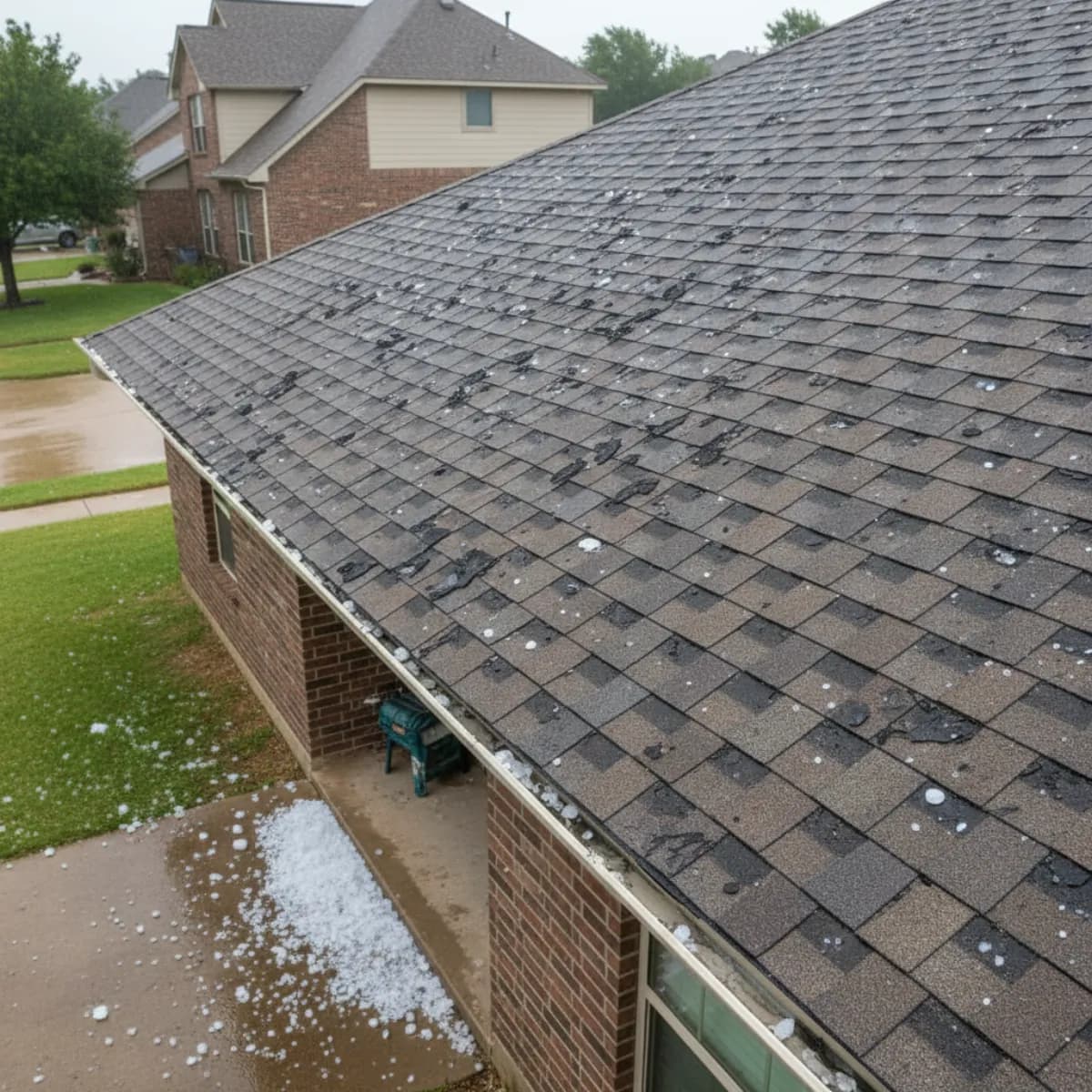
Texas Hail Damage Roof Repair Cost Guide (2026)
Texas recorded 878 significant hailstorms in 2024, causing $10.2 billion in insured losses. From minor shingle repair to full replacement with Class 4 impact-resistant upgrades, this guide covers every cost scenario for Texas homeowners — plus how to maximize your insurance claim and save 15-35% on premiums going forward.
Updated March 2026 · Covers DFW, Houston, San Antonio, Austin & all TX markets
Get instant hail damage repair quotes from pre-vetted Texas contractors
The Scale of Hail Damage in Texas
Texas is the most hail-damaged state in the nation by a wide margin. In 2024, the state recorded 878 significant hailstorms — events producing hailstones 1 inch or larger — resulting in $10.2 billion in insured losses. The DFW metroplex alone accounts for roughly 40% of that total. These are not freak occurrences. This is the annual reality of owning a home in Texas.
The geographic explanation is straightforward: warm, moisture-laden air from the Gulf of Mexico collides with cold, dry air pushing south from the Great Plains directly over central and north Texas. This atmospheric collision creates supercell thunderstorms that generate large, destructive hailstones. The DFW corridor sits at the epicenter of this convergence zone, which meteorologists have designated America's “Hail Alley.”
For homeowners, this means hail damage roof repair is not a question of “if” but “when” and “how much.” Understanding the cost spectrum — from minor shingle patches to full replacement with impact-resistant materials — is essential for making smart financial decisions before and after a storm.
878
Significant hailstorms recorded in Texas in 2024
$10.2B
Insured hail losses in Texas in 2024
15-35%
Insurance discount for Class 4 impact-resistant roofing (TDI mandate)
Hail Damage Repair Costs by Severity
Hail damage repair costs in Texas vary dramatically based on the severity of damage, the size of your roof, your material choice, and whether you need a partial repair or full replacement. The following breakdown covers the four primary damage tiers Texas homeowners encounter, with real cost ranges based on 2026 contractor pricing data.
These costs assume a typical Texas single-family home with a roof area of 1,800 to 2,400 square feet, a standard 4:12 to 6:12 pitch, and architectural asphalt shingles. Steeper pitches, multi-story homes, and premium materials will push costs toward the higher end of each range.
Minor Hail Damage
Scattered granule loss, 1-5 bruised or cracked shingles, no leaks
$450 - $1,800
1 day
Moderate Hail Damage
Widespread granule loss, 30-50% of shingles bruised, minor flashing dents
$3,500 - $8,000
1-2 days
Severe Hail Damage
Shingle mat fractures, exposed underlayment, dented ridge vents, active leaks
$8,500 - $16,000
2-4 days
Catastrophic Hail Damage
Punctured decking, structural damage, multiple interior leaks, blown-off sections
$16,000 - $35,000+
1-2 weeks
Important: These ranges reflect total project cost including materials, labor, tear-off, disposal, and permits. They do not include your insurance deductible. With a standard 2% wind/hail deductible on a $350,000 home, you pay $7,000 out of pocket before insurance covers anything. Factor this into your budget planning.
2026 Texas Roofing Material Pricing
The table below shows real-time contractor pricing for all roofing materials available in Texas. These prices are pulled directly from our contractor network and reflect current 2026 material and labor costs. When choosing a replacement material after hail damage, consider both the upfront cost and the long-term insurance savings that impact-resistant options provide.
At current Texas pricing, architectural asphalt shingles run $4.24 to $6.36 per square foot installed, Class 4 impact-resistant shingles run $5.40 to $8.64 per square foot, and standing seam metal runs $8.40 to $14.70 per square foot.
Roofing Material Hail Resistance Comparison
Not all roofing materials respond to hail the same way. The UL 2218 standard rates impact resistance on a scale from Class 1 (lowest) to Class 4 (highest), based on a test where a 2-inch steel ball is dropped from 20 feet onto the roofing material. Class 4 materials must show no fracture, cracking, or splitting after two strikes on the same spot.
For Texas homeowners, the material choice is not just about durability — it directly affects your insurance premium. Since 1998, TDI has mandated that insurers offer discounts for Class 4 roofing. This makes the higher upfront cost of impact-resistant materials a net-positive investment in most Texas markets.
| Material | UL Rating | Hail Resistance | Cost / sq ft | Insurance Discount |
|---|---|---|---|---|
| 3-Tab Asphalt | Class 1-2 | Low | $3.50 - $5.50 | None |
| Architectural Asphalt | Class 2-3 | Moderate | $4.75 - $8.50 | 0-10% |
| Class 4 Impact-Resistant | Class 4 | High | $6.00 - $11.00 | 15-35% |
| Standing Seam Metal | Class 4 | Very High | $10.00 - $18.00 | 15-35% |
| Concrete Tile | Class 3-4 | High | $9.00 - $16.00 | 10-25% |
3-Tab Asphalt: Budget replacements, rental properties, low-hail-risk areas (El Paso, South TX coast)
Architectural Asphalt: Standard replacement in moderate hail areas (Houston, Austin)
Class 4 Impact-Resistant: DFW, San Antonio, and anywhere in Hail Alley -- the ROI-positive choice for most TX homeowners
Standing Seam Metal: Long-term investment, ranch homes, high-wind + hail areas; resists hail up to 2" without functional damage
Concrete Tile: Hill Country and San Antonio luxury homes; excellent hail resistance but heavy (requires structural verification)
Class 4 Impact-Resistant Shingles: The Texas ROI Calculation
Class 4 impact-resistant shingles are the single most important cost-saving upgrade available to Texas homeowners. The TDI mandate dating back to 1998 requires every licensed insurer in Texas to offer premium discounts for homes with UL 2218 Class 4 roofing. The typical discount ranges from 15% to 35%, depending on the carrier and your policy details.
Here is the math for a typical DFW homeowner. The average Texas homeowners insurance premium is approximately $4,200 per year (and rising). A 25% discount saves $1,050 annually. Over the 20-to-30-year lifespan of quality Class 4 shingles, that totals $21,000 to $31,500 in insurance savings. The upfront cost premium for Class 4 over standard architectural shingles is typically $2,000 to $5,000 for a 2,000 sq ft roof — meaning the upgrade pays for itself within 2 to 5 years and generates net savings for the remaining 15 to 25 years.
Beyond the financial return, Class 4 shingles dramatically reduce the likelihood of filing a claim in the first place. Fewer claims mean fewer deductible payments (remember, $7,000 or more on a 2% policy), less hassle with adjusters, and no risk of non-renewal due to excessive claims history. In DFW's extreme hail environment, upgrading to Class 4 is not a luxury decision. It is a financial no-brainer.
Class 4 Upgrade ROI: DFW Example
Costs (One-Time)
Savings (Annual + Cumulative)
Top Class 4 brands for Texas
GAF Timberline HDZ (with StainGuard Plus, Lifetime Limited), Owens Corning Duration FLEX (SureNail technology, Class 4), CertainTeed NorthGate (SBS-modified, polymer-reinforced), and Atlas StormMaster Slate (Class 4 rated, Scotchgard coating). All are widely available from Texas distributors and installed by pre-vetted RoofVista contractors.
Regional Hail Risk and Average Claim Costs
Hail frequency and severity vary significantly across Texas. The DFW metroplex is the undisputed epicenter, but San Antonio, Austin, and the West Texas plains all face substantial risk. Your location directly determines your insurance premiums, likely deductible amounts, and the cost-effectiveness of impact-resistant material upgrades.
The table below shows average annual hail days, risk classification, and typical insurance claim costs by region. These figures reflect 2023-2024 data from the Insurance Information Institute and Texas Department of Insurance filings.
DFW Metroplex (Dallas, Tarrant, Collin, Denton)
Avg claim: $12,000 - $18,000
Highest hail frequency in the U.S. June 2025 supercell produced 3" hailstones across Plano, McKinney, and Frisco.
San Antonio / I-35 Corridor
Avg claim: $9,000 - $14,000
The 2016 San Antonio hailstorm caused $1.36B in insured losses. New Braunfels and Schertz are particularly exposed.
Austin / Cedar Park / Round Rock
Avg claim: $8,500 - $13,000
Rapid suburban growth means many newer homes have standard shingles vulnerable to hail above 1.5". Travis County premiums up 28% since 2023.
Houston / Gulf Coast
Avg claim: $7,500 - $12,000
Fewer hail events but compounding risk from hurricanes and extreme heat that accelerates shingle degradation.
Lubbock / Amarillo / West Texas
Avg claim: $8,000 - $12,000
Open plains geography creates ideal supercell conditions. Lower property values mean lower total claim costs despite high hail frequency.
El Paso / Far West Texas
Avg claim: $5,000 - $8,000
Outside the primary hail corridor. UV degradation is a bigger roof concern than hail in this region.
Understanding Your Texas Wind/Hail Deductible
The single biggest surprise for Texas homeowners filing their first hail damage claim is the wind/hail deductible. Unlike the flat-dollar deductible you may be accustomed to for fire or theft claims, wind and hail damage in Texas uses a percentage-based deductible — typically 2% of your dwelling coverage amount.
This means on a home insured for $350,000, your wind/hail deductible is $7,000. On a $500,000 home, it is $10,000. You pay this amount out of pocket before insurance covers a single dollar of your hail damage repair. This is the standard in Texas, not an exception. Some carriers offer 1% deductibles at higher annual premiums, and a few offer flat-dollar wind/hail deductibles, but the 2% structure dominates the Texas market.
The reason is straightforward: Texas accounts for more hail damage claims than any other state, and insurers use percentage deductibles to manage their exposure. For homeowners, this means minor-to-moderate hail damage often falls partially or entirely within the deductible, making the repair effectively out of pocket. This is another reason Class 4 impact-resistant materials are so valuable in Texas: they reduce the frequency of claims, meaning fewer $7,000+ deductible hits over the life of your roof.
| Home Insured Value | 1% Deductible | 2% Deductible |
|---|---|---|
| $250,000 | $2,500 | $5,000 |
| $350,000 | $3,500 | $7,000 |
| $450,000 | $4,500 | $9,000 |
| $550,000 | $5,500 | $11,000 |
| $700,000 | $7,000 | $14,000 |
Check your policy now
Review your homeowners policy declarations page to confirm your wind/hail deductible percentage. If you have a 2% deductible and your home is valued at $400,000 or more, consider shopping for a 1% policy at renewal. The higher annual premium may be worth it given DFW's hail frequency. Your agent can run the comparison.
Filing a Hail Damage Insurance Claim in Texas
Navigating a hail damage insurance claim in Texas requires a specific playbook. The combination of percentage-based deductibles, tightening filing deadlines, and aggressive cost containment by adjusters means you need to be prepared, documented, and strategic from the moment hail hits your roof.
The Texas Prompt Payment of Claims Act (Insurance Code Chapter 542) gives you legal protections that homeowners in most other states do not have. Insurers must acknowledge your claim within 15 days and make a coverage determination within 15 business days of receiving all required documentation. If they miss these deadlines, they owe you interest penalties. Use this leverage.
Document damage within 24-48 hours
Photograph all visible damage from ground level: dented gutters, cracked siding, damaged window screens, missing shingles. Include close-ups with a coin or ruler for scale. Save weather radar screenshots and local storm reports to establish the event date. This evidence is your foundation.
Mitigate further damage immediately
Texas law requires homeowners to take reasonable steps to prevent additional damage. Tarp active leaks, collect water from interior leaks, and move valuables away from wet areas. Keep all receipts for temporary repair materials. These costs are reimbursable under your policy.
Get an independent roof inspection before calling your insurer
Hire a pre-vetted local roofing contractor to inspect your roof and provide a written damage assessment with photos. This independent baseline is critical for comparing against your insurance adjuster's findings. Do this before the adjuster visit so you are negotiating from an informed position.
File your claim promptly
Contact your insurer and file the claim. Most Texas policies require filing within 90 to 365 days of the damage date, but sooner is always better. Provide your photo documentation, the storm date, and a general description. Request a claim number and the name of your assigned adjuster in writing.
Be present for the adjuster inspection
When the insurance adjuster inspects your roof, be there. Walk them through your documentation. Have your independent contractor's report available. If the adjuster misses damage areas your contractor identified, point them out. The adjuster works for the insurer; your contractor works for you.
Review the settlement and supplement if needed
If the initial settlement does not cover the actual repair cost documented by your contractor, file a supplement. Your contractor prepares an itemized Xactimate estimate showing the additional work needed and submits it to your insurer. Supplements are normal and expected in Texas hail claims. Most experienced contractors handle this process routinely.
Related guide
For a comprehensive step-by-step insurance claim walkthrough including public adjuster guidance, deductible fraud laws, and TDI complaint procedures, see our Texas Roof Insurance Claim Guide.
Avoiding Storm Chaser Scams After Texas Hailstorms
Within 48 hours of every major Texas hailstorm, out-of-state contractors flood affected neighborhoods with door-to-door solicitations, often driving branded trucks from hundreds of miles away. These “storm chasers” collect upfront payments or sign homeowners to contracts, perform substandard work (or disappear entirely), and are gone before warranty claims arise. Texas Attorney General complaints related to roofing fraud spike 300-400% in the weeks following major hailstorms.
Protecting yourself is not complicated, but it requires discipline when you are stressed about your damaged roof and eager to get repairs started.
Never sign a contract with a door-to-door solicitor
Legitimate contractors do not need to canvass neighborhoods. They have established reputations and referral networks.
Verify TX business registration and insurance
Ask for their Certificate of Insurance showing general liability ($1M+) and workers compensation coverage. Verify it is current by calling the carrier directly.
Never pay more than one-third upfront
Texas law does not cap deposits, but reputable contractors rarely require more than 30-33%. Any contractor asking for 50%+ upfront is a red flag.
Never sign an Assignment of Benefits (AOB)
An AOB transfers control of your insurance claim to the contractor. This limits your ability to dispute charges and can lead to inflated billing that raises your future premiums.
Get at least three written quotes
Comparing itemized quotes from multiple contractors exposes outlier pricing and ensures you understand the actual scope of work.
Deductible fraud is illegal in Texas
Under Texas Insurance Code Section 27.155, any contractor offering to "waive" or "pay" your deductible is committing insurance fraud. Both the contractor and homeowner can face penalties.
RoofVista pre-vets every contractor for Texas business registration, active liability insurance, workers compensation coverage, and verified local references. When you get quotes through RoofVista, every contractor has already been screened — so you can compare standardized quotes from verified professionals without the risk of storm chaser fraud.
Cost Factors Specific to Texas Hail Damage Repair
Several factors unique to Texas drive hail damage repair costs above national averages. Understanding these variables helps you budget accurately and evaluate contractor quotes more effectively.
Post-Storm Demand Surge
After major hailstorms, contractor demand in DFW can spike 5-10x within days. Prices increase 15-30% during demand surges because labor crews are stretched thin and material distributors face temporary shortages. If your roof is not an emergency, waiting 4-8 weeks for the surge to subside can save thousands. If you have an active leak, get emergency repairs done immediately and schedule the full replacement for after the rush.
Roof Pitch and Accessibility
Texas homes commonly have roof pitches of 6:12 or steeper, especially newer construction in DFW suburbs. Steeper pitches require harness systems and slow installation speed, adding 15-25% to labor costs. Multi-story homes add further complexity. A 2-story home with a 8:12 pitch can cost 30-40% more than a single-story ranch with a 4:12 pitch for the same square footage.
Decking Damage (Hidden Costs)
Large hailstones can crack or fracture the plywood or OSB decking beneath the shingles. This damage is invisible until the old shingles are torn off. Decking replacement typically costs $2.50-$5.00 per square foot and is not always included in initial quotes or insurance estimates. Expect 10-20% of the decking to need replacement on a severe hail damage job. This is the most common source of insurance supplements in Texas.
Permit Requirements
Most Texas cities require permits for full roof replacements. Dallas, Houston, San Antonio, and Austin all require permits with fees ranging from $150 to $500+ depending on project scope. Some HOA-governed communities in DFW suburbs have additional architectural review requirements that can add time and cost. Confirm permit responsibility (contractor vs. homeowner) before signing a contract.
Code Upgrades at Replacement
When replacing a roof, Texas building codes (based on the International Residential Code) may require upgrades to ventilation, underlayment, or ice-and-water shield that were not present on the original roof. These code-required upgrades are covered by insurance under Ordinance or Law coverage (if included in your policy), but you must request them explicitly. Common upgrades include synthetic underlayment, improved ridge ventilation, and drip-edge flashing.
How to Get the Best Price on Hail Damage Repair in Texas
The difference between the most expensive and least expensive quote for the same hail damage repair job in Texas can be 40-60%. This is not because one contractor is cheating you. It reflects differences in overhead, material sourcing, subcontractor rates, and profit margins. Comparing multiple quotes is the single most effective way to ensure you pay a fair price.
Get 3+ comparable quotes
Ensure each quote uses the same scope of work: same material, same tear-off specification, same underlayment, same warranty terms. Apples-to-apples comparison is the only way to evaluate price fairly.
Time your replacement strategically
If your damage is not an active leak, consider scheduling the replacement during the off-season (November through February). Contractors are less busy, and pricing is typically 10-20% lower than peak season.
Upgrade to Class 4 at replacement
If you are already tearing off your roof, the incremental cost to upgrade from standard architectural to Class 4 impact-resistant is $2,000-$5,000. The insurance savings make this a net-positive investment within 2-5 years.
Negotiate contractor supplements
Ask your contractor upfront whether they handle insurance supplements. Experienced Texas roofers know how to document and submit supplements that capture the full cost of the repair, reducing your out-of-pocket beyond the deductible.
Get Instant Hail Damage Repair Quotes
Enter your address to get satellite-powered instant estimates from pre-vetted Texas roofing contractors. Compare standardized quotes side by side — no spam, no storm chasers, no pressure.
Related Texas Roofing Guides
Texas Roof Insurance Claim Guide
Step-by-step claim process, TDI deadlines, and settlement negotiation for TX homeowners.
Texas Hail Season 2026 Prep
Pre-season inspection checklist, material upgrades, and insurance review for DFW homeowners.
Roof Replacement Cost in Texas
Complete 2026 pricing for 8 materials across 40+ Texas cities with real contractor data.
Best Roofing Materials for Texas
Climate-optimized material recommendations for heat, hail, and wind across TX regions.
Class 4 Impact-Resistant Shingles Guide
UL 2218 ratings, brand comparison, and insurance discount calculations.
Storm Chaser Scam Guide
Red flags, legal protections, and how to verify contractor credentials after a storm.
Texas Hail Damage Roof Repair: Frequently Asked Questions
How much does it cost to repair a hail-damaged roof in Texas?
Minor hail damage repair in Texas typically costs $450 to $1,800 for localized shingle replacement on a small area (1-3 squares). Moderate damage requiring 30-50% of the roof surface to be replaced runs $3,500 to $8,000. A full roof replacement after severe hail damage costs $8,500 to $22,000+ for a typical 2,000 sq ft Texas home, depending on material choice. Impact-resistant Class 4 shingle upgrades add 15-25% to the base cost but qualify for TDI-mandated insurance discounts of 15-35%, often offsetting the premium within 3-5 years.
Does homeowners insurance cover hail damage roof repair in Texas?
Yes. Hail damage is covered under the wind/hail peril in virtually all Texas homeowners policies. However, Texas uses percentage-based wind/hail deductibles rather than flat-dollar amounts. The standard deductible is 2% of your dwelling coverage. On a home insured for $350,000, that means $7,000 out of pocket before insurance pays anything. Some carriers offer 1% deductibles at higher premiums. Your policy must be active at the time of the storm, and most carriers require claims to be filed within 90 to 365 days of the damage date.
What size hail causes roof damage in Texas?
Hail 1 inch in diameter (quarter-sized) can crack and bruise standard 3-tab shingles. At 1.5 inches (golf-ball-sized), architectural shingles sustain granule loss and mat fractures. At 2 inches or larger, even Class 4 impact-resistant shingles can be compromised. Metal roofing withstands hail up to 2 inches without functional damage, though cosmetic denting may occur. In 2024, Texas recorded 878 significant hailstorms, many producing hailstones exceeding 2 inches in the DFW corridor.
Do Class 4 impact-resistant shingles really save money on Texas insurance?
Yes. Texas Department of Insurance (TDI) regulations under Texas Insurance Code Section 2253.002, in effect since 1998, require all licensed insurers to offer premium discounts for homes with UL 2218 Class 4 impact-resistant roofing. Discounts range from 15% to 35% depending on the carrier. On a typical DFW homeowners policy costing $3,500 to $5,000 per year, that translates to $525 to $1,750 in annual savings. Over a 10-year shingle lifespan, insurance savings of $5,250 to $17,500 typically exceed the $2,000 to $5,000 upfront premium for Class 4 shingles.
How long do I have to file a hail damage claim in Texas?
Most Texas homeowner policies require you to file a claim within one year of the storm date. However, a growing number of carriers have shortened this window to 90 or 180 days. Check your policy declarations page for the specific deadline. Once you file, the Texas Prompt Payment of Claims Act (Insurance Code Chapter 542) requires the insurer to acknowledge your claim within 15 days and issue a coverage determination within 15 business days of receiving all documentation. Filing sooner is always better because weather evidence degrades and the insurer can argue that subsequent events caused or worsened the damage.
Should I repair or replace my roof after Texas hail damage?
If hail damage affects less than 25-30% of your roof surface and the roof is less than 10 years old, localized repair may be cost-effective. If damage exceeds 30%, or if your roof is already 15+ years old, full replacement is typically the better investment. A full replacement provides a uniform warranty, eliminates the risk of mismatched shingles, and is an opportunity to upgrade to Class 4 impact-resistant materials that reduce future hail vulnerability and lower insurance premiums. Your insurance adjuster will assess the damage scope, but getting an independent inspection from a pre-vetted local contractor gives you a second opinion and a more accurate cost baseline.
What is a wind/hail deductible and why is it so high in Texas?
A wind/hail deductible is a separate, percentage-based deductible that applies only to damage caused by wind and hail events. In Texas, the standard wind/hail deductible is 2% of the dwelling coverage amount. On a home insured for $400,000, that equals $8,000 out of pocket. This deductible exists because Texas experiences more hail claims than any other state, with $10.2 billion in insured hail losses in 2024 alone. Insurers use percentage deductibles to manage their aggregate exposure. Some policies offer 1% or flat-dollar deductibles at higher annual premiums.
How do I avoid storm chaser roofing scams after a Texas hailstorm?
After every major Texas hailstorm, unlicensed out-of-state contractors flood affected neighborhoods. Never sign a contract with a door-to-door solicitor. Verify the contractor has a Texas business registration, valid liability and workers comp insurance, and verifiable local references. Never pay more than one-third upfront. Never sign an Assignment of Benefits (AOB) that gives the contractor control of your insurance claim. Get at least three written quotes before committing. RoofVista pre-vets every contractor for licensing, insurance, and local references, so you can compare standardized quotes from verified Texas professionals without the spam.