In This Guide
Types of Storm Damage in Connecticut
Connecticut sits at the crossroads of multiple weather systems. Coastal communities face design wind speeds of 110+ mph, while inland areas contend with 100 mph zones under the Connecticut State Building Code. Understanding the specific threats to your roof helps you recognize damage quickly and take the right action.
Wind Damage
Wind is the most common cause of storm damage to Connecticut roofs. Nor'easters from October through April produce sustained winds of 40 to 60 mph with gusts reaching 70 to 80 mph along the coast. Summer microbursts can generate localized winds exceeding 80 mph in a concentrated area less than 2.5 miles across.
What to look for: Missing or lifted shingles (especially along ridges and eaves), creased shingle tabs bent backward and re-settled, displaced ridge cap shingles, loosened or missing flashing around chimneys, skylights, and vents. Damage typically concentrates on the roof face opposing the prevailing storm direction due to uplift forces.
Hail Damage
Hartford County has the highest hail risk in Connecticut, followed by the Connecticut River Valley corridor. Summer thunderstorms from June through August produce hail ranging from pea-size (0.25 inches) to golf-ball-size (1.75 inches). Even small hail driven by strong winds dislodges shingle granules and weakens the weathering surface.
What to look for: Random-pattern dark spots on shingles where granules were knocked loose, exposing black asphalt. Dents in aluminum gutters, downspouts, vent caps, and flashing. Hail damage is deceptive: a roof can sustain significant damage without visible leaks for months because granule loss accelerates UV degradation over time.
Fallen Trees and Debris
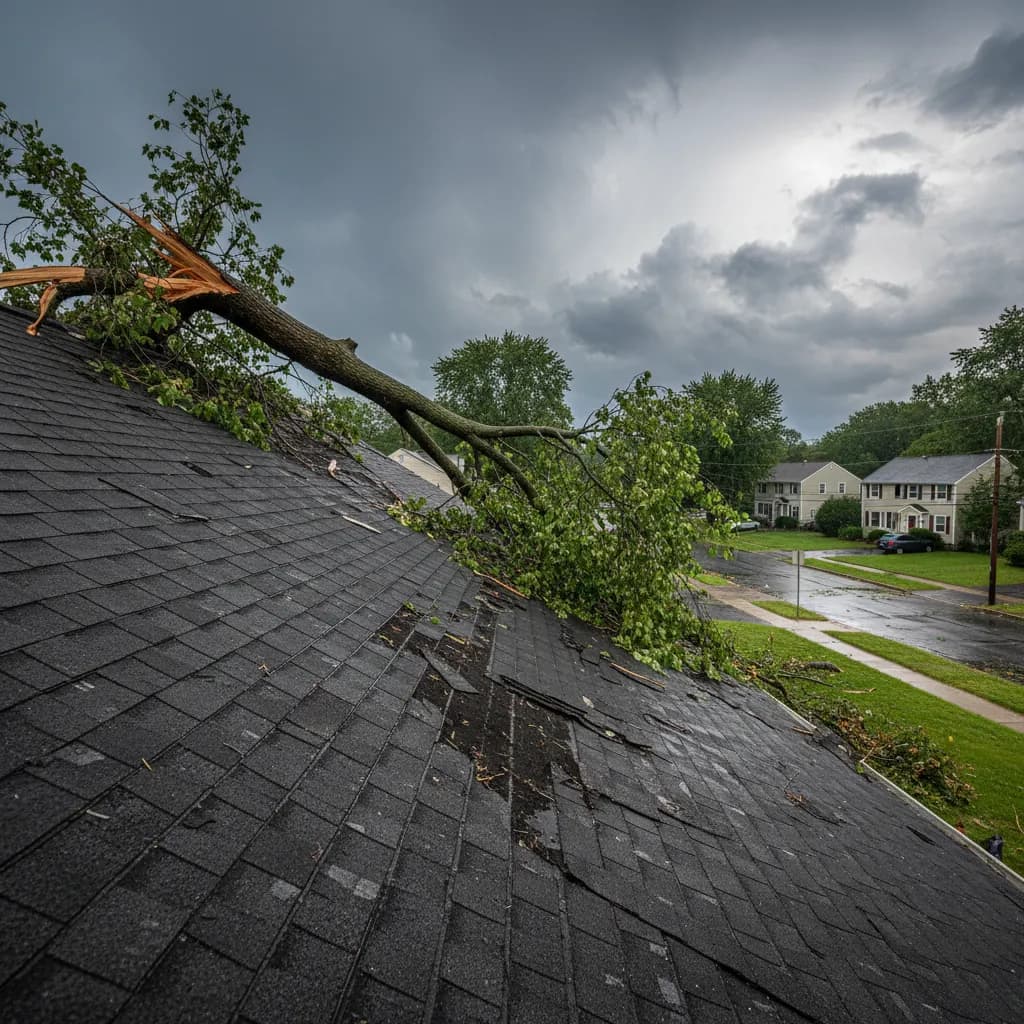
Connecticut is approximately 60 percent forested, with mature hardwoods and white pines growing within falling distance of many residential structures. Storm winds topple trees and launch branches onto roofs, causing damage ranging from minor scraping to catastrophic structural punctures.
What to look for:Debris on the roof surface, cracked or displaced shingles in isolated patterns, dented gutters from branch impact, depressions or soft spots in the roof deck. Even a 3-to-6-inch-diameter branch propelled by storm winds can crack shingles and bend flashing. Tree damage is covered by homeowners insurance regardless of whether the tree originated on your property or a neighbor's.
Ice and Nor'easter Damage
Connecticut averages 1 to 3 significant nor'easters per winter, combining heavy snow, freezing rain, and prolonged winds lasting 12 to 36 hours. The extended duration works shingles loose incrementally. Ice dams form when heat escaping through the roof melts snow, and the meltwater refreezes at the colder eaves, backing water under shingles.
What to look for: Interior water stains on ceilings (especially near eaves), icicles forming at gutters, ice buildup at roof edges, saturated insulation in the attic, peeling paint on exterior soffits. Ice dams often cause damage that is not visible until spring when the ice melts and water stains appear.
Connecticut homeowners face 3 to 5 weather events per year with the potential for meaningful roof damage. Coastal towns from Stamford to Stonington experience higher wind exposure, while the Connecticut River Valley (Hartford, Middletown, and surrounding communities) is the state's primary hail corridor. Tropical storm remnants tracking up the East Coast bring torrential rainfall and sustained winds roughly once every two to three years, adding another layer of risk statewide.
Emergency Steps After Storm Damage
The actions you take in the first 72 hours after storm damage determine how smoothly the repair and insurance process goes. Follow these steps in order.
Ensure Safety First
Account for all household members. Stay away from downed power lines (call Eversource at 800-286-2000 for CT), leaning trees, and any structural damage. If the roof has a visible hole or structural collapse, evacuate the rooms below it. Shut off electricity to affected areas if water is actively leaking near electrical fixtures. Call 911 if there is any immediate danger.
Document Everything with Photos and Video
Before touching, cleaning, or covering anything, take extensive photos and video from ground level. Walk the entire perimeter of the house. Photograph damaged shingles, debris on the ground, dented gutters, broken flashing, and any interior water damage. Include wide shots showing the full roof and close-ups of specific damage points. Record video narrating what you see. This documentation is your most important asset for the insurance claim.
Prevent Further Damage (Emergency Tarping)
Your Connecticut insurance policy requires you to take reasonable steps to prevent additional damage. This may include placing a tarp over exposed sections (if you can do so safely), placing buckets under interior leaks, boarding up broken windows, and clearing gutters so water drains properly.
Connecticut building code does not require a permit for emergency temporary repairs (tarping), but permanent repairs may require a permit depending on your municipality. Emergency tarping in CT typically costs $200 to $800 and is reimbursable under your insurance policy's “duty to mitigate” provision. Keep all receipts. See our Emergency Roof Tarp Guide for details.
File Your Insurance Claim Within 48 to 72 Hours
Contact your homeowners insurance company as soon as possible. While Connecticut law gives you up to one year to file, filing within 48 to 72 hours establishes a clear link between the storm event and your damage. Have your policy number, date and time of the storm, and your photos ready. Request a claim number and the name of the assigned adjuster. Ask about your deductible and whether you have Replacement Cost Value (RCV) or Actual Cash Value (ACV) coverage.
Get an Independent Estimate
Before the insurance adjuster visits, get an independent estimate from a pre-vetted contractor or use RoofVista's instant satellite estimate to establish a baseline cost. The adjuster works for the insurance company, and their assessment may miss damage or undervalue the repair. Your independent estimate gives you a documented comparison point for fair settlement negotiations. Use the address input above or visit our free estimate tool to get your estimate in minutes.
Do Not Sign Anything with Door-Knockers
After every significant storm in Connecticut, out-of-state storm chasers canvass affected neighborhoods. Politely decline and close the door. Do not let anyone you have not independently vetted onto your roof. Do not sign any contract, authorization to represent, or assignment of benefits document. Legitimate contractors do not need to pressure you into a same-day decision. See our Storm Chaser Scam Guide for a comprehensive breakdown of these tactics.
CT Insurance Claim Process
Connecticut has strong consumer protection laws for insurance claims. Here is the step-by-step process specific to CT storm damage claims. For a broader overview, see our Insurance Claims Guide for similar New England coverage.
Day 1: Report the Claim
Within 48–72 hrsCall your insurance company and report the damage. Provide your policy number, storm date, and description of damage. Request your claim number and adjuster's name. Email your date-stamped photos to your adjuster immediately.
Days 2–7: Get Independent Estimates
Before Adjuster VisitGet at least one independent estimate from a pre-vetted contractor. RoofVista provides instant satellite-based estimates that measure your roof area and provide material-specific pricing. Having your own estimate gives you leverage if the adjuster undervalues the repair.
Days 7–21: Adjuster Inspection
Be PresentBe present during the adjuster's inspection. Walk them through your documentation and point out all damage. If you have a contractor available, have them present to identify damage the adjuster may miss (especially hail damage that is difficult to see from the ground). Under CT's Unfair Insurance Practices Act, the adjuster must conduct a reasonably thorough investigation.
Days 21–45: Review Settlement Offer
Compare CarefullyReview the adjuster's scope of damage and dollar amount against your independent estimates. If the settlement is significantly lower, you have the right to negotiate. Connecticut law under the Unfair Insurance Practices Act (CGS 38a-816) prohibits insurers from lowballing claims. If negotiations stall, you can file a complaint with the CT Department of Insurance.
ACV vs. RCV: Know Your Coverage
Check Your PolicyActual Cash Value (ACV) policies pay the depreciated value based on roof age and condition. Replacement Cost Value (RCV) policies pay the full replacement cost. With RCV, you typically receive an initial payment minus depreciation holdback, then recoverable depreciation after you complete the work and submit receipts. Most CT homeowners have RCV coverage. Check your declarations page to confirm.
Storm Damage Repair Costs in Connecticut (2026)
The following cost ranges reflect 2026 Connecticut market pricing for labor and materials. Actual costs depend on roof size, pitch, accessibility, and material type. Use these ranges as a reference when evaluating estimates and insurance settlement offers. For comprehensive pricing, see our Connecticut Roof Replacement Cost Guide.
| Damage Type | Description | Cost Range |
|---|---|---|
| Minor Shingle Replacement | A few missing or lifted shingles, minor flashing repair | $300–$1,000 |
| Moderate Wind/Hail Repair | Multiple sections affected, exposed underlayment, ridge cap replacement | $1,500–$5,000 |
| Partial Re-Roof | One or more roof planes need full replacement, flashing and underlayment work | $3,000–$8,000 |
| Full Replacement | Severe widespread damage, complete tear-off and new installation | $9,000–$18,000+ |
| Tree Impact Repair | Branch or trunk removal, deck repair, potential structural framing | $1,000–$10,000+ |
| Emergency Tarping | Temporary waterproofing of exposed roof sections | $200–$800 |
| Ice Dam Damage Repair | Water intrusion damage, eave flashing, insulation replacement | $800–$4,000 |
Typical CT tarping cost
Full replacement range in CT
Tarping costs covered by insurance
Connecticut labor rates tend to be higher than the national average due to the state's cost of living and contractor licensing requirements. Coastal communities (Fairfield County, New Haven shoreline, southeastern CT) may see premiums of 10 to 20 percent above inland pricing due to the higher wind-resistance requirements and accessibility challenges. Get multiple estimates through RoofVista's instant estimate tool to compare quotes from pre-vetted Connecticut contractors.
Beware Storm Chasers in Connecticut
CT Department of Consumer Protection Warning
The Connecticut Department of Consumer Protection (DCP) warns homeowners to be on high alert for storm chaser scams after every major weather event. Out-of-state contractors descend on affected neighborhoods with door-to-door pitches promising free inspections and free roofs. These operators often lack CT licensing, carry inadequate insurance, and perform substandard work before disappearing.
Red Flags to Watch For
- 1.Unsolicited door-to-door contact immediately after a storm. Legitimate Connecticut contractors do not canvass neighborhoods. They are too busy serving existing customers.
- 2.Pressure to sign immediately. “This price is only good today” or “I have a crew available right now” are classic high-pressure tactics. A reputable contractor gives you time to get multiple quotes.
- 3.Offers to waive your deductible or give you a “free roof.” Waiving the deductible is insurance fraud. A contractor who offers this is willing to commit fraud, and you may be held liable.
- 4.Out-of-state license plates or no CT address. Check the contractor's vehicle plates. If they are from another state, they are likely not an established Connecticut business.
- 5.No Connecticut HIC registration. Connecticut law requires all home improvement contractors to register with the CT DCP. Ask for their HIC registration number and verify it at portal.ct.gov/DCP.
- 6.Demands large upfront payment. Connecticut law (CGS 20-429) limits contractor deposits to one-third of the total contract price. A demand for 50 percent or more upfront is both illegal and a red flag.
How to Verify a Connecticut Roofing Contractor
- Verify HIC registration at portal.ct.gov/DCP — all Connecticut home improvement contractors must be registered
- Request a Certificate of Insurance (COI) showing $1 million minimum general liability and workers' compensation coverage, and call the carrier to verify it is active
- Confirm a local physical CT address— drive past it or verify on Google Maps
- Read reviews spanning multiple years on Google, Yelp, and BBB (not just the past month)
- Get at least three written estimates and compare scope, materials, timeline, and payment terms
- Check for manufacturer certifications (GAF Master Elite, Owens Corning Platinum Preferred, CertainTeed ShingleMaster) that indicate ongoing training and quality standards
RoofVista pre-vets all contractors on the platform for CT HIC registration, insurance coverage, and customer reviews. Get instant quotes from verified Connecticut contractors through our Connecticut roofing page.
When Repair Becomes Replacement
Not all storm damage warrants a full roof replacement. Use these thresholds to guide your decision.
Repair Is Likely Sufficient When:
- ✓Damage affects less than 25–30% of total roof area
- ✓Roof is less than 15 years old with good overall condition
- ✓Matching shingles are available (same manufacturer, color line, and profile)
- ✓No structural damage to decking or rafters
- ✓Damage is localized to one or two roof planes
Replacement Is Likely Warranted When:
- ✗Damage exceeds 30% of total roof area
- ✗Roof is 20+ years old (nearing end of life for architectural shingles)
- ✗Structural damage to decking, rafters, or trusses
- ✗Multiple previous repairs with mismatched shingles
- ✗Insurance fully covers replacement (common with RCV policies)
When to Get an Independent Assessment
If you are unsure whether to repair or replace, get an independent assessment from a contractor who is not tied to your insurance company. Insurance adjusters may push for cheaper repairs to minimize the payout, while unscrupulous contractors may push for unnecessary full replacements to maximize their revenue. An independent assessment from a pre-vetted, locally established contractor gives you an unbiased opinion. RoofVista's satellite-based estimates can also provide a baseline comparison for the scope and cost of both options.
For Connecticut specifically, consider that coastal properties (Fairfield County, shoreline communities) face higher wind exposure. If your roof is already near end of life and you are in a high-wind zone, a full replacement with impact-resistant shingles (Class 4, UL 2218) and a six-nail installation pattern rated for 130+ mph winds may be the most cost-effective long-term decision, especially if insurance covers a significant portion. Many CT insurance companies offer 5 to 20 percent premium discounts for impact-resistant roofing.
Get Instant Storm Damage Repair Quotes for Your CT Home
Enter your Connecticut address to get satellite-measured roof data and instant repair estimates from pre-vetted local contractors. No phone calls, no spam.
Storm Damage Emergency Action Checklist
Use this interactive checklist to track your progress through the critical post-storm steps. Check off each item as you complete it to make sure nothing falls through the cracks.
Immediate Safety
0/4Documentation
0/5Damage Prevention
0/3Insurance
0/3Contractor
0/4Storm Damage Roof Repair FAQ (Connecticut)
Frequently Asked Questions
Everything you need to know about getting your roof replaced with RoofVista
Still have questions? We're here to help!