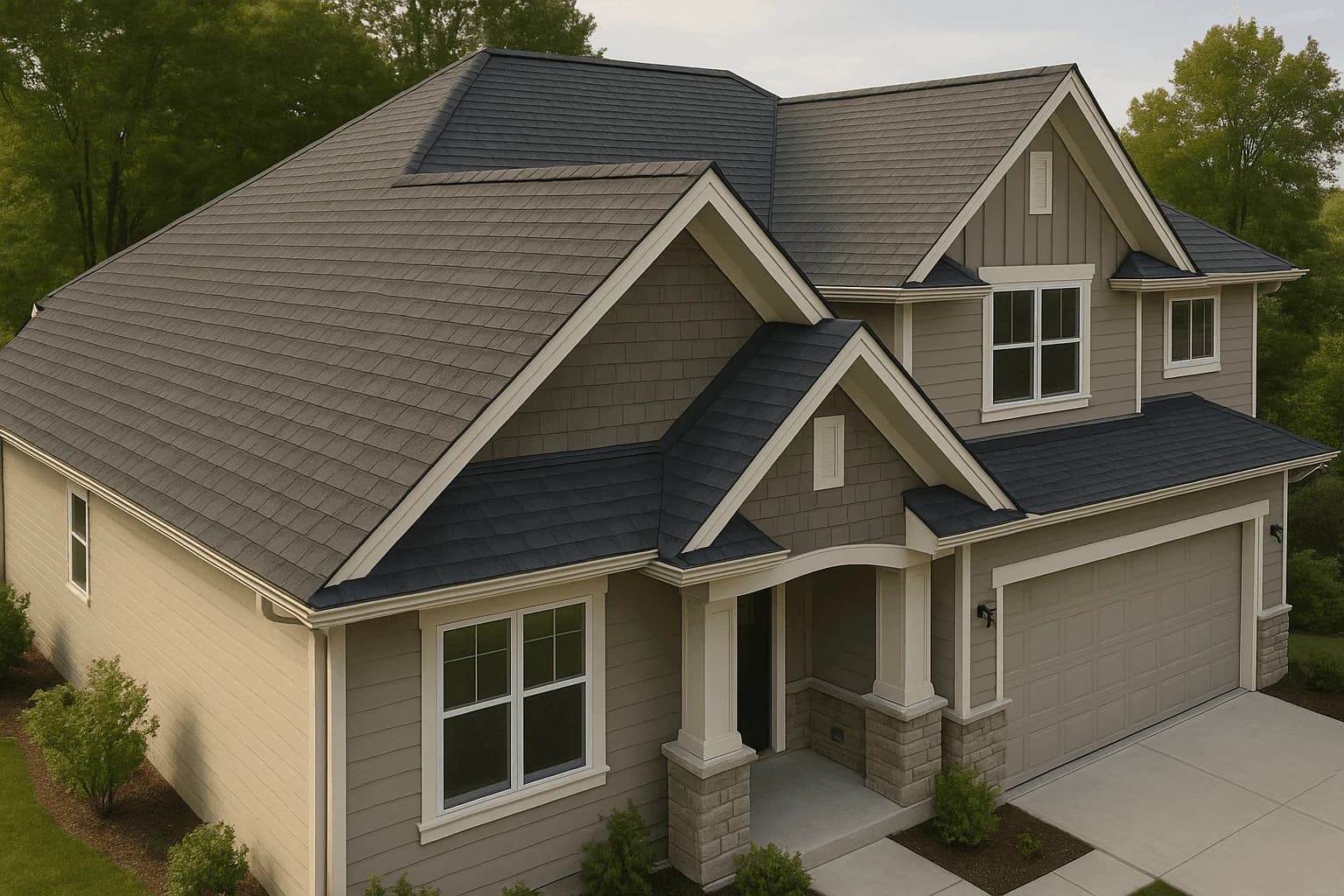
Why Massachusetts Changes the Metal vs Shingles Equation
The national metal vs shingles debate misses what matters most to Massachusetts homeowners: ice dams, nor'easters, coastal salt air, and some of the highest energy costs in the country. These Massachusetts-specific factors fundamentally shift the calculus in favor of standing seam metal roofing, making the 25-year total cost of ownership case even stronger than the national averages suggest.
Massachusetts homeowners face a unique combination of weather challenges that accelerate shingle degradation while barely affecting metal roofing. The state averages 80-100 freeze-thaw cycles per winter, each one working to break down the asphalt and granule bond on architectural shingles. Ice dams, which cost Massachusetts homeowners an average of $1,500-$4,000 per incident in interior water damage, are a recurring winter threat that standing seam metal virtually eliminates. And with average electricity rates of $0.31/kWh (the 3rd highest in the nation), the energy savings from reflective metal roofing compound faster here than in most other states.
This guide provides Massachusetts-specific cost data, a 25-year total cost of ownership analysis calibrated to MA conditions, and climate performance comparisons based on actual New England weather patterns. Whether you live in Boston, Worcester, the Cape, or the Berkshires, this is the data you need to make the right roofing investment.
Massachusetts-Specific Factors That Favor Metal
- 1.Ice dams: MA averages 4-8 ice dam events per winter; standing seam metal eliminates the damage cycle
- 2.Nor'easters: 3-5 significant storms per season with 60-90+ mph gusts; metal rated to 120-180 mph
- 3.High energy costs:$0.31/kWh electricity means metal's reflective savings add up faster
- 4.Short installation season:Metal's year-round installability avoids the spring/fall crush that inflates shingle labor costs
- 5.High home values: Median $595K means the 3-6% resale premium for metal = $17,850-$35,700
For a broader national comparison, see our Metal Roof vs Shingles 2026 guide.
Upfront Cost: Standing Seam vs Architectural Shingles in Massachusetts
Massachusetts roofing costs run 8-15% above national averages due to higher labor rates, the MA building code requirement for ice and water shield underlayment on the first 3 feet from eaves, and seasonal demand compression. Here is the current 2026 cost breakdown for a typical 1,800 square foot Massachusetts roof, including the impact of 2026 steel tariffs.
Standing Seam Metal (MA)
$11.00 - $18.50 per sqft installed
Architectural Shingles (MA)
$5.00 - $9.50 per sqft installed
2026 Tariff Impact on Massachusetts Metal Pricing
The 25%+ steel tariffs enacted in early 2026 have added approximately $1.75-$3.00 per square foot to standing seam metal roofing costs in Massachusetts (slightly above the national $1.50-$2.50 increase due to MA's already higher baseline). Asphalt shingles have seen only a 2-4% price increase. Despite the widened upfront gap, the 25-year TCO analysis below shows metal still wins on total cost. For the latest tariff-adjusted pricing, see our Metal Roof Cost Massachusetts guide.
Current Massachusetts Roofing Material Prices
These are real-time pricing ranges for all roofing materials in Massachusetts, updated from our contractor network. Use this data to benchmark any quotes you receive.
For a complete breakdown of Massachusetts roofing costs by material and region, see our Roof Replacement Cost Massachusetts guide.
Head-to-Head: Standing Seam vs Architectural Shingles for Massachusetts
This comparison table is calibrated to Massachusetts conditions, including MA-specific lifespans (which are shorter than rated due to harsh winters), local installation timelines, and state-specific warranty and code considerations.
| Factor | Standing Seam Metal | Architectural Shingles |
|---|---|---|
| Installed Cost (per sqft, MA) | $11.00 - $18.50 | $5.00 - $9.50 |
| Total for 1,800 sqft Roof | $19,800 - $33,300 | $9,000 - $17,100 |
| Realistic MA Lifespan | 40 - 60+ years | 18 - 25 years |
| Ice Dam Protection | Excellent; snow sheds naturally | Vulnerable; relies on underlayment |
| Snow Shedding | Self-clearing; reduces snow load | Snow accumulates; manual removal may be needed |
| Wind Resistance | 120 - 180 mph | 110 - 130 mph |
| Salt Air Resistance | Excellent (Galvalume/aluminum) | Good; granule loss accelerates near coast |
| MA Insurance Discount | 5-15% premium reduction | Standard rates; no discount |
| Energy Savings (MA rates) | 10-20% cooling; $200-$450/year at $0.31/kWh | Minimal; absorbs heat |
| Resale Value Added (MA) | 3-6% ($17,850-$35,700 on median) | Expected; no premium |
| Installation Timeline | 3-7 days; year-round capable | 1-3 days; limited below 40F |
| Warranty (Material) | 30-50 year paint; lifetime substrate | 25-50 year limited (prorated) |
| Maintenance in MA | Inspect every 2-3 years; minimal | Annual inspection; patch/repair every 5-8 years |
25-Year Total Cost of Ownership: The Massachusetts TCO Calculator
Upfront cost is only one variable. This 25-year TCO analysis accounts for Massachusetts-specific factors: re-roofing costs at MA labor rates, ice dam damage avoidance, MA electricity rates for energy savings, and actual insurance discounts available from MA insurers. We model a typical 1,800 square foot colonial-style home using mid-range pricing for both materials.
| Cost Category (25 Years) | Standing Seam Metal | Architectural Shingles |
|---|---|---|
| Initial installation (mid-range) | $26,500 | $13,000 |
| Re-roofing at year 20-23 (inflation-adjusted MA rates) | $0 (still has 20-40 years left) | $18,500 |
| Ice dam repair costs (avg 1.5 events/yr at $1,500-$4,000) | $0 | $3,000 - $6,000 |
| Maintenance and repairs over 25 years | $600 - $1,500 | $3,000 - $6,000 |
| Snow removal costs (professional roof raking) | $0 (self-shedding) | $500 - $2,500 |
| Energy savings (cooling at $0.31/kWh) | -$3,500 to -$8,000 | $0 |
| Insurance savings (10% avg on $1,800/yr premium) | -$4,500 | $0 |
| Estimated 25-Year Total Cost | $19,100 - $26,500 | $38,000 - $45,100 |
| 25-Year Savings with Metal | $11,500 - $18,600 | |
TCO Scenario: The Break-Even Point
For a typical Massachusetts home, the standing seam metal roof reaches cost parity with architectural shingles at approximately year 12-16. After that point, every additional year in the home saves money compared to the shingle alternative. The two largest drivers of this crossover are:
- Avoided re-roofing: At year 20-23, architectural shingles need full replacement at $18,500+ (inflation-adjusted MA rates). The metal roof still has 20-40 years of life remaining.
- Eliminated ice dam costs: Even 2-3 ice dam incidents over 25 years at $2,000-$4,000 each add $4,000-$12,000 in costs that metal homeowners never incur.
TCO Calculator Scenario: Worcester County Colonial
1,950 sqft roof, 8/12 pitch, 2 dormers, 1 chimney, 1 existing layer of 3-tab shingles
Option A: Standing Seam Metal
Option B: Architectural Shingles
Metal saves $28,150 over 25 years in this high-snow scenario. Even with conservative assumptions (2 ice dam events, lower energy savings), metal still saves $14,000-$18,000.
Massachusetts Climate Performance: How Each Material Handles MA Weather
Massachusetts throws nearly every weather challenge at your roof: heavy snow, ice dams, nor'easters, summer heat, coastal salt air, and frequent freeze-thaw cycling. Here is how standing seam metal and architectural shingles perform against each threat.
Ice Dams
Metal wins decisively. Standing seam's smooth, continuous surface allows snow to slide off before it can accumulate at the eaves and refreeze. The interlocking seams prevent water backup infiltration that damages interiors. Massachusetts homeowners with shingle roofs spend $1,500-$4,000 per ice dam event on interior water damage repairs. Metal roof owners report zero ice dam-related damage.
See our MA ice dam prevention guide for more detail.
Snow Load Management
Metal wins. MA building code requires roofs to handle 30-50+ PSF ground snow loads depending on municipality. Standing seam metal sheds snow naturally, reducing the effective load on the structure by 50-70%. Shingle roofs retain snow, occasionally requiring costly professional roof raking ($250-$500 per visit) to prevent structural stress. Snow guards on metal roofs control shedding over walkways and entryways.
Nor'easter Wind Resistance
Metal wins decisively. Massachusetts experiences 3-5 significant nor'easters per season with sustained winds of 40-60 mph and gusts to 80-100+ mph. Standing seam panels interlock mechanically and are rated for 120-180 mph. Architectural shingles rely on adhesive sealant strips that degrade with age; shingle blow-offs after nor'easters are the #1 storm damage claim in Massachusetts.
See our Nor'easter roof damage MA guide.
Salt Air Corrosion (Coastal MA)
Depends on material choice. For Cape Cod, the North Shore, South Shore, and the Islands, salt air accelerates corrosion on unprotected steel. However, modern Galvalume-coated steel with PVDF (Kynar) finishes handles coastal environments well for 30-40+ years. For homes within 1,500 feet of saltwater, aluminum standing seam is the premium choice with near-zero corrosion risk. Shingles experience accelerated granule loss from salt-laden wind but no structural corrosion.
See our Coastal wind zone roofing MA guide.
Freeze-Thaw Cycling
Metal wins. Massachusetts averages 80-100 freeze-thaw cycles per winter. Each cycle works to break down the asphalt-granule bond on shingles, causing premature granule loss and reducing effective lifespan. This is the primary reason MA shingles underperform their rated lifespan by 5-10 years. Standing seam metal is unaffected by freeze-thaw cycling: it has no granules to lose, no adhesive to degrade, and expands/contracts on its floating clip system without stress.
Summer Heat and Energy Efficiency
Metal wins. Massachusetts summers are hotter and more humid than many homeowners realize, with July averaging 82-90F. Reflective metal roofing (especially light colors or ENERGY STAR-rated coatings) reduces attic temperatures by 20-30F, translating to 10-20% savings on cooling costs. At Massachusetts's $0.31/kWh rate, that is $200-$450/year in electricity savings. Over 25 years, that compounds to $5,000-$11,250.
Massachusetts Insurance Discounts for Metal Roofing
Insurance premium discounts are one of the most overlooked financial benefits of metal roofing in Massachusetts. Because metal roofs virtually eliminate the two most common MA roofing claims (ice dam water damage and nor'easter wind damage), insurers offer meaningful ongoing discounts.
| MA Insurer | Metal Roof Discount | Requirements |
|---|---|---|
| Amica Mutual | 10-15% | Standing seam or metal shingle; Class A fire rated |
| MAPFRE | 8-12% | Documented installation; wind rating 110+ mph |
| Plymouth Rock | 8-15% | Standing seam preferred; includes coastal wind credit |
| Safety Insurance | 5-10% | Class A fire rating documentation required |
| Norfolk & Dedham | 5-10% | New roof credit plus material upgrade credit |
25-Year Insurance Savings Estimate
The average Massachusetts homeowners insurance premium is approximately $1,800/year. A 10% metal roof discount saves $180 annually, or $4,500 over 25 years. For coastal communities (Cape Cod, Gloucester, Scituate, Hull) where premiums run $2,200-$3,000+/year, a 12-15% discount saves $6,600-$11,250 over 25 years. Contact your insurer before installation and request documentation requirements so you can provide the correct specifications for maximum credit.
For more on insurance benefits, see our Metal Roof Insurance Discounts guide.
Energy Efficiency: Why Metal Saves More in Massachusetts
Massachusetts has the 3rd highest electricity rates in the continental United States at $0.31/kWh (2026 average). This means every percentage point of cooling efficiency saved by reflective metal roofing is worth significantly more here than in states with cheaper power. Even Massachusetts's moderate summer cooling season (June through September) generates meaningful savings at these rates.
Annual Energy Savings (Metal vs Shingles)
Tax Credits and Rebates (MA)
Federal 25C Tax Credit: ENERGY STAR-certified metal roofing qualifies for up to $500 in federal tax credits under the Inflation Reduction Act provisions still active in 2026.
Mass Save: While Mass Save does not directly cover roofing materials, their insulation rebates ($0.75-$1.50/sqft) pair perfectly with a metal roof installation to maximize energy efficiency. See our Mass Save Roofing guide.
Solar readiness: Standing seam metal is the ideal substrate for solar panels (clamp-on mounting, no penetrations), potentially qualifying for additional solar incentives.
Curb Appeal and Resale Value in Massachusetts
Massachusetts has a diverse housing stock: Colonials, Cape Cods, Victorians, triple-deckers, and modern construction. Standing seam metal complements all of these styles, though the aesthetic fit varies. Here is how each material affects curb appeal and resale value in the Massachusetts real estate market.
Standing Seam Metal: Resale Impact
- +Adds 3-6% to resale value ($17,850-$35,700 on MA median)
- +Listed as a selling feature by MA real estate agents, alongside updated kitchens and HVAC
- +Buyers in snow-heavy areas (Worcester, Berkshires) specifically seek ice dam-resistant roofing
- +Coastal buyers (Cape Cod, North Shore) value storm resistance
- ~Historic districts may require specific profiles/colors; check local historic commission
Architectural Shingles: Resale Impact
- ~Expected by buyers; does not add premium above baseline
- ~Universally accepted aesthetic; no historic commission concerns
- -Aging shingles (10+ years) can actually reduce offers; buyers negotiate roof replacement into price
- -No “selling feature” value; considered standard maintenance
For more on how roofing affects Massachusetts home sales, see our Roof Replacement Before Selling Home Massachusetts guide.
Installation Timeline and Process in Massachusetts
The Massachusetts roofing installation season is compressed by weather: the ideal window is April through November, with peak demand (and highest labor pricing) from May through October. One advantage of standing seam metal is year-round installation capability, since metal installation does not depend on adhesive activation temperatures.
Standing Seam Metal Timeline
Winter advantage: Metal can be installed in temperatures below 40F since it does not rely on adhesive sealant activation. Off-season installation (December-March) often comes with 5-10% lower labor rates.
Architectural Shingle Timeline
Winter limitation: Shingle adhesive strips require temperatures above 40F to seal properly. Installation below this threshold risks wind uplift failures. Winter installation is possible but manufacturers recommend hand-sealing each shingle (adds labor cost).
For details on winter roofing in Massachusetts, see our Winter Roof Replacement Massachusetts guide.
Warranty Comparison: What Massachusetts Homeowners Actually Get
Warranty terms sound impressive on paper but vary significantly in real-world coverage. Here is what Massachusetts homeowners can actually expect from manufacturer and workmanship warranties for each material.
| Warranty Aspect | Standing Seam Metal | Architectural Shingles |
|---|---|---|
| Material/Substrate | Lifetime (40-year non-prorated typical) | 25-50 year limited (prorated after 10-15 years) |
| Paint/Finish | 30-40 year fade/chalk warranty (PVDF/Kynar) | 10-year algae resistance (select premium lines) |
| Wind Coverage | 120-180 mph; no special requirements | 110-130 mph; requires all starter strips and specific nailing patterns |
| Transferability | Most transfer to second owner (some with reduced terms) | Usually transfers but drops to prorated coverage |
| Workmanship (contractor) | 5-15 years typical for certified installers | 5-25 years (GAF Golden Pledge, CertainTeed 5-Star) |
The Fine Print That Matters in Massachusetts
Many shingle warranty claims are denied due to “improper ventilation” or “acts of nature” exclusions. In Massachusetts, where ice dam damage is the #1 warranty inquiry, manufacturers routinely classify ice dam damage as an “act of nature” not covered by warranty. This means the very problem that most affects Massachusetts shingle roofs is explicitly excluded from coverage. Standing seam metal warranties do not have this issue because metal roofs are functionally immune to ice dam damage.
Always verify warranty terms with your contractor and request written documentation of all coverage details before signing a contract.
Maintenance Requirements in Massachusetts
Massachusetts weather demands more roof maintenance than most states. The combination of ice, snow, wind-driven rain, and summer humidity creates ongoing wear that differs significantly between the two materials.
Standing Seam Metal: MA Maintenance
- +Inspect every 2-3 years (check sealant at penetrations, ensure snow guards intact)
- +Clean debris from valleys annually (especially leaf-heavy lots)
- +No granule loss, no moss/algae growth, no shingle blow-off repairs
- +Estimated 25-year maintenance cost: $600-$1,500
Architectural Shingles: MA Maintenance
- -Annual inspection required (check for blow-offs, granule loss, flashing separation)
- -Patch repairs every 5-8 years for blown or cracked shingles ($300-$800 each)
- -Moss and algae treatment in shaded areas ($200-$500 every 3-5 years)
- -Estimated 25-year maintenance cost: $3,000-$6,000
Compare Metal and Shingle Quotes from MA Contractors
Get instant satellite-based estimates for both standing seam metal and architectural shingle options from pre-vetted Massachusetts contractors.
Free estimates. No spam. No selling your info.
Regional Recommendations by Massachusetts Area
Massachusetts is not monolithic: coastal, suburban, and inland areas face different climate pressures that influence the optimal roofing choice. Here are area-specific recommendations.
Greater Boston / Metro West
Recommendation: Standing seam metal
High home values ($700K+ median), significant ice dam risk, nor'easter exposure, and competitive contractor market make metal the clear ROI winner. The 3-6% resale premium on these home values often exceeds the upfront cost difference alone.
Cape Cod and the Islands
Recommendation: Aluminum standing seam
Salt air exposure makes aluminum the premium choice over Galvalume steel. Extreme wind exposure from nor'easters makes metal's 120-180 mph rating critical. Historic district restrictions may require specific profiles; metal shingle panels are the workaround for historic commissions.
Worcester County / Central MA
Recommendation: Standing seam metal (strongest case)
The highest snow loads in eastern Massachusetts (40-50+ PSF), severe ice dam risk, and cold temperatures that accelerate shingle degradation. The TCO advantage of metal is largest in this region. Lower home values ($400-$500K) mean the upfront gap is more noticeable, but the 25-year savings offset it completely.
North Shore and South Shore
Recommendation: Standing seam metal (Galvalume or aluminum)
Coastal wind exposure combined with moderate salt air creates a dual threat that favors metal. Galvalume-coated steel works well for most Shore communities; switch to aluminum for oceanfront properties within 1,500 feet of the water.
Western MA / Berkshires
Recommendation: Standing seam metal
The heaviest snow loads in the state (50-70+ PSF), extended winters, and limited contractor availability make metal's low maintenance and self-shedding snow properties especially valuable. Metal's year-round installation capability helps with the compressed season.
Southeast MA / Bristol County
Recommendation: Metal (moderate advantage)
Moderate snow loads, some coastal exposure, and lower home values ($380-$450K) make this a closer call. Metal still wins on 25-year TCO, but architectural shingles are a reasonable budget-conscious alternative for homeowners planning to sell within 10 years.
Frequently Asked Questions: Standing Seam vs Shingles in Massachusetts
How much does a standing seam metal roof cost in Massachusetts compared to architectural shingles?
Does a standing seam metal roof prevent ice dams in Massachusetts?
What insurance discounts do Massachusetts homeowners get for metal roofing?
Is a standing seam metal roof worth the extra cost for Massachusetts homes over 25 years?
How do standing seam metal roofs handle Massachusetts nor'easters and coastal salt air?
How long does a standing seam metal roof last in Massachusetts compared to architectural shingles?
Does a standing seam metal roof increase home resale value in Massachusetts?
Ready to Compare Metal and Shingle Quotes in Massachusetts?
Enter your address below to get instant satellite-based roof replacement estimates from pre-vetted Massachusetts contractors. Compare quotes for both standing seam metal and architectural shingle options with standardized scopes of work.
Serving all Massachusetts communities from Boston to the Berkshires, Cape Cod to the North Shore.
Free estimates. No spam. No selling your info.
Related Massachusetts Roofing Resources
Metal Roof vs Shingles 2026
National comparison with 2026 tariff impact analysis across all 12 RoofVista states.
Metal Roof Cost Massachusetts
Detailed metal roofing pricing for Massachusetts including all panel types and finishes.
Roof Replacement Cost Massachusetts
Complete Massachusetts roof replacement cost guide for all materials and home types.
Metal Roof Insurance Discounts
How metal roofing reduces insurance premiums state by state, including Massachusetts-specific discounts.
Best Roofing Materials Massachusetts
Complete guide to all roofing material options for Massachusetts homes and climates.
Ice Dam Prevention Massachusetts
Prevention strategies and repair options for Massachusetts ice dam problems.