In This Guide
1. Total Project Timeline: Contract to Completion
Most NJ homeowners are surprised to learn that the actual on-site work is only 20 to 40 percent of the total project timeline. The remaining 60 to 80 percent is consumed by contract negotiation, permit pull, material delivery, and contractor scheduling. Understanding the full timeline helps set realistic expectations and avoid the most common scheduling mistakes.
| Phase | Typical Duration | Key Variables |
|---|---|---|
| Contractor selection & quoting | 1–3 weeks | Number of quotes, contractor availability |
| Contract negotiation & signing | 3–7 days | Material selection, payment terms, scope |
| Permit application & approval | 3–14 days | Municipality, season, application completeness |
| Material delivery | 1–3 weeks (asphalt) / 4–8 weeks (specialty) | Color, brand, supply chain |
| Contractor scheduling backlog | 2–6 weeks (peak season) | April-Oct peak; Nov-Mar lighter |
| On-site work | 2–5 days | Roof size, complexity, weather |
| Final inspection | 3–10 days | Municipal scheduling availability |
| TOTAL (typical NJ) | 3–8 weeks | Median: 4-5 weeks |
The two phases that most often produce schedule overruns are permit pull (when contractors submit incomplete applications, leading to back-and-forth) and material delivery for non-standard colors or brands (special-order shingle colors can extend lead times to 6+ weeks even when the manufacturer normally stocks the product).
2. NJ Permit Timelines by County
Permit approval timing in NJ varies dramatically by municipality. The following groupings reflect typical 2025-2026 turnaround for residential roofing permit applications submitted by HIC-registered contractors with complete documentation.
Fast (1 to 5 business days, often same-day)
Most of Sussex, Hunterdon, Warren, Salem, Cumberland counties. Many smaller boroughs in Morris, Somerset, Bergen, and Monmouth. These municipalities often have over-the-counter approval for HIC-registered contractor submissions and online portals for electronic filing.
Moderate (5 to 14 business days)
Most of Bergen, Monmouth, Ocean, Middlesex, Mercer, Burlington, Camden, Gloucester, Atlantic, Cape May counties. Larger boroughs and townships with established review processes. Most use electronic submission systems but require formal review of contractor licensing and insurance documentation.
Slower (10 to 30 business days)
Newark, Jersey City, Hoboken, Paterson, Elizabeth, Trenton, Atlantic City, and other large NJ cities. Staffing constraints, dense permit volume, and inspection scheduling backlogs extend turnaround. Some require additional documentation for properties in historic districts or coastal flood zones.
Permit fees by county: Most NJ municipal roofing permit fees are calculated as a base fee ($50 to $150) plus a percentage of declared project value (typically 0.5 to 2 percent). Total fees for a typical $14,000 NJ residential roof replacement run $150 to $500. Some municipalities apply additional administrative fees, plan review fees for properties in historic districts, or zoning review fees for modifications to roof pitch or dormers.
Practical tip: Pull permits at least 2 weeks before the desired start date. NJ contractors who insist on starting work before the permit is issued are putting the homeowner at risk for code violation fines, insurance claim denial, and resale disclosure liabilities. The small time savings is never worth the risk.
3. On-Site Work Duration: 2 vs. 5 Day Jobs
The actual on-site work duration depends on roof size, complexity, material, crew size, and weather. The breakdown below reflects realistic durations for experienced NJ residential roofing crews.
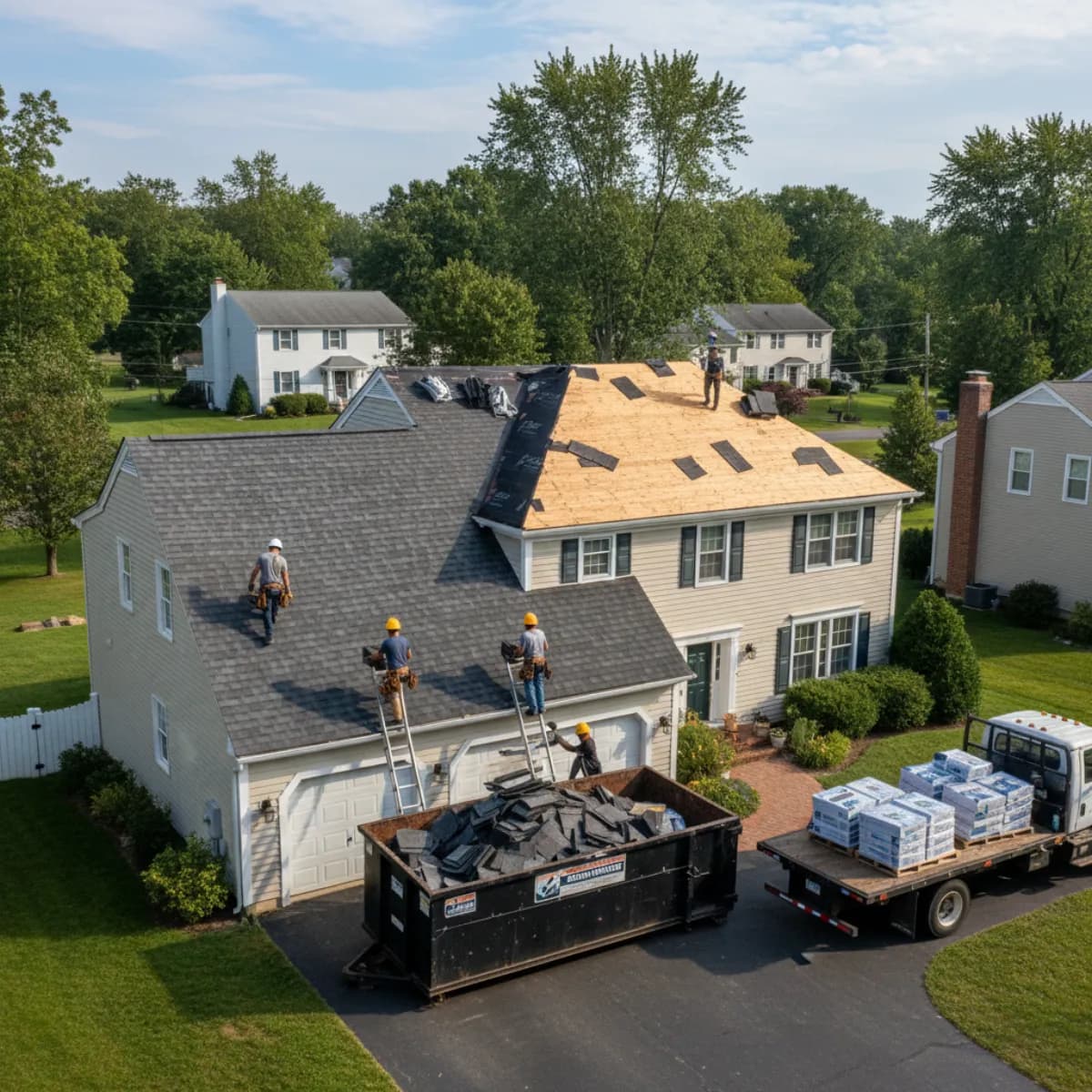
1-day jobs (15 to 22 squares): Single-story ranch or smaller Cape Cod homes with simple gable roofs, no chimneys or skylights, architectural asphalt shingles, 6 to 8-person crews, favorable weather. Common in Cherry Hill, Toms River, Brick, Edison, and many Central Jersey suburbs.
2-day jobs (22 to 30 squares): Two-story colonials, splits, or larger Capes with moderate complexity (one chimney, one or two skylights, multiple slopes), architectural asphalt, 5 to 7-person crews. The single most common NJ residential project. Day 1: tear-off, deck prep, ice and water shield, underlayment, drip edge. Day 2: shingle installation, ridge venting, flashing details, cleanup.
3-4 day jobs (30 to 45 squares): Larger colonials, Tudors, custom homes with multiple gables, dormers, two or more chimneys, complex flashing. Architectural or premium asphalt shingles. Common in Bergen, Morris, Essex (Montclair, Maplewood, South Orange), Union (Summit, Westfield, Cranford), and Monmouth (Rumson, Fair Haven, Holmdel) counties.
5-10 day jobs (45+ squares or premium materials): Large Victorians (3-story with turrets, multiple roof planes), slate replacements, cedar shake replacements, copper standing seam, or projects with extensive deck repair. The slow phases are deck repair (often discovered only after tear-off) and the slower per-square installation rate of premium materials (slate installs at roughly 1 square per crew-day vs. 4 to 6 squares per crew-day for asphalt).
What turns a 2-day job into a 5-day job: Discovered deck rot requiring replacement (1 to 3 days delay); weather delays (rain, high wind); crew under-staffing (sometimes a sign of contractor cash flow problems); permit re-inspection failures requiring rework; material delivery shortfalls requiring waiting for additional shipment.
4. NJ Weather Windows & Best Months
NJ weather creates four distinct seasonal patterns that affect roofing work scheduling and quality.
Spring (April to mid-June): Optimal window for NJ roofing. Average highs 55 to 80 degrees; relatively low precipitation (3 to 4 inches per month); long daylight hours; lower contractor pricing than midsummer; best contractor availability. Watch for: occasional late-season nor easter wind events through April; late-spring thunderstorms beginning mid-May; pollen and spring tree-bloom debris.
Summer (mid-June to August): Workable but premium-priced. Highs 80 to 95 degrees with humidity reaching 70 to 90 percent; afternoon thunderstorms common; peak contractor demand (4 to 8 week lead times); 5 to 15 percent pricing premium vs. spring. Experienced NJ contractors structure the workday to start at 6 to 7 am and complete tear-off and underlayment by mid-afternoon, before thunderstorm risk peaks. Heat is a real safety concern for crews; quality contractors limit work above 95 degrees.
Fall (September to mid-November): Second-best NJ window. Average highs 55 to 80 degrees in September dropping to 40 to 60 degrees by mid-November; lower humidity than summer; reduced thunderstorm risk; falling leaves create cleanup issues in tree-heavy North and Central NJ. October roof projects in Bergen, Morris, Essex, and Union counties typically require pre-project tree limb trimming and aggressive cleanup of leaves that fall during the project.
Winter (mid-November to March): Avoid except for emergency replacements. Temperatures below 40 degrees compromise asphalt sealant bonding (manufacturers specify 50+ degrees for proper sealant activation; sealant applied below 40 degrees may take 4 to 8 weeks of warm sun to fully bond, leaving a wind-vulnerability window). Snow and ice make roof work hazardous and can hide deck damage. Coastal NJ adds nor easter risk October through April. Some NJ contractors offer winter discounts (10 to 20 percent off) but the trade-off in install quality is rarely worth it for a 25+ year investment.
5. Material Lead Times by Type
Material delivery lead times are often the binding constraint on NJ roofing project schedules, particularly for non-standard colors and premium materials. The following lead times reflect typical 2025-2026 NJ supply chain conditions.
| Material | Typical Lead Time | Notes |
|---|---|---|
| Architectural asphalt (popular colors) | 3–10 days | GAF, Owens Corning, CertainTeed standard |
| Architectural asphalt (specialty colors) | 2–6 weeks | Less popular SKUs, custom blends |
| Premium / designer asphalt | 2–5 weeks | GAF Glenwood, Owens Corning Berkshire, CertainTeed Presidential |
| Aluminum standing seam | 3–8 weeks | Custom-painted; longer for unusual colors |
| Synthetic slate / shake | 3–6 weeks | DaVinci, Brava direct from manufacturer |
| Natural slate | 6–16 weeks | Vermont, Pennsylvania quarries; color matching |
| Cedar shake (Western Red Cedar) | 4–10 weeks | Pacific Northwest mills; grade-dependent |
| Copper standing seam | 8–16 weeks | Custom fabrication required |
| EPDM / TPO membrane (flat) | 5–14 days | Standard widths typically in stock |
For projects where speed is critical (sale closing, expired insurance carrier requirement), restrict material selection to widely-stocked colors of widely-stocked architectural asphalt (Weathered Wood, Charcoal, Pewter Gray, Driftwood). Custom colors and premium materials should be ordered 4 to 8 weeks before the desired start date.
6. Scheduling Around Sales, Moves & Closings
Roof replacement timing relative to a home sale, purchase, or move can save or cost thousands. Three common scenarios with proven scheduling strategies.
Replacing before a sale: Work backwards from the closing date. Allow 8 to 12 weeks total: 2 to 4 weeks for contractor selection and contract negotiation, 1 to 2 weeks for permit pull, 1 to 4 weeks for material delivery, 2 to 5 days for actual installation, and 1 to 2 weeks buffer for weather and final inspection. The replacement should be complete 2 to 4 weeks before listing the property to allow time for landscaping cleanup and listing photos showing the new roof. New-roof listings typically receive offers 7 to 14 days faster than otherwise-equivalent properties with aging roofs.
Replacing during the sale process (after offer accepted): Use the inspection contingency period to negotiate seller-funded replacement. Most NJ purchase contracts provide 10 to 17 days for inspection and negotiation; this is typically too short to complete the replacement before closing. Two structures: (1) seller credit at closing (buyer takes responsibility for replacement; common in NJ); or (2) seller completes replacement before closing with closing date extended 4 to 6 weeks. Buyer should require permitted work and a passed final inspection prior to closing.
Replacing after move-in: Best window is 60 to 120 days after move-in. The first 30 days are typically dominated by unpacking, settling in, and addressing immediate fix items. Schedule replacement during the first favorable seasonal window after move-in. Avoid scheduling during the move-in week itself; the disruption from material delivery, debris, ladders, and crew traffic compounds the move-in stress.
Insurance-driven scheduling: If your NJ insurance carrier has issued non-renewal notice for an aging roof, you typically have 60 days to replace and provide proof to maintain coverage. Begin contractor selection within 7 days of receiving the notice. Choose architectural asphalt in a widely-stocked color to minimize material lead time. Communicate the deadline to your contractor; quality contractors will work to meet a documented insurance deadline.
Get Your NJ Roof Estimate & Project Timeline
Enter your NJ address for satellite-measured pricing and a realistic project timeline based on your municipality permit data, current contractor availability, and material lead times.
NJ Roof Replacement Timeline FAQ
How long does a roof replacement take in New Jersey?
For a typical 2,000 to 2,500 square foot single-family NJ home with a moderately complex roof (multiple slopes, one or two skylights, a chimney), the actual on-site work for a tear-off and architectural shingle replacement takes 2 to 5 working days. Single-day completions are achievable on simple ranch-style or smaller Cape Cod roofs (20 squares or less) with experienced 5 to 7-person crews. Three-story Victorians, slate or cedar shake replacements, and homes with steep pitches or extensive flashing details can take 5 to 10 days. The total project timeline from signed contract to completion is typically 3 to 8 weeks in NJ, dominated by permit approval (3 to 14 days), material delivery (1 to 3 weeks for standard architectural; 4 to 8 weeks for slate, copper, or specialty colors), and contractor scheduling backlog (2 to 6 weeks during peak NJ season of April through October).
How long does a NJ roofing permit take to approve?
NJ municipal roofing permit approval timelines vary widely by county and municipality. Faster jurisdictions (most of Sussex, Hunterdon, Warren, Salem, Cumberland counties; many Morris and Somerset boroughs): 1 to 5 business days, often same-day for over-the-counter applications submitted by HIC-registered contractors. Moderate jurisdictions (most of Bergen, Monmouth, Ocean, Middlesex, Mercer, Burlington, Camden, Gloucester, Atlantic, Cape May counties): 5 to 14 business days, with electronic submission systems used in most municipalities. Slower jurisdictions (Newark, Jersey City, Hoboken, Paterson, Elizabeth, Trenton, Atlantic City, and other large NJ cities): 10 to 30 business days due to staffing constraints and inspection scheduling backlogs. Plan to pull permit at least 2 weeks before desired construction start to avoid project delay; contractors who skip the permit step expose homeowners to insurance claim denial and resale-disclosure liabilities.
What is the best month to replace a roof in New Jersey?
The optimal NJ roofing months are April through June and September through early November. These windows offer four advantages: ambient temperatures of 50 to 80 degrees that allow asphalt shingle sealant to bond properly within 2 to 4 weeks of installation; lower precipitation than midsummer afternoon thunderstorms; lower contractor pricing than peak summer months (5 to 15 percent below July to August rates); and best contractor availability with lead times of 2 to 4 weeks vs. 4 to 8 weeks during peak. Avoid December through February except for emergency replacements; cold-weather installs use modified asphalt sealant that takes 4 to 8 weeks of warm sun to fully bond, leaving a wind-vulnerability window. July and August are workable but premium-priced, with crews working extended hours to keep up with demand and a higher rate of weather-induced delays.
How does NJ weather affect roof replacement scheduling?
NJ weather creates four distinct scheduling constraints. Spring (March-April) precipitation: NJ averages 4 to 5 inches of rainfall per month in early spring; rain delays of 1 to 3 days are common on multi-day projects. Summer thunderstorms: late June through August brings frequent afternoon thunderstorms; experienced NJ contractors structure the workday to complete tear-off and water-tight underlayment by mid-afternoon. Fall foliage: October roof projects in tree-heavy North and Central NJ require pre-project tree limb trimming and aggressive cleanup of leaves that fall during the project. Winter cold: December through February temperatures below 40 degrees compromise asphalt sealant bonding; reputable NJ contractors avoid these months for tear-off projects except for true emergencies. Coastal NJ adds the additional constraint of nor easter activity from October through April; wind events can blow off newly installed shingles before sealant bonds, and most NJ shore contractors decline work during forecast nor easter periods.
Can a NJ roof replacement be completed in one day?
Yes for smaller, simpler roofs with experienced crews. Single-day completion is realistic for: ranch-style homes under 2,000 square feet with simple gable roofs (15 to 20 squares total); architectural asphalt shingle installations (the fastest material to install); experienced 6 to 8-person crews with dedicated tear-off, deck-prep, and shingle-install roles; favorable weather (no rain forecast, ambient temperature 50 to 75 degrees); and pre-staged materials delivered the night before. For larger homes (2,500+ sq ft, 25+ squares), multiple slopes, dormers, skylights, or premium materials, single-day completion is typically not realistic and should be considered a warning sign that the contractor is rushing or has under-staffed the project. Quality NJ residential roofing typically requires 2 to 4 working days for the median home; longer for slate, cedar, or complex Victorian-era rooflines.
What permits and inspections are required for NJ roof replacement?
NJ Uniform Construction Code (UCC) requires a building permit for any roof replacement that exceeds minor repair scope (roughly 10 percent of roof area or 100 square feet, whichever is less). The permit application is filed with the municipal Construction Office and typically requires: contractor name and HIC registration number; property address and owner contact; project description including material specifications and tear-off vs. overlay scope; declared project value (used to calculate fees); and sometimes a sketch of the roof with dimensions. Most NJ municipalities issue permits within 3 to 14 calendar days. Inspections required: a final inspection at project completion (mandatory in all NJ municipalities) verifies code compliance, ridge venting, flashing details, and overall workmanship; a mid-project inspection after tear-off but before re-roofing (required in many municipalities, particularly for tear-off jobs) verifies deck condition and ice and water shield placement.
How do I schedule a NJ roof replacement around a sale or move-in?
For sale-related roof replacement, work backwards from the closing date. Allow 8 to 12 weeks total: 2 to 4 weeks for contractor selection and contract negotiation, 1 to 2 weeks for permit pull, 1 to 4 weeks for material delivery, 2 to 5 days for actual installation, and 1 to 2 weeks buffer for weather and final inspection. Coordinate the inspection contingency in the purchase contract to allow for completion before closing. For move-in scenarios, schedule replacement either before move-in (cleanest, no resident disruption) or 60+ days after move-in (allows time to settle in and address other priorities). Avoid scheduling during the move-in week itself; the disruption from material delivery, debris, ladders, and crew traffic compounds the move-in stress. Most NJ contractors will work with realistic deadlines but should be told upfront about hard date constraints; tight schedules sometimes carry a 5 to 15 percent rush premium.