Key Takeaways
- •Newton re-roofs run $22,400–$68,800 in 2026, the highest MA suburb range. Natural slate can reach $80K+ on large Chestnut Hill estates.
- •13 distinct villages, each with different housing stock and pricing. Chestnut Hill / Waban skew premium; Newton Highlands / Oak Hill skew value.
- •Synthetic slate at $14–$20/sqft is the pragmatic Victorian choice, half the weight and half the cost of natural slate.
- •MA opt-in stretch code adds $800–$2,500 for solar-ready provisions, air-sealing, and ventilation on most re-roofs.
- •Copper flashing adds $3,000–$12,000 but lasts 75–100 years. Standard spec on premium Newton homes.
In This Guide
2026 Newton Roof Replacement Cost Overview
Newton sits at the premium end of the Massachusetts roofing market in 2026. Typical projects land between $22,400 and $68,800, with heritage Chestnut Hill and Waban slate re-roofs regularly exceeding $80,000. For comparison, the MA statewide baseline is $12,000 to $36,000. Newton's premium reflects three underlying factors: high median home value (approximately $1.4M), a material mix that skews heavily toward slate, synthetic slate, standing seam, and copper flashing, and 13 geographically distributed villages that add scheduling and coordination overhead.
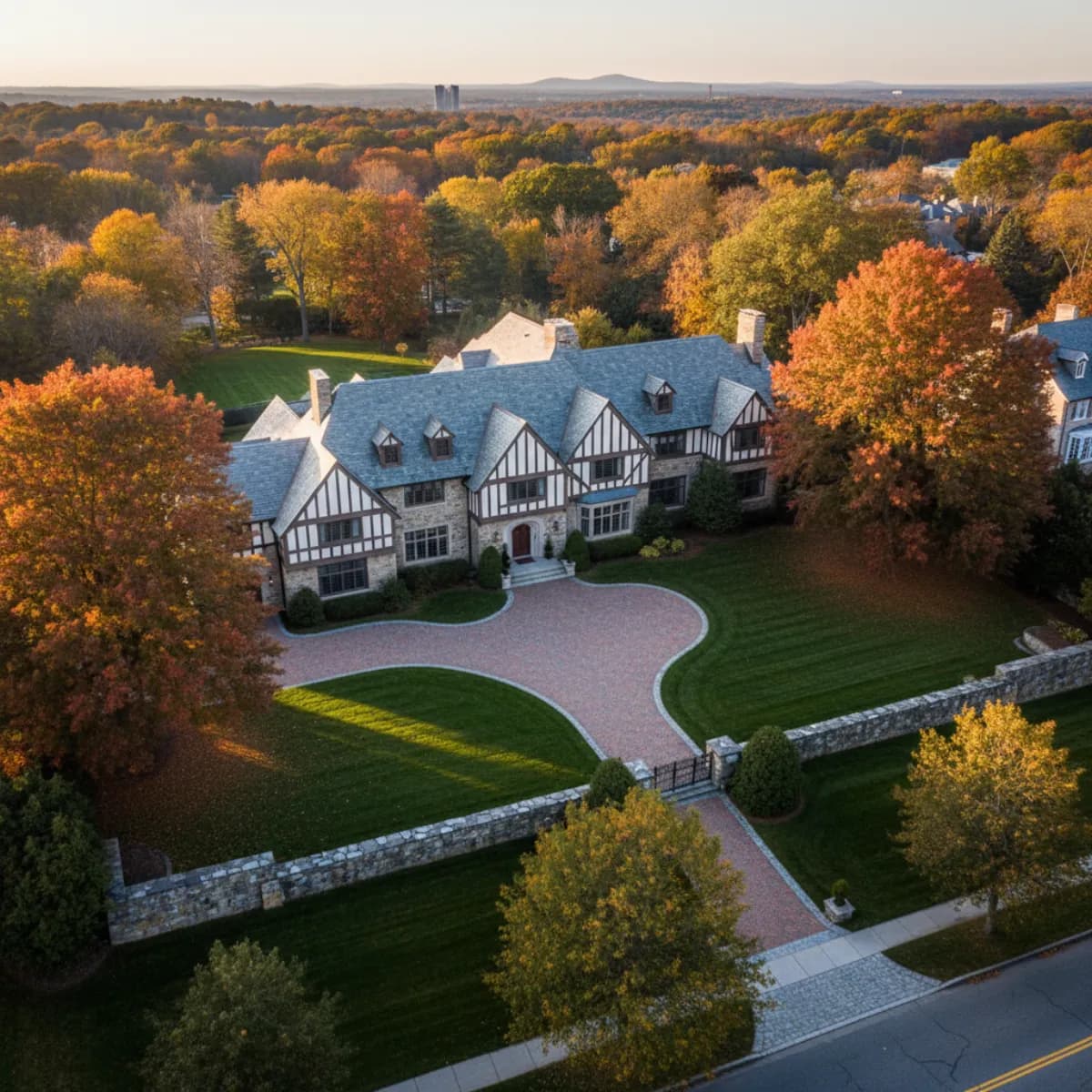
The Newton housing stock is unusual. A large share of homes were built before 1940, with Tudor Revivals, Shingle-Style Victorians, Colonial Revivals, and Craftsman bungalows common across Newton Centre, Auburndale, West Newton, Chestnut Hill, and Waban. Newton Highlands, Oak Hill, Nonantum, and Thompsonville skew newer and more modest. A typical Newton Centre 3,000 sqft Colonial with natural-slate-original roof can easily land a $65,000+ replacement quote if restoring the original material; the same home re-roofed in architectural asphalt lands at $30,000.
Typical 2026 Newton Project Costs by Material Tier
| Home Size | Architectural Asphalt | Synthetic Slate | Natural Vermont Slate |
|---|---|---|---|
| 1,800 sqft (small Colonial) | $17,200–$24,200 | $28,200–$40,300 | $44,300–$76,600 |
| 2,500 sqft (typical Newton) | $23,800–$33,600 | $39,200–$56,000 | $61,600–$106,400 |
| 3,500 sqft (large Tudor Revival) | $33,300–$47,000 | $54,900–$78,400 | $86,200–$148,900 |
| 5,000 sqft (Chestnut Hill estate) | $47,600–$67,200 | $78,400–$112,000 | $123,200–$212,800 |
Figures include Newton ISD permits, stretch-code compliance, tear-off, and standard flashing. Copper flashing and Commission-reviewed heritage properties are add-ons. Source baseline: roofvista.com MA roofing_pricing data, Angi 2026 Boston western-suburb metrics, HomeAdvisor Newton area.
Why Newton Is Different From the Rest of MA
A $18,000 Natick re-roof and a $32,000 Newton Centre re-roof on identical 2,500 sqft Colonials use similar labor hours but produce very different numbers. The four drivers:
1. Premium Material Mix
Newton's architectural heritage pushes roughly a third of re-roof projects toward slate, synthetic slate, or standing seam rather than asphalt. Neighboring suburbs like Wellesley and Needham also have premium stock, but Newton goes further: a typical Chestnut Hill re-roof is specified with natural Vermont slate, 16-oz copper flashing, and hand-rolled copper gutters. That spec naturally produces $60,000 to $120,000 quotes where a tract-subdivision asphalt quote would be $15,000 to $20,000.
2. Structural Engineering Requirements
Natural slate weighs 800 to 1,200 pounds per 100 sqft of roof area. Any re-roof transitioning to slate (or re-installing slate on a structure that has been stripped) requires structural verification by a licensed engineer and sometimes truss or rafter reinforcement. Typical cost: $800 to $2,500 for engineering plus $1,500 to $5,000 for reinforcement. This is uncommon in asphalt-suburb markets but routine in Newton.
3. Massachusetts Opt-In Stretch Code
Newton adopted the MA opt-in stretch code, which is more stringent than the base state energy code. For a re-roof-only project, the stretch code mainly adds solar-ready provisions (unshaded south-facing area, conduit pathway, electrical panel capacity), enhanced continuous air-sealing at roof-to-wall transitions, and more stringent ventilation calculations. Practical cost impact: $800 to $2,500 on a typical Newton re-roof. Bundling solar, attic insulation, or an addition expands the stretch-code scope significantly.
4. 13-Village Distributed Scheduling
Newton's 13 villages are spread across roughly 18 square miles with varying drive-times from any contractor staging yard. Scheduling crews across Chestnut Hill, Newton Lower Falls, Auburndale, and Oak Hill on a single week adds coordination overhead that shows up as a 3 to 5 percent premium in quoted labor. Specialist slate and copper crews are fewer than general asphalt crews, which further concentrates scheduling across the Newton village geography.
Cost Breakdown by Material (Newton Market)
The table below shows an itemized breakdown for a typical 3,000 sqft Newton Centre Colonial by material tier. Totals include labor, materials, tear-off, disposal, ISD permit, and dumpster. Structural engineering is only required for natural slate.
| Line Item | Architectural Asphalt | Synthetic Slate | Natural Slate + Copper |
|---|---|---|---|
| Labor (install) | $9,600–$12,000 | $15,000–$19,200 | $24,000–$33,000 |
| Materials (shingles/slate, underlayment) | $7,200–$9,600 | $16,800–$23,400 | $30,600–$51,000 |
| Tear-off of existing roof | $2,700–$3,600 | $2,700–$3,600 | $3,600–$4,800 |
| Disposal (haul + tipping) | $1,800–$2,400 | $1,800–$2,400 | $2,700–$3,600 |
| Copper flashing + valleys | N/A (aluminum) | $1,500–$3,500 | $5,500–$10,000 |
| Structural engineering + reinforcement | N/A | N/A (half weight) | $2,300–$7,500 |
| Newton ISD permit + stretch code | $300–$750 | $300–$750 | $400–$900 |
| Dumpster | $650–$900 | $650–$900 | $850–$1,200 |
| Project Total (3,000 sqft) | $22,250–$29,250 | $38,750–$53,750 | $69,950–$112,000 |
Figures include Newton ISD permits and MA stretch-code compliance. Structural engineering only applies to natural slate transitions. Source: roofvista.com MA roofing_pricing data, Angi 2026 Boston western-suburb averages, HomeAdvisor Newton area.
Architectural Asphalt — $8.50 to $12 per sqft
Premium architectural asphalt from GAF Timberline HDZ Premium, CertainTeed Presidential, and Owens Corning TruDefinition Duration is common on Newton homes that prioritize budget over authenticity. Class A fire-rated, 30-year to limited-lifetime warranties, aluminum flashing standard. Typical 3,000 sqft Newton total: $22,250 to $29,250. Lifespan 25 to 30 years. Not the preferred choice in Chestnut Hill or Waban heritage properties but common in Newton Highlands and Oak Hill.
Premium Synthetic Slate — $14 to $20 per sqft
The Newton value sweet-spot. Brands like DaVinci, Brava, and EcoStar deliver the visual weight of quarried slate at half the physical weight, half the cost, and 50-year manufacturer warranties. Preserves the Newton village aesthetic and is approved by Newton Historical Commission for in-kind replacement. Typical 3,000 sqft total: $38,750 to $53,750.
Natural Vermont / PA Slate — $22 to $38 per sqft
The heritage material. Vermont unfading green, Vermont purple, and Pennsylvania grey slate are the classic Newton choices. 75 to 150 year lifespan, Class A fire-rated, paired with 16-oz copper flashing and gutters that develop the green patina matching heritage village streetscapes. Typical 3,000 sqft total (with copper and engineering): $69,950 to $112,000. Best economic match for multi-generational ownership or heritage-preservation priorities in Chestnut Hill, Waban, and Newton Centre.
Standing Seam Metal — $16 to $26 per sqft
Increasingly common on Newton new-construction and modern-rehab projects. 50 to 70 year lifespan, Class A fire-rated, sheds snow, pairs with solar PV via S-5 clamps. Typical 3,000 sqft total: $46,400 to $75,400. Newton Historical Commission typically reviews standing seam on primary-visible slopes in Chestnut Hill and Waban; approval depends on profile match with surrounding architecture.
See Your Newton Roof Estimate in 30 Seconds
Skip three contractor visits. Our satellite measures your roof in seconds and matches you with pre-vetted Massachusetts contractors — no phone number, no sign-up required.
What Affects Newton Roof Costs
Within the wide $22,400 to $68,800 Newton range, these variables most directly move the price.
| Village | Premium vs Newton Avg | Typical Stock | Common Material |
|---|---|---|---|
| Chestnut Hill / Waban | +25% | Tudor Revival, Shingle Victorian | Natural slate, copper |
| Newton Centre / Newton Corner | +15% | Colonial Revival, Victorian | Synthetic slate, slate |
| Auburndale / West Newton | +8% | Mixed Victorian + Colonial | Synthetic slate, asphalt |
| Newtonville / Newton Lower Falls | Baseline | Colonial, Craftsman | Asphalt, synthetic slate |
| Newton Highlands / Oak Hill | -5% | Ranch, Capes, smaller Colonials | Asphalt |
| Nonantum / Thompsonville | -8% | Cape, ranch, 2-family | Asphalt |
Premiums reflect material mix and historic review likelihood. Baseline = citywide Newton average; actual variance depends heavily on individual home spec.
Beyond village, these variables most directly move price:
- Roof pitch:Steep 10/12+ pitches on Chestnut Hill Tudors add 20–30% for fall-protection rigging, crane access, and slower slate placement.
- Complexity:Multiple dormers, turrets, cupolas, and intersecting gables common on Newton Victorians. Each dormer adds $600–$1,800 in flashing.
- Chimney work:Newton homes average 2–4 chimneys. Copper flashing and cricket addition add $800–$2,000 each.
- Copper vs aluminum flashing:Copper adds $3,000–$12,000 but lasts 75–100 years. Standard spec on premium Newton homes.
- Solar-ready provisions:Stretch-code solar-ready adds $800–$2,500 (conduit pathway, clear south roof area, panel upgrade).
- Structural verification:Natural slate transitions require engineer sign-off ($800–$2,500) and sometimes reinforcement ($1,500–$5,000).
Permits & Inspections in Newton
Newton ISD Permit Process
The Newton Inspectional Services Department (ISD) issues building permits for all roof replacements. Typical fee: $300 to $750 for residential single-family and two-family, scaling with roof area. Your contractor pulls the permit under their Massachusetts CSL and HIC registration. Newton ISD required inspections:
- Sheathing / underlayment: Verifies deck, ice-and-water shield (24" minimum past warm-wall), drip edge, and stretch-code air-sealing details.
- Final: Verifies finished assembly, flashing, ventilation, and stretch-code solar-ready provisions where applicable.
Newton Historical Commission Review
Homes in Newton's local historic districts and on the MA Historical Commission register require Newton Historical Commission review of exterior changes visible from a public way. Scope includes roof material, color, and profile. In-kind replacement (same material, same color) is often approved administratively in 2 to 4 weeks. Material changes trigger full Commission review (4 to 8 weeks) and a public hearing. This applies to a meaningful fraction of Chestnut Hill, Waban, and Newton Centre properties.
MA Stretch Code for Re-Roofs
Newton adopted the Massachusetts opt-in stretch code. For a pure roof replacement, the applicable provisions include solar-ready roof requirements (when doing a full tear-off on a home without existing solar), continuous air-sealing at roof-to-wall transitions, enhanced ventilation calculations, and slightly higher attic-insulation expectations where accessible. Typical impact: $800 to $2,500 added to a Newton re-roof.
Local Insurance Considerations
Slate & Tile Coverage Specifics
Newton's heritage natural-slate roofs require specialty coverage that many standard MA policies do not automatically include. Standard HO-3 policies often pay only the depreciated asphalt-replacement value on a damaged slate roof, leaving a $50,000+ gap. Ask your carrier about a slate-and-tile roof endorsement or an agreed-value schedule that commits the insurer to like-kind replacement. Expect a premium bump of 10 to 20 percent for this coverage but peace of mind on a $100,000+ heritage asset.
ACV vs RCV and Newton's Roof Age Profile
Most MA carriers now settle roof claims on actual cash value (ACV) basis when the roof is over 15 to 20 years old. A 20-year-old Newton asphalt roof with storm damage might only collect $9,000 to $14,000 in settlement on a $30,000 replacement, leaving a significant gap. Request a current policy review. A completed permitted re-roof typically restores full replacement-cost value (RCV) coverage.
Premium Savings After Replacement
A new documented Class A roof with permits, manufacturer certifications, and photographs typically reduces MA homeowners insurance premiums 5 to 15 percent. Impact-rated (UL 2218 Class 4) shingles earn an additional 5 to 10 percent discount. Save every permit, product label, inspection card, and invoice; present them to your insurer at renewal.
Interactive Newton 3-Tier Cost Calculator
Use the calculator below to compare all three Newton-tier material options side-by-side: architectural asphalt, premium synthetic slate, and natural Vermont slate. See total cost, annual cost-per-year of lifespan, and estimated resale-value bump for Newton-tier homes.
Newton 3-Tier Roof Cost Calculator (2026)
Compare all three Newton-tier material options side-by-side: architectural asphalt, premium synthetic slate, and natural Vermont slate. See total cost, annual cost-per-year of lifespan, and estimated resale-value bump for Newton-tier homes.
Architectural Asphalt Shingle
- Lifespan:
- 25-30 years
- Annual cost-of-roof:
- $953–$1,343/yr
- Est. resale bump:
- $17,200–$24,200
GAF Timberline HDZ Premium, CertainTeed Presidential. Typical Newton middle-tier choice. Roughly 60% project-cost resale recapture in Newton market.
Premium Synthetic Slate
- Lifespan:
- 50+ years
- Annual cost-of-roof:
- $940–$1,344/yr
- Est. resale bump:
- $33,800–$48,400
DaVinci, Brava, EcoStar polymer slate. Preserves Newton village aesthetic, half the weight of natural slate. Approx 72% resale recapture.
Natural Vermont / Pennsylvania Slate
- Lifespan:
- 75-150 years
- Annual cost-of-roof:
- $739–$1,277/yr
- Est. resale bump:
- $62,800–$108,500
Quarried natural stone. Required for some Newton heritage properties. 75-150 year lifespan, roughly 85% resale recapture in Chestnut Hill / Newton Centre.
Estimate based on 2026 Newton market data, MA roofing_pricing reference data, and public Angi / HomeAdvisor Boston western-suburb averages. Resale bump figures reflect Newton-tier premium market; actual ROI varies by village and home condition. Final quotes from pre-vetted contractors factor in tear-off condition, pitch, access, and stretch-code specifics.
Newton roof calculator updated for 3,000 square feet.
Get Instant Roof Replacement Quotes for Your Newton Home
Enter your Newton address to get satellite-measured roof data and instant quotes from pre-vetted contractors experienced with Newton ISD permits, stretch-code compliance, and heritage material specification. Compare prices side by side. No phone calls, no spam, no pressure.
Newton Roof Replacement Cost FAQ
What is the average cost of a roof replacement in Newton, MA in 2026?
Newton roof replacements run $22,400 to $68,800 in 2026, the highest range of any major Massachusetts suburb, reflecting high median home value (approximately $1.4M), premium housing stock, and material preferences. An architectural asphalt shingle replacement on a typical 3,000 sqft Newton home runs $25,500 to $36,000. Premium synthetic slate lands at $42,000 to $60,000. Natural Vermont slate with copper flashing and valleys reaches $66,000 to $114,000 on the same home. Newton village premium materials (slate, copper, standing seam) drive the upper range, and the Boston-metro labor market adds roughly 12 percent over the MA statewide baseline. Chestnut Hill, Newton Centre, and Waban typically land in the upper third of the Newton range.
Why is Newton more expensive than other Boston-area suburbs?
Newton has the highest median home value in Massachusetts and premium roofing materials are the norm rather than the exception. Across the 13 Newton villages, pre-1930 Victorians, Tudor Revivals, and Shingle-Style colonials with natural slate, copper, and complex rooflines are common. Four cost drivers: (1) Material mix - roughly a third of Newton re-roofs involve slate, synthetic slate, or standing seam rather than asphalt. (2) Structural engineering - natural slate re-roofs require load verification and sometimes reinforcement ($2,000 to $6,000). (3) Stretch-code compliance - Newton enforces the Massachusetts opt-in stretch code with solar-ready provisions and ventilation/air-sealing details. (4) Labor market - Newton ISD-experienced crews command 10 to 15 percent above Boston-metro baseline because of material specialization.
What are the 13 villages of Newton and how does that affect roofing cost?
Newton has 13 named villages: Newton Centre, Newtonville, Auburndale, Chestnut Hill, Waban, Newton Corner, West Newton, Newton Highlands, Newton Lower Falls, Newton Upper Falls, Nonantum, Oak Hill, and Thompsonville. Each has distinct housing stock and pricing: Chestnut Hill and Waban skew toward high-end Tudor Revival and Shingle-Style with heavy slate/copper ($35,000 to $80,000+ projects). Newton Centre, Auburndale, and West Newton have large Victorian and Colonial stock mixing asphalt, synthetic slate, and natural slate ($25,000 to $55,000). Newton Highlands, Newtonville, and Oak Hill skew smaller homes with asphalt being the common choice ($20,000 to $32,000). The 13-village geography means contractors schedule crews across distributed sites, adding a 3 to 5 percent premium over a denser Cambridge or Brookline baseline.
Does Newton require a permit for a roof replacement?
Yes. The Newton Inspectional Services Department (ISD) issues building permits for all roof replacements. Typical fees run $300 to $750 for single-family and two-family projects, scaling with roof area. Your contractor pulls the permit under their Massachusetts Construction Supervisor License (CSL) and Home Improvement Contractor (HIC) registration. Newton ISD inspects after tear-off (to verify deck, ice-and-water shield, drip edge) and at final (to verify assembly, flashing, ventilation, and stretch-code compliance). Newton's 13 villages include properties on the MA Historical Commission register and a handful of local historic districts; those trigger Newton Historical Commission review before ISD issues the permit, adding 2 to 6 weeks.
Does the Massachusetts stretch code affect my Newton roof replacement?
Newton adopted the Massachusetts opt-in stretch energy code, which is more stringent than the base state code. For a straight roof replacement, the stretch-code impact is narrower than homeowners sometimes expect. The main provisions that apply: (1) solar-ready roof requirements (unshaded south-facing area, conduit pathway, electrical panel capacity) when doing a full tear-off on a home without existing solar, (2) continuous air-sealing details at roof-to-wall transitions, and (3) enhanced ventilation calculations. Stretch code does not trigger a full envelope upgrade on a re-roof alone. Practical cost impact: roughly $800 to $2,500 additional on a typical Newton re-roof project. Bundling solar, attic finishing, or a major renovation expands scope significantly.
Is natural slate worth the premium over synthetic slate in Newton?
For most Newton Centre, Auburndale, and Chestnut Hill homes, synthetic slate is the pragmatic winner in 2026. It costs half as much as natural slate ($14 to $20 per sqft installed versus $22 to $38), weighs roughly half as much (eliminating or reducing structural reinforcement), carries a 50-year manufacturer warranty, and is visually indistinguishable from quarried slate beyond about 30 feet. Natural slate makes sense for heritage Chestnut Hill and Waban properties where the existing structure handles the load, owners who value the 75-to-150-year lifespan and authentic character, and homes where the Newton Historical Commission specifically requests natural stone. The lifecycle math favors natural slate if you or your heirs will own the home for 50+ years; synthetic slate wins for typical 10-to-20-year owner horizons.
Does the MassSave HEAT loan cover a Newton roof replacement?
Partially. The MassSave HEAT loan provides 0 percent financing up to $50,000 (or $25,000 for certain measures) for qualifying energy-efficiency and weatherization projects over 7 years. A roof replacement is only eligible if it bundles qualifying measures: added R-49 or higher attic insulation, ice-and-water shield upgrades, continuous air-sealing at roof-to-wall transitions, and enhanced ventilation. A pure roof replacement (shingle tear-off and re-cover) without energy-efficiency measures does not qualify. Bundling insulation and air-sealing into your Newton re-roof can pull $8,000 to $25,000 into 0 percent financing. Newton homeowners with natural-gas heating through Eversource or National Grid qualify. Full-electric and oil-heating homes have more limited offerings.
How much does copper flashing add to a Newton roof replacement?
Copper flashing, valleys, step-flashing, and gutters add $3,000 to $12,000 on a typical Newton project over standard galvanized or aluminum, but it is the correct long-term spec for premium Newton homes. Copper lasts 75 to 100 years (outlasting the shingle roof itself multiple times), develops the green patina that matches heritage Newton aesthetics, resists corrosion, and is recyclable at end of life. For a 3,000 sqft Newton Centre home with typical flashing surface, copper adds about $4,500 to $8,000 over aluminum. Ask for the copper line-item quote even on asphalt projects if you intend to keep the home 20+ years - you save the tear-off-and-replace cost at the next re-roof.