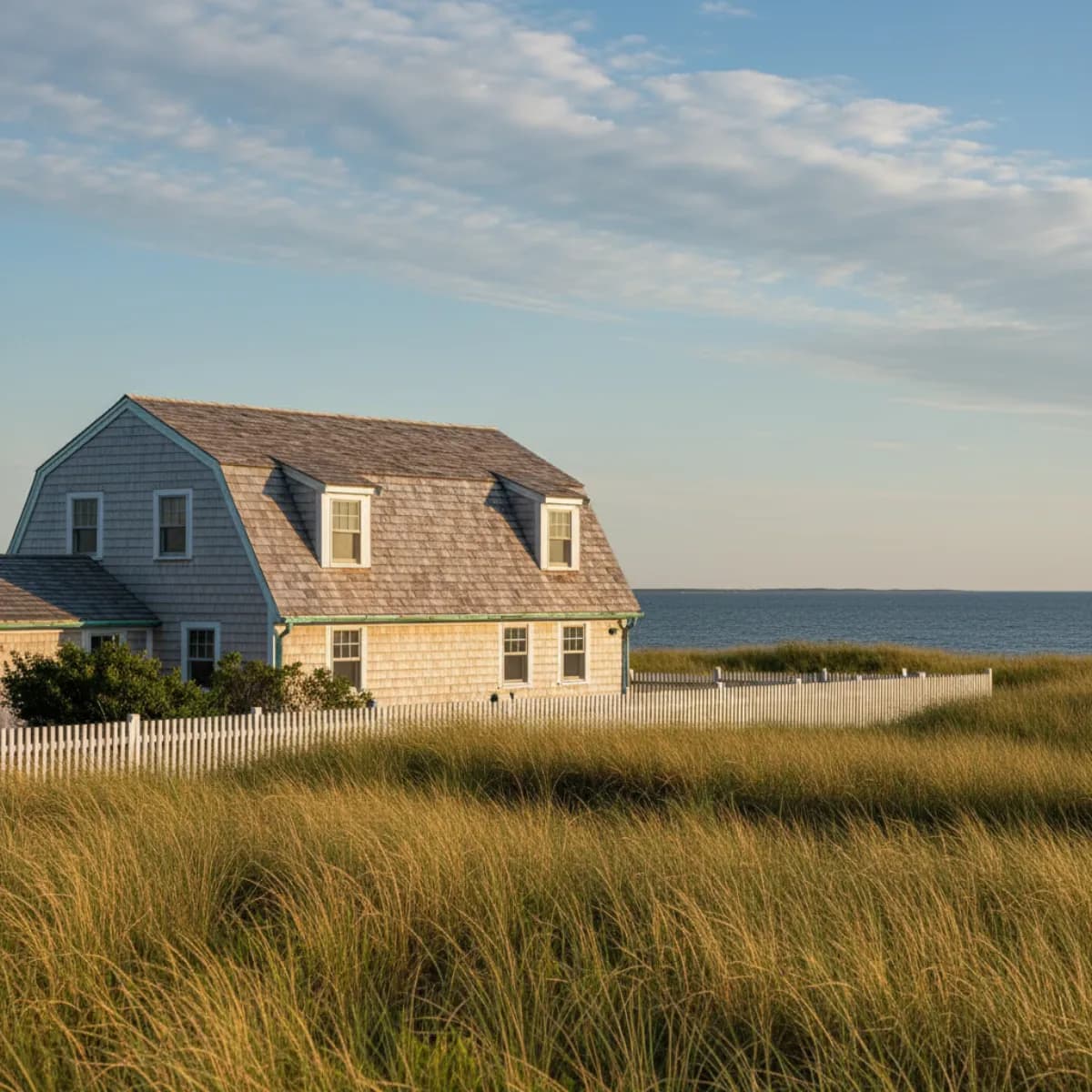
Key Takeaways
- • Cape Cod 2026 range: $16,800–$58,400 for a typical 2,200 sqft cottage.
- • Cedar shake still dominates; Old King's Highway towns often require it for visible roof planes.
- • Entire Cape is an ASCE 7 Special Wind Region — 130 mph uplift engineering is standard.
- • Cape Cod Commission DRI review only triggers on projects over 10,000 sqft site disturbance or in a DCPC.
- • Outer Cape (Wellfleet, Truro, Provincetown) costs 10–18% more than Upper Cape (Sandwich, Bourne).
- • Shoulder-season scheduling (April–June) cuts 10–20% from peak-summer pricing.
In This Guide
2026 Cost Ranges by Material
Cape Cod roofing pricing in 2026 sits above the Massachusetts state average for four structural reasons: (1) the dominant material is cedar shake rather than asphalt, (2) the entire peninsula is a 130 mph wind zone under ASCE 7, (3) salt-air specs require stainless or copper fasteners and upgraded underlayment, and (4) freight from inland wholesalers over the Sagamore and Bourne bridges adds $400–$2,800 per project. The figures below assume a typical 2,200 sqft Cape cottage.
| Material | Per sqft (installed) | 2,200 sqft Total | Lifespan (Cape salt) |
|---|---|---|---|
| Architectural asphalt (130 mph) | $7–$11 | $16,800–$27,500 | 22–28 yr |
| Red cedar shake | $14–$20 | $32,000–$48,000 | 22–28 yr |
| Alaskan yellow cedar | $16–$22 | $36,000–$52,000 | 30–40 yr |
| Vermont slate | $22–$38 | $48,400–$85,000 | 75–100 yr |
| Standing-seam copper | $28–$44 | $62,000–$95,000 | 80+ yr |
Source ranges reflect 2026 pricing from Massachusetts contractors, MPA published labor rates, and regional wholesaler freight. Oceanfront and Outer-Cape addresses run above these baselines; Upper Cape and inland below them.
Why Cedar Shake Still Dominates the Cape
Cedar shake is more than a stylistic preference on the Cape; it is the default regulatory and cultural expectation across most of the six Old King's Highway Regional Historic District towns (Sandwich, Barnstable, Yarmouth, Dennis, Brewster, Orleans). In those districts, Massachusetts General Law Chapter 470 requires a Certificate of Appropriateness from the local historic committee for any change visible from a public way. Cedar, slate, and aged-copper standing seam pass review almost automatically. Synthetic shake look-alikes (DaVinci, Brava, Enviroshake) are often rejected in favor of real cedar, though acceptance is growing in some towns when the product is visually indistinguishable at ground level.
Outside Old King's Highway, the towns of Mashpee, Falmouth, Bourne, and the Outer Cape (Eastham, Wellfleet, Truro, Provincetown) have their own historic districts with similar but independent review boards. Chatham runs two separate district committees (Historic Business District plus Old Village). Even in non-historic neighborhoods, most HOA-governed villages (New Seabury, Popponesset, The Ridge Club, Ocean Edge) impose cedar-look requirements through private design covenants.
For non-historic, non-HOA properties, owners have full material freedom. The strongest alternative-to-cedar case is impact-resistant asphalt (CertainTeed Landmark Pro IR, GAF Armorshield II, Malarkey Legacy) when paired with a 130 mph wind-rated install spec — the insurance savings alone can fund a re-roof cycle every 25 years at roughly half the upfront cost of cedar. See ourMA cedar-shake banned cities guide for the broader state picture.
Salt-Air Corrosion & Material Specs
Salt-air corrosion is the second hidden cost driver on Cape Cod projects. Within roughly 2,500 feet of the shoreline, chloride deposition rates reach 10–30 mg/m²/day, which degrades standard galvanized steel fasteners in 5–8 years. Cape roof assemblies therefore require upgraded material specs:
- • Stainless steel ring-shank nails (Type 304 or 316) or copper nails for cedar shake
- • Copper or stainless drip edge and valley metal — galvanized corrodes through in under a decade on oceanfront properties
- • Synthetic underlayment (GAF Tiger Paw, CertainTeed DiamondDeck) or ice-and-water shield across the full deck
- • Ice & water shield at all eaves, valleys, rake edges, and around penetrations per 780 CMR 1507 (MA amendment of IRC R905)
- • Accelerated-weathering granule technology on any asphalt shingle (ASTM D3161 Class F and ASTM D7158 Class H ratings)
- • Copper or stainless flashings at chimneys, sidewalls, and dormer corners
These upgrades typically add $1.00–$2.50 per sqft over a non-coastal install — roughly $2,200–$5,500 on a 2,200 sqft roof. The investment pays back through a 15–25 year lifespan extension and the HO-3 wind mitigation credit. For the underlayment requirement specifics, see ourMA ice & water shield code guide.
Category 3 Wind Zone Engineering
The entire Cape is in ASCE 7 Special Wind Region with a basic wind speed of 130 mph (Vult), which translates to Category 3 hurricane design wind loads. Under Massachusetts amendment 780 CMR 1609, roof assemblies on the Cape must meet enhanced fastener pullout requirements, uplift-rated starter strips, ridge bracing, and minimum nail count (6 nails per shingle for asphalt, hand-nailed for cedar with minimum 5 inch exposure, 1 1/4 inch depth). For architectural shingles, specify ASTM D3161 Class F or D7158 Class H products only.
For homes within 1,500 feet of the open coast, building departments in Chatham, Truro, Wellfleet, and Provincetown also require a stamped structural engineer review of truss uplift connections. The engineer scope typically includes hurricane-strap verification, collar-tie spacing, and gable-end bracing. That review runs $600–$1,800 as a separate line item. Always build it into the project budget for oceanfront work.
The Massachusetts Building Code has been fully aligned with IRC 2021 and IBC 2021 since 2023, with Cape-specific wind amendments. The state is expected to adopt the IRC 2024 updates during the 2026–2027 code cycle, which may tighten connection requirements further.
Price Your Cape Cod Roof Instantly
Get an instant quote from pre-vetted Cape contractors who handle Old King's Highway review, 130 mph wind-uplift engineering, and salt-air-spec material selection.
Town-by-Town Permit Differences
All 15 Cape Cod towns operate their own building departments, but the review burden varies dramatically. Typical permit fees range from $150 (Bourne, Mashpee) to $450 (Chatham, Provincetown). The deeper cost driver is review timing:
| Town | Historic Review | Typical Cycle | Notes |
|---|---|---|---|
| Sandwich | Old King's Highway | 2–3 wk | Oldest town (1637); strict on visible changes. |
| Bourne | Limited | 1–2 wk | Upper Cape gateway; fastest approvals. |
| Falmouth | Falmouth + Woods Hole | 3–4 wk | Woods Hole village review adds time. |
| Mashpee | HOA only | 1–2 wk | Private villages (New Seabury) drive rules. |
| Barnstable | Old King's Highway | 2–3 wk | Cotuit, Osterville, and Barnstable Village strict. |
| Yarmouth | Old King's Highway | 2–3 wk | Yarmouth Port is the most rigid. |
| Dennis | Old King's Highway | 2–3 wk | Dennis Village historic review. |
| Harwich | Old King's Highway | 2–3 wk | Harwich Port cottage colony detail-heavy. |
| Chatham | Dual (HBD + Old Village) | 4–6 wk | Two separate committees; plan ahead. |
| Eastham | Old King's Highway | 3–4 wk | Seashore overlays add steps. |
| Wellfleet | Wellfleet Historic | 4–5 wk | National Seashore overlay for coastal lots. |
| Truro | Truro Historic | 4–5 wk | Narrow Cape; wind spec scrutiny high. |
| Provincetown | P-town Historic | 5–8 wk | Entire downtown in district; strictest. |
Cape Cod Commission Review (DRI)
The Cape Cod Commission (created by the Cape Cod Commission Act of 1989, MGL Ch. 716) reviews Developments of Regional Impact (DRI) under published thresholds. For roof work specifically, DRI review is only triggered in three situations:
- • The project is part of a larger development exceeding 10,000 sqft of cumulative site disturbance (new construction, additions, lot re-grading)
- • The property is inside a designated District of Critical Planning Concern (DCPC) — for example, the Six Ponds DCPC in Barnstable, or the Sandy Neck DCPC
- • The project is commercial or mixed-use and triggers DRI via square-footage or trip-generation tests
A like-for-like residential re-roof never triggers DRI review on its own. Any contractor claiming otherwise is mistaken. What sometimes surprises homeowners is that if they combine a re-roof with a footprint expansion (adding a screened porch, dormer addition, or second-story conversion), the whole project can tip into DRI scope. Pull a pre-application call with your town building commissioner to confirm. See ourCape Cod Commission historic roof rules guide for the full DRI framework.
Interactive Town & Material Matrix
Pick your Cape town, distance from shoreline, material, and wind-uplift engineering status. The calculator applies town-specific labor premiums, historic-district flags, salt-air material upgrades, and wind-zone engineering overhead.
Cape Cod Material & Town Cost Matrix (2026)
Combine Cape town, distance from shoreline, material, and wind-uplift engineering to get a live Cape Cod cost range with town-specific permit notes.
$18.5–$29.1/sqft · Cedar Shake (Red / White) · 2,200 sqft · Within 1 mile of shoreline
Barnstable (Hyannis / Osterville / Centerville)
Old King's Highway Historic District covers most of Barnstable Village and Cotuit. Review by town historic committee required for visible roof changes.
Permit complexity: 3/5 · Historic-district review · CC Commission DRI > 10K sqft
Material Note
The dominant Cape look. Red cedar lasts 25-30 yr, Alaskan yellow cedar 35-40 yr in salt air. Requires 18 in starter, copper valleys, stainless fasteners.
Estimates reflect 2026 Cape Cod market pricing and public data from Massachusetts contractors. Actual quotes from pre-vetted contractors factor in pitch, tear-off, chimney/skylight count, and Cape Cod Commission Development of Regional Impact review scope when applicable.
Seasonality & Absentee-Owner Timing
Cape Cod is a vacation-home market dominated by absentee owners. Roughly 40 percent of Barnstable County's 176,000 housing units are seasonal-use, which forces a specific scheduling rhythm:
| Window | Crew Availability | Pricing vs. Annual Avg. | Use Case |
|---|---|---|---|
| Mid Mar – early Jun | Excellent | −10 to −20% | Best for absentee owners; finishes before rental season. |
| Late Jun – early Sep | Scarce | +10 to +20% | Emergency-only; beach-noise ordinances limit workdays. |
| Mid Sep – early Nov | Excellent | −5 to −10% | Post-rental; good for full cedar installs before frost. |
| Mid Nov – mid Mar | Limited | Flat | Asphalt only above 40°F; many shops pause Jan–Feb. |
For absentee owners managing projects remotely, the best practice is to sign a scope and contract in January, target a late April through early June install, and require a final inspection photograph set with date-stamped WiFi-enabled progress updates.
HO-3 Insurance & the Wind Mitigation Credit
Most MA HO-3 carriers apply a coastal wind surcharge to properties within 2,500 feet of the shoreline. A new roof installed to 130 mph uplift specification with a Wind Mitigation Certificate typically earns $200–$700/year in premium credit at renewal. The FAIR Plan (required for many oceanfront properties that carriers decline) requires the certificate as a condition of binding.
For older properties (pre-2000 roof deck), some carriers now require ACV (actual cash value) rather than RCV (replacement cost value) settlement on any wind-or-hail claim once the roof passes 15 years. Details in ourMA roof age-limit ACV/RCV guide.
Frequently Asked Questions
Frequently Asked Questions
How much does a roof replacement cost on Cape Cod in 2026?
A typical 2,200 sqft Cape Cod home in 2026 runs $16,800-$58,400 installed depending on material and town. Architectural asphalt with 130 mph wind-rated shingles sits at the $16,800-$27,500 end. Cedar shake (the dominant Cape look) falls in the $32,000-$48,000 band for a standard 2,200 sqft cottage. Vermont slate runs $48,000-$85,000 and standing-seam copper $62,000-$95,000. Outer Cape towns (Wellfleet, Truro, Provincetown) price 10-18 percent higher than Upper Cape (Sandwich, Bourne) because of freight, labor commute, and tighter historic review. Oceanfront addresses add another 5-12 percent for salt-air fasteners and insurance-required wind mitigation details.
Is cedar shake still the best choice on the Cape, or should I switch to impact-resistant shingles?
Cedar shake remains the culturally and often regulatorily preferred material across the Cape, especially inside Old King's Highway Historic District towns (Sandwich, Barnstable, Yarmouth, Dennis, Harwich, Brewster, Orleans, Eastham). Visible-plane roof changes in those towns must pass historic committee review, and synthetic shake substitutes are often rejected in favor of real cedar. That said, there is a real cost-and-maintenance case for FR-treated cedar or top-tier impact-resistant asphalt (CertainTeed Landmark Pro IR, GAF Armorshield II, Malarkey Legacy) on non-historic properties where the insurance premium reduction and lower re-roof frequency may outweigh aesthetics. Alaskan yellow cedar (30-40 yr on the Cape) outperforms Western red cedar (22-28 yr) in salt air. Most Cape installers now spec stainless ring-shank nails and copper underlayment at valleys to stretch cedar lifespan.
Who needs Cape Cod Commission approval for a roof project?
The Cape Cod Commission reviews Developments of Regional Impact (DRI) when a project crosses certain size or impact thresholds. For residential roof work, DRI review is generally triggered only when the project is part of a larger development footprint exceeding 10,000 sqft of site disturbance or when the property is in a designated District of Critical Planning Concern (DCPC). A like-for-like residential re-roof almost never triggers DRI review. What does commonly trigger review is a project that simultaneously expands building footprint, adds a second story, or alters lot drainage. On any non-trivial project on the Cape, your contractor should pull a pre-application call with your town building commissioner to confirm whether Commission review applies.
How does Old King's Highway Historic District affect roofing material choice?
Old King's Highway Regional Historic District (established 1973, MGL Ch. 470) covers all of Sandwich, Barnstable, Yarmouth, Dennis, Brewster, and Orleans north of Route 6. For properties within the district, any change visible from a public way requires a Certificate of Appropriateness from the local historic committee before the building permit can issue. Cedar shake, cedar shingle, and slate are almost always approved on first submittal. Architectural asphalt is usually approved in weathered-wood or driftwood color. Pure white asphalt, vivid colors, and most synthetic shake look-alikes face significant resistance. Metal roofing is approved case-by-case, typically only in muted aged-copper, charcoal, or black with standing-seam profile. Submit elevation drawings, a product color chip, and a CRRC/CRRC-equivalent reflectance sheet to accelerate review.
Do HO-3 insurers on the Cape require wind-uplift riders or special endorsements?
Most Massachusetts HO-3 carriers (MAPFRE, Safety, Vermont Mutual, Arbella, Plymouth Rock) require a Wind Mitigation Certificate for homes within roughly 2,500 feet of the shoreline, and the FAIR Plan requires one for coastal properties it accepts. The certificate documents fastener type and spacing, starter strip, sealed deck, and hip-to-ridge bracing. Post-install, your contractor should provide the inspector wind mitigation form so your carrier can apply the policy credit at renewal. Without the certificate, carriers often charge a 10-20 percent coastal wind surcharge on the policy wind-loss portion. A new roof installed to 130 mph uplift specification typically earns $200-$700/year in premium credit on coastal Cape policies. See our Massachusetts Roof Insurance Age Limit guide for ACV-vs-RCV implications on older Cape properties.
What is the best time of year to schedule a Cape Cod roof replacement?
Shoulder seasons (late March through early June, and mid-September through early November) offer the best combination of crew availability, off-Cape labor rates, and weather. Peak summer (late June through Labor Day) brings the highest pricing (10-20 percent premium) because crews are balancing full-schedule vacation-home emergencies, tourist traffic affects delivery windows, and many towns impose weekday-only noise ordinances in beach neighborhoods. Winter work is possible but limited: cedar requires 40 degrees F minimum for sealant cure, slate work slows materially, and most Cape contractors take a 6-8 week maintenance pause between mid-January and mid-March. For absentee owners, scheduling mid-April through mid-June gives the best chance of completion before the summer rental season opens Memorial Day weekend.
How do barge and bridge delivery affect Cape Cod roofing material cost?
Materials for Cape Cod projects travel from inland wholesalers (Hingham, Plymouth, Taunton, Worcester) over the Sagamore or Bourne bridges. For routine asphalt and cedar orders, freight adds $400-900 per project compared to inland Massachusetts. For heavy materials (Vermont slate, concrete tile, copper standing seam), the freight premium runs $1,200-$2,800. Outer Cape deliveries (Wellfleet through Provincetown) add another $200-600 because of the Route 6 two-hour haul from the bridge. A small number of materials still arrive by barge to Provincetown harbor, though most contractors route everything over the bridges now. Plan deliveries 4-6 weeks ahead during peak summer since bridge lift restrictions and seasonal-road staging can extend lead times.
Which towns have the strictest permit and historic review?
Chatham, Wellfleet, Truro, and Provincetown run the most detailed review cycles. Chatham has both a Historic Business District committee and the Old Village committee; typical review is 4-6 weeks. Wellfleet and Truro add Cape Cod National Seashore overlays for properties within the park's jurisdiction, and Provincetown Historic District covers virtually the entire downtown with strict color and material guidance. Barnstable and Yarmouth are moderately strict but predictable within Old King's Highway; approval typically lands in 2-3 weeks on conventional cedar/slate submittals. Mashpee and Bourne have the lightest review outside of HOA-governed villages (New Seabury, Popponesset, The Ridge Club) where private design committees impose their own rules.