Roofing in Monmouth County: What Homeowners Need to Know
Monmouth County stretches from the Raritan Bay south to the Manasquan River and inland to the Pinelands edge. It’s home to roughly 644,000 residents across 53 municipalities. Median home values run about $510,000 countywide — one of the higher county medians in NJ — with shore-town and Two Rivers area medians well above $700,000. The county splits geographically into three distinct roofing markets: the Atlantic shore corridor (Sea Bright south through Belmar, Spring Lake, Bay Head), the Two Rivers / Bayshore corridor (Rumson, Fair Haven, Red Bank, Atlantic Highlands, Highlands), and the inland horse-country and suburban core (Holmdel, Colts Neck, Marlboro, Manalapan, Freehold, Howell).
The county’s major towns include Long Branch (population 31,000), Asbury Park (15,000), Red Bank (12,000), Freehold Borough (12,000), Middletown Township (66,000), and Howell Township (52,000). Middletown and Howell are the two largest townships by population, with extensive 1980s-2000s suburban Colonial subdivisions averaging 2,000-2,800 sqft of roof.
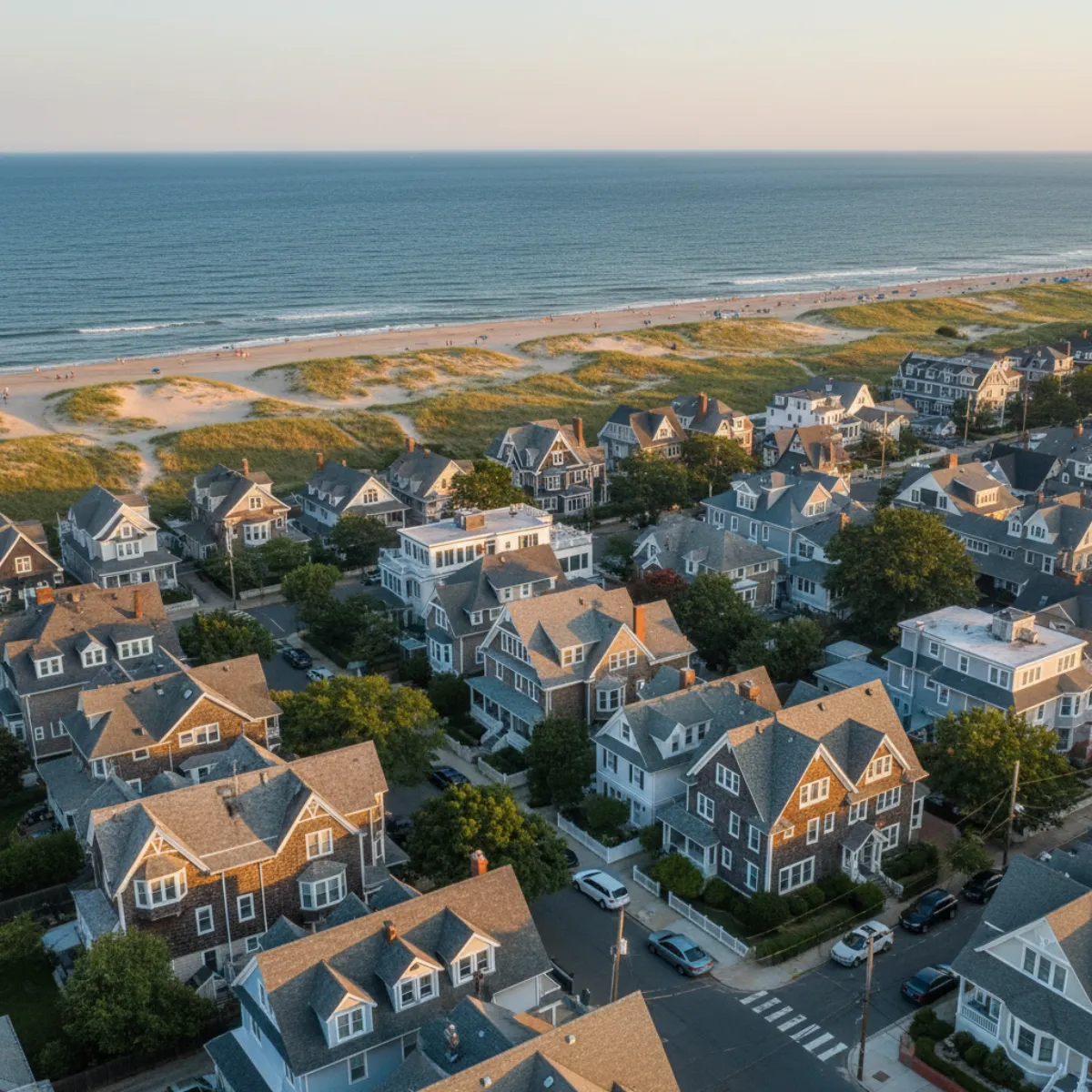
The shore corridor is dominated by a mix of pre-war beach cottages, mid-century ranches, and 2000s-2020s rebuild Colonials replacing Sandy-damaged structures. Pricing on the shore averages 15-25% above inland Monmouth because of wind-rated material requirements, tighter staging logistics, and the higher contractor labor cost in shore towns. The Two Rivers area (Rumson, Fair Haven, Little Silver, Shrewsbury) carries the highest residential roof costs in the county — large estate Colonials with 3,500-6,500 sqft of roof, often with cedar shake or slate and intricate copper gutter and downspout systems.
How the Monmouth Shore Climate Drives Roofing Wear
Monmouth County experiences a humid continental climate with significant maritime influence on the eastern third. The county receives 47-50 inches of rain annually and 20-32 inches of snow (less than inland NJ counties due to ocean moderation). The dominant roofing wear factors are wind, salt, UV, and named storm exposure.
Hurricane & Nor'easter Wind
Monmouth County sits in the named-storm corridor for both Atlantic hurricanes and Nor'easters. Sustained 60-80 mph winds during major events are routine in shore towns, with gusts to 95-110 mph during direct hurricane strikes (Sandy 2012, Henri 2021). Even non-named storms commonly produce 50-65 mph gusts on the shore.
Architectural shingles rated for 130 mph wind uplift with six-nail patterns are the standard specification for any home east of Route 35. Inland Monmouth (Howell, Freehold, Marlboro) can use 110 mph rated shingles though many owners specify 130 mph for the modest 5-8% premium.
Salt Air & Corrosion
Salt-air corrosion is severe within 1-2 miles of the Atlantic coast. Common bright steel roofing nails rust through within 5-7 years in shore exposure, voiding any shingle warranty. Galvanized step flashing pitting begins in 8-10 years; aluminum flashing lasts 25+ years.
Stainless steel or hot-dipped galvanized fasteners are non-negotiable for shore homes. Aluminum drip edge, step flashing, and counter flashing add $0.30-$0.55 per linear foot over galvanized but extend roof life by 10-15 years in shore exposure.
UV Intensity & Algae
Shore-zone UV intensity is 15-20% higher than inland Monmouth due to less atmospheric attenuation and ocean reflection. Combined with high humidity, this drives rapid algae and black-streak growth on shaded roof areas.
Algae-resistant shingles with copper or zinc granule integration carry a 5-8% premium and dramatically extend visual life on shore homes. Annual roof cleaning by a soft-wash specialist (NOT pressure washing — this voids most warranties) is the highest-ROI shore-zone maintenance item.
Sandy Flood Zone Compliance
Post-Sandy FEMA flood maps designate large stretches of Sea Bright, Highlands, Union Beach, Keansburg, and the entire LBI bayfront as Special Flood Hazard Areas with velocity (V) zones in the most exposed locations.
Reroofing in V-zones requires enhanced wind-uplift documentation, hurricane straps on rafters/trusses, and (in many municipalities) ice/water shield over the entire roof deck rather than just the eaves. These requirements add $1.50-$3.00 per sqft.
Monmouth County Roof Replacement Costs (2026)
Monmouth County roofing costs sit 8-15% above the New Jersey state average inland and 15-25% above on the shore. Three structural drivers: wind-rated material requirements add $1.00-$2.50 per sqft on shore homes; the housing stock skews larger (2,000-3,500 sqft roofs are typical) than statewide averages; and the high-end shore and Two Rivers clientele specify premium materials at much higher rates than statewide averages.
Cost by Material — Monmouth County 2026
| Material | Cost / Sqft | 2,000 Sqft Roof | Lifespan (Monmouth) |
|---|---|---|---|
| 3-Tab Asphalt | $3.95–$5.50 | $7,900–$11,000 | 12–16 yr (shore) |
| Architectural Shingles (110 mph) | $5.25–$7.50 | $10,500–$15,000 | 22–28 yr inland |
| Architectural Shingles (130 mph shore) | $6.00–$8.50 | $12,000–$17,000 | 18–24 yr shore |
| Class 4 Impact Shingles | $6.75–$10.25 | $13,500–$20,500 | 25–30 yr |
| Standing Seam Metal (Kynar) | $11.00–$16.00 | $22,000–$32,000 | 35–55 yr shore |
| Cedar Shake | $11.75–$17.50 | $23,500–$35,000 | 20–30 yr shore |
| Slate | $24.00–$32.00 | $48,000–$64,000 | 75–150 yr |
* Includes tear-off, disposal, ice/water shield, synthetic underlayment, and standard ventilation. Shore-zone projects add hurricane strap documentation and full-deck ice/water shield (mandatory in V-zones). Complex roofs with multiple dormers, copper flashing, or steep pitch will add 15-30% to total cost.
Monmouth-Specific Cost Add-Ons
- •Stainless steel fasteners: $0.10-$0.20/sqft over standard galvanized. Required by every reputable shore contractor.
- •Aluminum flashing upgrade: $0.30-$0.55/linear foot over galvanized. Pays back in 8-12 years through extended life.
- •Full-deck ice/water shield: $0.50-$0.85/sqft. Required in V-zones; recommended on any shore home.
- •Hurricane strap documentation: $300-$800 for inspector-witnessed verification. Required by some V-zone permits.
- •Copper gutter system: $40-$75/linear foot. Common on Two Rivers estate Colonials in Rumson and Fair Haven.
2026 Tariff & Material Trends
Steel and aluminum tariffs added $1.50-$2.50 per sqft to standing seam metal pricing in 2026 and $0.50-$0.85 per sqft to architectural shingles. The shore-zone Kynar PVDF coating (essential for salt-air metal roof longevity) added another $0.40-$0.75 per sqft due to specialty coating supply constraints.
Cedar shake pricing rose 18-25% in 2025-2026 due to British Columbia supply constraints. Many shore homeowners are switching to synthetic shake (DaVinci or Brava) which delivers similar aesthetics at $9-$13 per sqft installed.
Roofing Notes by Monmouth County Town
Long Branch, Deal & West Long Branch
Long Branch has a wide pricing spread — the West End and Elberon sections carry larger 2,500-4,000 sqft Colonials with average reroof cost $15,000-$24,000, while the central Long Branch and downtown areas have smaller 1,400-1,800 sqft Capes and single-families at $11,000-$16,000. Deal’s estate Colonials run $20,000-$45,000+. All require shore-zone wind-rated specs and stainless fasteners.
Asbury Park, Bradley Beach & Ocean Grove
The central shore corridor. Asbury Park has dense pre-war Victorians and bungalows in the historic Northeast district plus newer redevelopment Colonials. Bradley Beach is mostly 1920s-1950s beach cottages and bungalows. Ocean Grove is a designated historic district with strict architectural review — cedar shake or matching architectural shingle profiles required, copper or aluminum (not galvanized) flashing required. Average reroof cost runs $12,000-$19,000 for typical homes; historic Victorians run $20,000-$35,000+.
Spring Lake, Sea Girt, Bay Head & Mantoloking
The high-end shore corridor. Spring Lake’s historic district features large Victorian and Colonial Revival estates with cedar shake, slate, and copper flashing almost universal. Sea Girt and Bay Head carry similar high-end stock. Mantoloking was severely damaged by Sandy and rebuilt with modern wind-rated specs across most of the borough. Average reroof cost runs $25,000-$75,000 in these communities, with many projects exceeding $100,000 for slate or full cedar reroofs on large estates.
Red Bank, Rumson, Fair Haven & Little Silver
The Two Rivers area. Red Bank has a tight downtown historic district with strict preservation rules plus newer riverfront Colonials. Rumson and Fair Haven are estate communities with 3,500-7,000+ sqft Colonials, complex hip-and-valley roof geometry, and frequent specification of cedar shake, slate, and copper systems. Average reroof cost runs $25,000-$65,000+ in Rumson; $20,000-$50,000 in Fair Haven and Little Silver. The contractor pool for these projects is smaller because slate and copper expertise is required.
Middletown, Holmdel & Colts Neck
Inland horse-country and large-lot suburban Monmouth. Middletown is the largest township by population with diverse 1960s-2000s housing stock from ranches to large Colonials. Holmdel is upper-middle-class suburban with average 2,200-3,000 sqft roofs. Colts Neck is the highest-end inland township with 3-10 acre lots and custom estate Colonials averaging 3,500-6,000 sqft of roof. Average reroof costs run $13,000-$22,000 in Middletown, $16,000-$28,000 in Holmdel, and $22,000-$50,000+ in Colts Neck.
Freehold Township, Howell, Marlboro & Manalapan
Western suburban Monmouth. These four townships host extensive 1980s-2010s Colonial subdivisions with uniform 2,000-2,800 sqft roofs and HOA architectural standards. Average reroof cost runs $12,000-$18,000 across these townships. Pricing is the most consistent in Monmouth County because the housing stock is so uniform. Many homes have integrated solar PV from the 2010s incentive era — factor in $1,500-$3,500 for panel removal and reinstallation during reroof.
Sea Bright, Highlands, Union Beach & Keansburg
The bayshore and northern barrier-island corridor. These communities took the worst of Hurricane Sandy and have the most stringent flood-zone roofing requirements in Monmouth County. Most reroofs require V-zone documentation, full-deck ice/water shield, hurricane strap verification, and stainless fasteners. Average reroof cost runs $14,000-$22,000 for typical small shore homes. Many homes have been raised post-Sandy — reroofing during or after raising adds $5,000-$15,000 in staging cost.
Monmouth County Building Codes & Permit Process
All Monmouth County reroofs are governed by the New Jersey Uniform Construction Code (N.J.A.C. 5:23) with shore-zone amendments. Permits are issued at the municipal level. For statewide details, see the New Jersey Roofing Permit Guide and NJ Building Codes for Roofing.
Key Code Requirements for Monmouth County Reroofs
- 1Wind rating: 110 mph minimum statewide; shore-zone municipalities require 130 mph rated shingles with six-nail patterns. Sea Bright and Mantoloking have informally pushed contractors toward 150 mph rated systems.
- 2Ice and water shield: 24" past interior wall line minimum; full-deck coverage required in V-zones.
- 3Hurricane straps / H2.5 connectors: Documentation required on roof structural members in V-zones.
- 4Underlayment: Synthetic underlayment (or 30-lb felt) required over the rest of the deck.
- 5Maximum layers: Two layers of asphalt shingles maximum. If two layers exist, complete tear-off to the deck is mandatory.
- 6Historic district overlay: Red Bank, Allenhurst, Asbury Park NE, Spring Lake, and Ocean Grove require architectural review for material/color before permit issuance.
Why Standardized Quote Comparison Matters in Monmouth County
Monmouth County’s shore-zone roofing market has a uniquely wide quality gap. On the same Spring Lake Colonial, three different bids can vary by $6,000-$15,000 — not because anyone is being dishonest, but because each contractor uses different shingle wind ratings, different fastener metals (stainless vs. galvanized vs. bright steel), different flashing alloys (aluminum vs. copper vs. galvanized), and different warranty terms. RoofVista standardizes the spec across all bids so you compare price, not specification gaps.
How RoofVista Standardizes Monmouth Quotes
Satellite Measurement
Your Monmouth roof measured from satellite imagery — including hip/valley/dormer count.
Identical Shore Spec
130 mph shingles, stainless fasteners, aluminum flashing, full-deck ice/water shield in V-zones.
Pre-Vetted Shore Contractors
NJ HIC, post-Sandy V-zone training, and shore-zone manufacturer certifications verified.
Monmouth County Roofing: Frequently Asked Questions
How much does a roof replacement cost in Monmouth County, NJ?
A typical Monmouth County roof replacement runs $11,500 to $19,000 for a 1,800-2,200 sqft home using architectural asphalt shingles in 2026. Monmouth pricing sits 8-12% above the New Jersey state average due to coastal wind-rated material requirements, the prevalence of larger 2,500+ sqft Colonial estates inland, and the higher labor costs along the shore corridor. Architectural shingles average $5.25-$8.25 per square foot installed; standing seam metal runs $11.00-$16.00 per square foot. Shore-zone homes east of Route 35 typically need 130 mph wind-rated shingles with six-nail patterns, adding $0.50-$1.00 per sqft over standard 110 mph specs.
Which Monmouth County towns have the highest roofing costs?
Rumson, Fair Haven, Sea Bright, Deal, Allenhurst, Spring Lake, Bay Head, Mantoloking, Holmdel, and Colts Neck consistently see the highest roofing quotes in Monmouth County. Three drivers: (1) larger custom homes with 3,000-6,000+ sqft of roof and complex multi-hip geometry; (2) shore wind-uplift requirements that push contractors toward 130 mph rated shingles, copper flashing, and reinforced ridge vent systems; (3) high-net-worth clientele specifying premium materials like cedar shake, slate, and standing seam metal at much higher rates than statewide averages. By contrast, Howell, Freehold Township, and Manalapan have lower per-job costs because of more uniform Colonial subdivision housing.
How does the Monmouth shore affect roofing material choice?
Salt air and high-wind exposure in Monmouth shore towns (Sea Bright, Long Branch, Asbury Park, Bradley Beach, Belmar, Spring Lake, Sea Girt, Manasquan, Bay Head) require materials and fasteners that resist salt corrosion. Stainless steel or hot-dipped galvanized roofing nails are non-negotiable — common bright steel nails will rust through within 5-7 years in shore-zone exposure. Aluminum drip edge and step flashing outperform galvanized in shore zones. For metal roof systems, aluminum or Galvalume with Kynar 500 PVDF coating handles salt corrosion better than bare galvanized steel. Architectural shingles with copper-zinc algae-resistant granules are recommended for any shore home — black streak algae growth is severe within 2 miles of the Atlantic.
Do I need a permit for roof replacement in Monmouth County?
Yes — every Monmouth County municipality requires a building permit for roof replacement under the New Jersey Uniform Construction Code (N.J.A.C. 5:23). Shore towns like Sea Bright, Bay Head, Mantoloking, and Long Beach Island add post-Sandy flood-zone documentation requirements — your contractor must show that any new roof structural elements meet current freeboard and wind-uplift standards. Permit fees typically run $100-$400, with shore towns at the higher end. Historic district overlays in Red Bank, Allenhurst, and parts of Asbury Park add architectural review requirements for material and color. A reputable contractor pulls the permit in their company name and schedules the required final inspection.
How did Hurricane Sandy and recent Nor'easters affect Monmouth roofing standards?
Hurricane Sandy in 2012 caused widespread roof damage across Monmouth County, particularly in Sea Bright, Union Beach, Keansburg, Highlands, and Long Branch. Post-Sandy, the New Jersey UCC was updated to require enhanced wind-uplift ratings on coastal reroofs and all new construction in V-zones (velocity flood zones). Most Monmouth shore-town building departments now require: (1) 130 mph rated shingles minimum with six-nail patterns; (2) ice and water shield over the entire roof deck (not just eaves); (3) hurricane straps or H2.5 connectors documented on roof structural members; (4) ridge vent systems rated for the same wind uplift as the shingles. These requirements add $1.00-$2.50 per sqft over inland Monmouth specifications.
How long does a roof last in Monmouth County?
Realistic roof lifespan in Monmouth County: architectural shingles 22-28 years inland, 18-24 years in shore-zone exposure (UV intensity, salt air, and wind degradation accelerate aging). Standing seam metal: 40-70 years inland, 35-55 years shore-zone (with proper Kynar coating). Cedar shake: 25-35 years inland, 20-30 years shore-zone. Slate: 75-150 years anywhere. The biggest factor in shore-zone lifespan is regular maintenance — annual inspection and re-sealing of penetrations (vent stacks, chimney flashing, skylights) extends life by 5-8 years.
Are there Monmouth County HOA or historic district rules I should know?
Yes — Monmouth has multiple historic district overlays. Red Bank's historic downtown, Allenhurst, parts of Asbury Park (especially the Northeast historic district), and Spring Lake all enforce material and color guidelines on roof replacements. Cedar shake or matching architectural shingle profiles are commonly required. Newer planned communities in Manalapan, Marlboro, Howell, and the 55+ developments in Wall Township have HOA architectural review boards that pre-approve shingle color and brand. The Bay Head Yacht Club community and Spring Lake have particularly strict aesthetic standards for visible-from-street materials. Always check covenants and call your municipal historic preservation office before signing a contract.
Get Instant Roof Replacement Quotes for Your Monmouth County Home
Compare quotes from pre-vetted contractors serving Long Branch, Asbury Park, Red Bank, Freehold, Middletown, Howell, and every Monmouth County municipality. Enter your address for a free instant estimate based on your actual roof dimensions.
No spam. No phone calls. Just instant quotes from vetted Monmouth County contractors.