Roofing in Hudson County: What Property Owners Need to Know
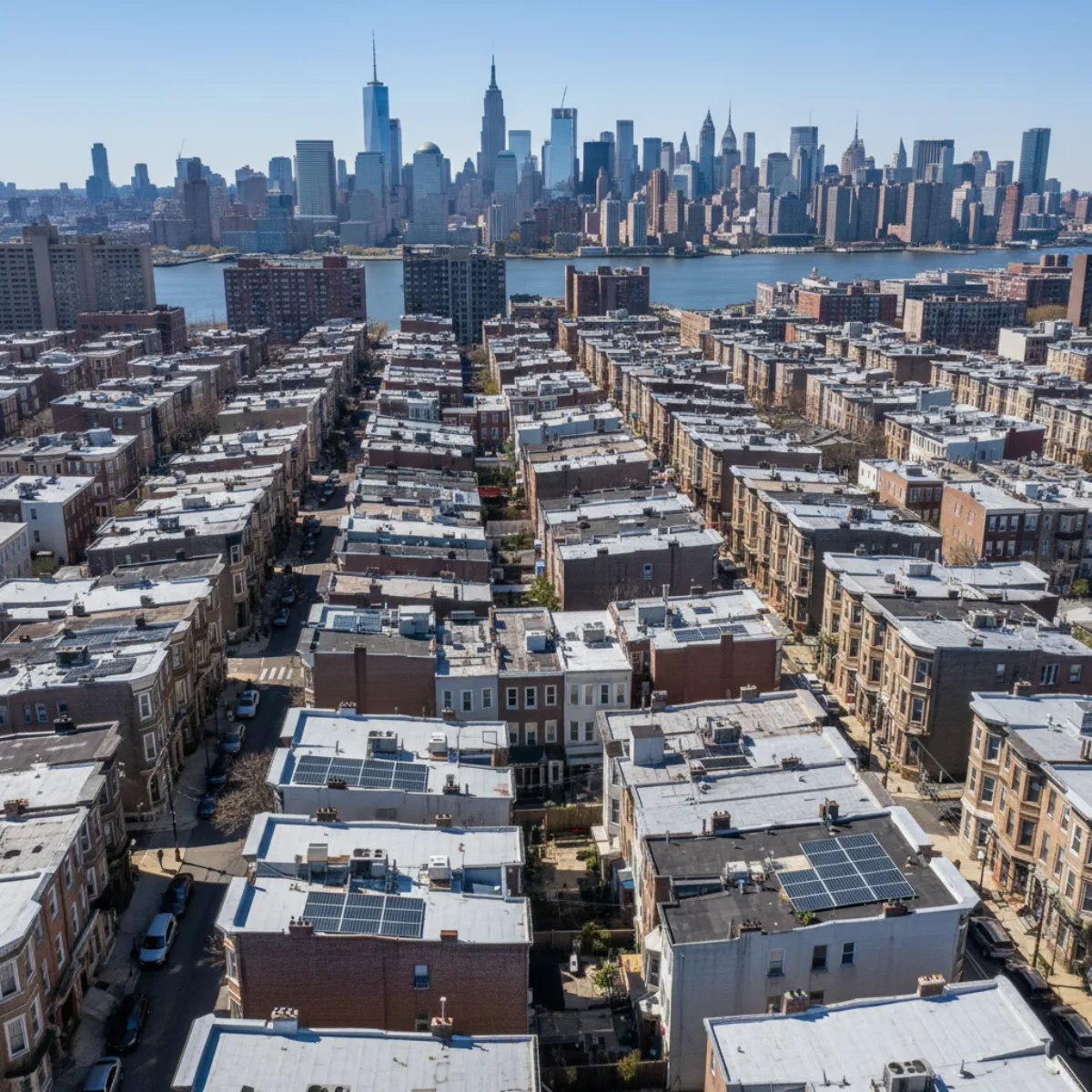
Hudson County is the densest county in New Jersey and one of the densest in the United States outside the New York City boroughs — roughly 720,000 residents packed into about 47 square miles. Median home values run about $500,000 countywide, but the housing stock is overwhelmingly multi-family: brownstones, three-deckers, four-story walk-ups, and high-rise condos dominate the market. Hudson sits directly across the Hudson River from lower Manhattan and Midtown, and roofing economics here look more like NYC than like the rest of New Jersey.
The county’s major cities are Jersey City (population 290,000, second-largest city in NJ), Hoboken (60,000), Bayonne (72,000), Union City (68,000), West New York (54,000), North Bergen (66,000), Kearny (42,000), and Secaucus (22,000). The pitch-roofed single-family housing that dominates suburban Bergen, Morris, and Somerset counties is rare here. Hudson is fundamentally a flat-roof and low-slope membrane market.
Hoboken is a one-square-mile city of brownstones and four-story walk-ups built largely between 1880 and 1925, with a small inventory of newer high-rise condo towers along the waterfront. Jersey City’s housing splits between the historic brownstone districts (Hamilton Park, Van Vorst, Paulus Hook, Harsimus Cove), the high-rise waterfront (Newport, Exchange Place, Newport), the Heights (largely 1900-1940 row homes), and Greenville/West Side (smaller two-families and bungalows). Bayonne is more single-family than the rest of Hudson but still mostly two-and-three-family homes. Secaucus is the county’s suburban outlier with ranches, splits, and contemporary single-family stock.
Climate Factors Driving Hudson County Roofing Wear
Hudson County experiences the same humid continental climate as the rest of metro NJ, but the urban heat island effect, Hudson River wind exposure, and post-Sandy flood-zone status create specific roofing wear patterns that pure suburban counties do not see.
Wind Exposure off the Hudson
The Hudson River creates a long uninterrupted fetch for prevailing west winds. Sustained 40-50 mph winds during Nor'easter events are routine in Hoboken, Jersey City waterfront, Weehawken, and West New York — with gusts to 70+ mph during named storms. Membrane roofs need fully adhered or mechanically fastened attachment with reinforced perimeter strips.
For pitched roofs, six-nail shingle patterns and 130 mph rated architectural shingles are standard. Loose-laid ballasted EPDM systems are no longer recommended in the Hudson waterfront wind zone.
Urban Heat Island Effect
Hudson County roof temperatures regularly exceed surrounding suburbs by 8-12°F in summer due to dense building mass, asphalt streets, and reduced tree canopy. A black EPDM roof in Jersey City Heights can hit 175°F on a clear July afternoon.
This is why white TPO has displaced black EPDM as the default Hudson County membrane choice over the past decade. White reflective membranes lower peak roof temperatures by 50-60°F, extending material life and reducing top-floor cooling loads by 10-20%.
Sandy Flood Zone & Storm Surge
Most of waterfront Hoboken, downtown Jersey City, Weehawken, Bayonne, and West New York remain in FEMA Special Flood Hazard Areas. Storm surge during a major hurricane or Nor'easter event can drive water 6-12 feet above mean sea level. Roofs above the surge line are critical to keeping structures habitable for insurance recovery.
Insurance carriers increasingly require photographic roof condition documentation every 3-5 years for flood-zone properties, and some require Class 4 impact-rated materials on sloped sections.
Ponding Water & Drains
Older Hudson County flat roofs often have inadequate slope to internal drains or parapet scuppers. Ponding water (water that remains on the roof more than 48 hours after rain) is the single biggest cause of Hudson County membrane failure. Voids any manufacturer warranty.
A proper Hudson reroof should include tapered ISO insulation to create positive drainage to drains, new drain bowls and clamping rings, and (where possible) additional overflow scuppers at the parapet. This adds $1.50-$3.00 per sqft but prevents the most common premature failure mode.
Hudson County Roof Replacement Costs (2026)
Hudson County pricing splits into two completely separate markets: pitched single-family shingle work (a small fraction of total volume, priced similar to upper Bergen County) and flat-roof membrane work (the bulk of the market, priced similar to NYC outer boroughs). Logistics — sidewalk sheds, street-occupancy permits, lack of parking, crane staging — routinely add 15-30% over comparable suburban work.
Cost by Material — Hudson County 2026
| Material / System | Cost / Sqft | Typical Project | Lifespan |
|---|---|---|---|
| TPO Single-Ply (white) | $8.00–$12.50 | $12,000–$22,000 | 22–28 yr |
| EPDM Rubber (black) | $7.50–$11.50 | $11,000–$20,000 | 20–30 yr |
| Modified Bitumen (mod-bit) | $8.50–$13.00 | $13,000–$23,000 | 18–25 yr |
| Built-Up Roof (BUR / hot tar) | $9.00–$14.00 | $14,000–$25,000 | 15–22 yr |
| Architectural Shingles | $5.75–$9.50 | $9,500–$18,000 | 22–28 yr |
| Standing Seam Metal | $12.00–$17.50 | $22,000–$35,000 | 40–70 yr |
* Includes tear-off, disposal, ISO insulation (for membrane systems), drain work, and wall flashing. Sidewalk sheds, crane fees, street-occupancy permits, and parking permits typically add $1,500-$5,000 to Hoboken and downtown Jersey City projects.
Hudson-Specific Cost Add-Ons
- •Sidewalk shed: $200-$400/linear foot of frontage. Required by Hoboken and downtown JC for any reroof on a 3+ story building.
- •Street occupancy permit: $150-$500 for dumpster and material staging. Daily fees apply in Hoboken and Jersey City.
- •Crane / lift fee: $1,500-$3,500 per day for material hoisting on 4+ story buildings without elevator access.
- •Asbestos abatement: $4-$10/sqft for pre-1980 BUR removal where asbestos-containing felts are confirmed. Required testing on most buildings built before 1981.
- •Parapet wall coping: $25-$60/linear foot for new aluminum or copper coping where existing has failed.
2026 Material Trends
TPO continues to take share from EPDM for new installations — lower upfront cost, white reflective surface, and easier seam welding (vs EPDM’s adhesive seams) make it the default specification on most new Hudson reroofs.
Tariffs on imported steel and aluminum added $1.50-$2.50 per sqft to standing seam metal pricing across 2025-2026. Rooftop solar PV installations on Jersey City and Bayonne flat roofs are growing rapidly, and many reroofs now include a structural load assessment so panels can be added later without re-penetrating new membrane.
Roofing Notes by Hudson County Neighborhood
Jersey City (Downtown, Heights, Greenville)
Jersey City’s reroof market is enormous and bifurcated. The downtown brownstone districts (Hamilton Park, Van Vorst, Paulus Hook, Harsimus Cove) need historic-sensitive flat-roof membrane work with sidewalk shed permits and tight street logistics. The Heights has a mix of older row homes and three-family buildings with parapet flat roofs and some mansard pitched sections. Greenville and the West Side carry smaller two-family bungalows and Capes where pitched-roof shingle work is more common. The newer high-rise corridor (Newport, Exchange Place, Powerhouse Arts) is institutional commercial roofing — outside RoofVista’s residential scope.
Hoboken
One square mile, four-story brownstones and walk-ups built 1880-1925, plus newer waterfront condo towers. Average flat-roof footprint is 800-1,100 sqft per building. Hoboken requires sidewalk shed permits for any reroof on a 3+ story structure, and street parking is so scarce that most contractors stage material via daily delivery rather than dumpster. Expect $14,000-$26,000 for full TPO replacement on a typical brownstone, plus $2,500-$5,000 in logistics costs (shed, permits, parking). Many buildings have rooftop decks — these require paver pedestal removal and reinstallation, adding $3,000-$8,000.
Bayonne
Bayonne has the highest single-family ratio in Hudson County. Most homes are two-family or two-and-a-half-story Capes/Colonials from 1920-1960 with simple gable or hip roofs and pitched architectural shingle systems. Average reroof cost runs $10,000-$16,000 for a typical two-family with 1,400-1,800 sqft of roof. Logistics are easier than Hoboken or Jersey City — most homes have driveways for dumpster placement. Bayonne is the most cost-efficient pitched-roof market in Hudson County.
Union City, West New York & Weehawken
The Hudson Palisades cliff towns are dense urban with three-and-four-family rentals on tight 25-foot-wide lots. Flat-roof membrane work dominates (TPO/EPDM). Wind exposure off the cliff face is severe — mechanically fastened or fully adhered systems with reinforced perimeters are essential. Average reroof cost runs $13,000-$22,000 for a typical three-family. Crane fees are common because buildings often back directly to cliff faces with no rear access.
North Bergen, Kearny & Harrison
These western Hudson towns are mixed industrial/residential. North Bergen has dense multi-family and some single-family stock. Kearny and Harrison are more suburban with single-family ranches and Capes alongside older two-families. Pricing runs $10,000-$17,000 for typical pitched-roof reroofs and $11,000-$19,000 for typical flat-roof membrane work. Logistics are significantly easier than the waterfront cities.
Secaucus
Secaucus is Hudson County’s suburban outlier — ranches, splits, and contemporary single-family homes from the 1950s-1990s on quarter-acre lots. Roof footprints typically run 1,500-2,200 sqft. Pricing matches eastern Bergen County ($10,500-$17,000 for architectural shingle reroof). Dumpster placement and crew staging are easy. Secaucus is the lowest-cost reroof market in Hudson County.
Hudson County Building Codes & Permit Process
All Hudson County reroofs are governed by the New Jersey Uniform Construction Code (N.J.A.C. 5:23). Permits are issued at the municipal level. For statewide details, see the New Jersey Roofing Permit Guide and NJ Building Codes for Roofing.
Key Hudson County Reroof Requirements
- 1Building permit: Required in every Hudson municipality, including for in-kind membrane replacement. Hoboken and Jersey City do not allow contractor self-attestation — full inspection is mandatory.
- 2Sidewalk shed: Required in Hoboken and downtown Jersey City for buildings 3+ stories. Permit through DOT or municipal engineering.
- 3Asbestos testing: Required for any tear-off on buildings constructed before 1981. NJ-licensed asbestos testing firm samples 2-3 cores.
- 4Wind uplift attachment: Membrane systems must be fully adhered or mechanically fastened with reinforced perimeter. Loose-laid ballasted not permitted in waterfront wind zones.
- 5Drainage: Positive slope to drains required. Tapered ISO insulation typically used to create slope.
- 6HIC registration: All NJ home improvement contractors must hold Division of Consumer Affairs HIC registration.
Why Standardized Quote Comparison Matters in Hudson County
Hudson County’s membrane roofing market is opaque. Same brownstone in Hoboken can receive bids ranging from $14,000 to $32,000, and the gap is rarely contractor margin — it is differences in scope (full ISO insulation upgrade vs. cover-board only), attachment method (fully adhered vs. mechanically fastened), warranty terms (10-year workmanship vs. 25-year manufacturer NDL), and whether sidewalk shed and permits are included or extras.
How RoofVista Standardizes Hudson Quotes
Satellite Measurement
Your Hudson County roof measured from satellite imagery, including parapet wall flashing length.
Identical Line Items
Same scope: tear-off, ISO insulation R-value, membrane spec, wall flashing, drains, permit, shed.
Pre-Vetted Contractors
NJ HIC, GAF/Carlisle/Firestone manufacturer training, and storm-zone insurance verified.
Hudson County Roofing: Frequently Asked Questions
How much does a roof replacement cost in Hudson County, NJ?
A typical Hudson County reroof runs $9,500 to $18,000 for a 1,400-1,800 sqft single-family home in 2026, but the real story is flat-roof and low-slope work. The vast majority of Hudson County housing is row homes, brownstones, and multi-family buildings with TPO, EPDM, or modified bitumen membrane systems — these run $7.50-$12.50 per square foot installed. Jersey City brownstones, Hoboken row homes, and Bayonne two-families dominate the market. Architectural shingle work is concentrated in pockets like the Heights neighborhood of Jersey City, Bayonne single-families, and Secaucus suburban tracts.
Which Hudson County neighborhoods have the highest roofing costs?
Hoboken and downtown Jersey City carry the highest per-square-foot pricing in the county — and arguably in all of New Jersey — because of brutal logistics. Tight one-way streets, no parking, scaffolding permits, sidewalk shed requirements, and crane staging add $1,500-$5,000 to mobilization on a typical Hoboken brownstone reroof. Jersey City Heights, Bayonne, Weehawken, and West New York carry mid-range pricing with similar logistics challenges. Secaucus and Kearny are the most cost-efficient because their single-family ranches and split-levels have suburban-style logistics with driveway dumpster placement.
What roofing materials work best for Hudson County buildings?
TPO single-ply membrane has become the dominant flat-roof choice in Hudson County over the past decade — it offers a 25-30 year service life, reflective white surface (which earns Title 24-equivalent energy savings even though NJ does not require it), and faster installation than built-up systems. EPDM rubber remains common on older Hoboken and Jersey City buildings where the existing roof is being matched. Modified bitumen (mod-bit) torch-down or self-adhered systems handle the older brownstone parapet-and-flat-roof geometry. For the limited single-family pitched-roof stock, architectural shingles rated 110+ mph wind uplift are standard, with six-nail patterns required because of the wind exposure off the Hudson.
Do I need a permit for roof replacement in Hudson County?
Yes — every Hudson County municipality requires a building permit under the New Jersey Uniform Construction Code (N.J.A.C. 5:23). Hoboken and Jersey City both require permits even for in-kind flat-roof membrane replacement, and they both require sidewalk shed permits, street-occupancy permits for dumpsters, and (in many neighborhoods) special handling for asbestos-suspect built-up roofs from pre-1980 construction. Permit fees in Hudson typically run higher than the rest of NJ — $200-$700 is common because most projects are scoped as commercial or multi-family rather than single-family. Always confirm your contractor is pulling the permit in their company name and is the registered HIC of record.
How does Hurricane Sandy flood-zone status affect Hudson County roofing?
Hudson County took some of the most severe damage in the entire Northeast during Hurricane Sandy in 2012. Large stretches of Hoboken, downtown Jersey City, Weehawken, and Bayonne remain in FEMA Special Flood Hazard Areas (Zone AE and Zone VE in waterfront sections). For roofing, this matters in two ways: (1) wind uplift requirements for membrane attachment are stricter near the waterfront — fully adhered systems or mechanically fastened systems with reinforced perimeter strips are now standard practice; (2) insurance carriers in flood zones often require photographic documentation of roof condition every 3-5 years, and some require Class 4 impact-rated materials on any sloped sections. RoofVista verifies that all pre-vetted Hudson contractors carry the additional storm-zone training and licensing required by carriers like Plymouth Rock and NJM.
How long does a flat roof last in Hudson County?
Realistic service life for a properly installed Hudson County flat roof: TPO 22-28 years, EPDM 20-30 years, modified bitumen 18-25 years, built-up (BUR) tar-and-gravel 15-22 years. The biggest factor in actual lifespan is rooftop traffic — many Hoboken and Jersey City roofs host HVAC equipment, satellite dishes, antennas, deck pavers, and pedestrian traffic. Walking on EPDM accelerates seam separation; walking on TPO is generally fine but ponding water around equipment is the most common failure mode. If you have or plan to add a roof deck, an additional protection layer (paver pedestals or sleepers) over the membrane extends life dramatically.
What is the average cost to replace a brownstone roof in Hudson County?
A typical 4-story Hoboken brownstone has 800-1,100 sqft of flat roof at the top plus parapet wall flashing on three or four sides. Full membrane replacement (tear-off, new ISO insulation, fully adhered TPO or EPDM, new wall flashing, drain bowls) runs $14,000-$26,000 in 2026. Add scaffolding/sidewalk shed at $200-$400 per linear foot of frontage and street-occupancy permits, and the all-in cost commonly lands $18,000-$32,000. Jersey City brownstones in Hamilton Park, Van Vorst, and Paulus Hook carry similar pricing. Older structures with deteriorated wood roof decking can need $3,000-$6,000 of decking work on top.
Get Instant Roof Replacement Quotes for Your Hudson County Property
Compare quotes from pre-vetted contractors serving Jersey City, Hoboken, Bayonne, Union City, West New York, Secaucus, and every Hudson neighborhood. Enter your address for a free instant estimate based on your actual roof dimensions.
No spam. No phone calls. Just instant quotes from vetted Hudson County contractors.