Roofing in Essex County: Two Markets, One County
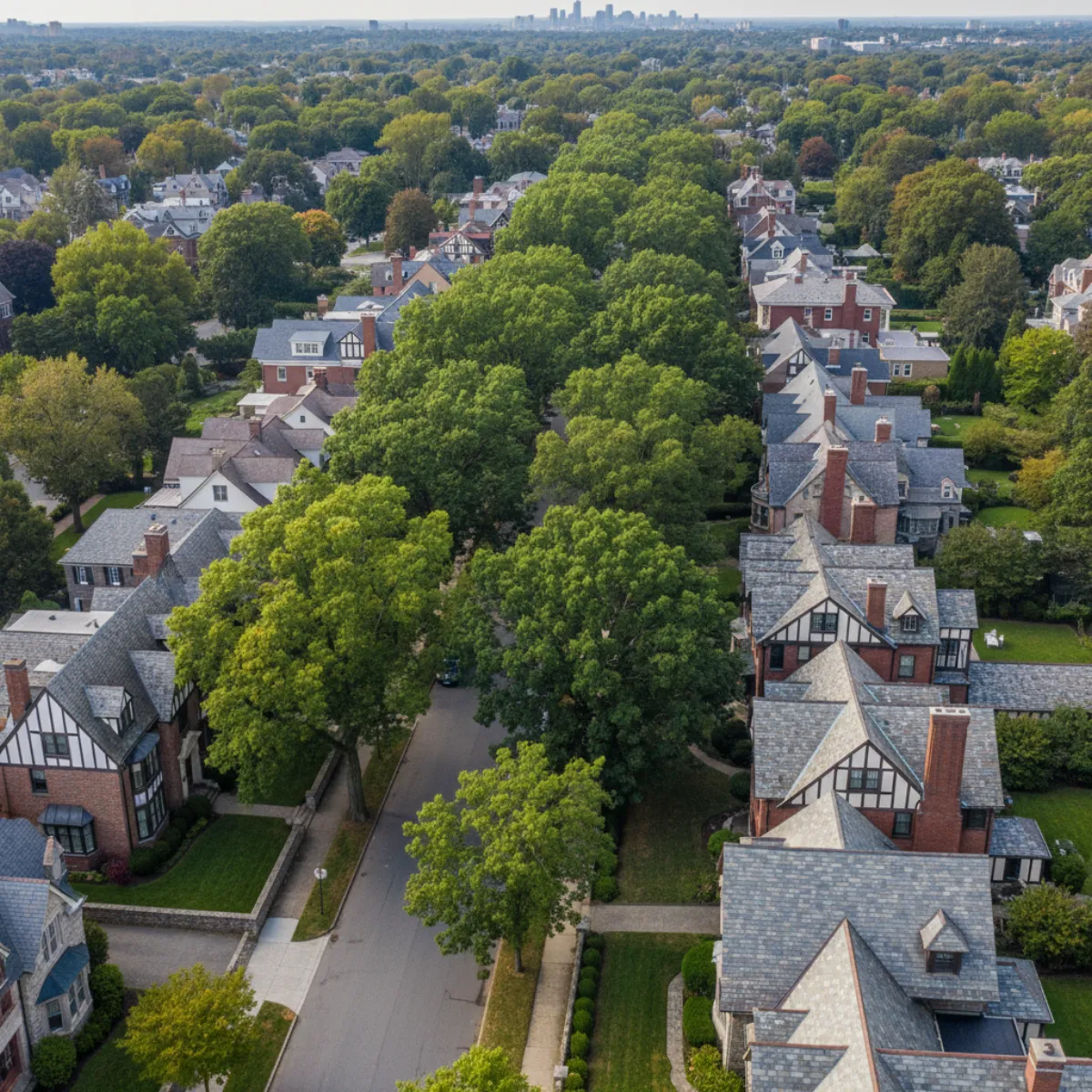
Essex County is home to roughly 860,000 residents across 22 municipalities and contains perhaps the widest housing-stock contrast in New Jersey. On one end is Newark, the state’s largest city with dense pre-war urban housing, brick row homes, and two-family/three-family flats. On the other end are the affluent Watchung Mountain suburbs — Montclair, Glen Ridge, Verona, Caldwell, Essex Fells, and Llewellyn Park (West Orange) — with sprawling Victorian, Tudor, and Colonial Revival homes that originally featured slate roofs and copper flashing.
The county’s major centers are Newark (population 311,000), East Orange (69,000), Bloomfield (53,000), Montclair (40,000), Irvington (54,000), and West Orange (49,000). Newark’s housing stock is dominated by 1900-1940s construction: brick row houses in the Forest Hill, Vailsburg, and Weequahic neighborhoods; multi-family flats throughout the South Ward and Central Ward; and a small ring of post-war single-family Capes around the city’s edges. Roof footprints are small (typically 1,000-1,700 sqft) but many properties combine a pitched front roof with a flat or low-slope rear addition, complicating reroof scope.
The county’s suburban tier is divided by the Watchung Mountains. East of the ridge: Bloomfield, Glen Ridge, Belleville, Nutley, and the Oranges — older first-ring suburbs developed 1890-1940 with predominantly Victorian, Colonial, and Tudor architecture. West of the ridge: Montclair, Verona, Cedar Grove, North Caldwell, Caldwell, Roseland, Essex Fells, and Livingston — later suburban development (1920-1970s) with larger lots and a wider mix of architectural styles. The westernmost Livingston-Roseland-Essex Fells corridor includes some of the most expensive residential real estate in New Jersey.
Maplewood and South Orange, on the county’s southern border with Union County, share housing-stock characteristics with western Essex: large Tudors, Colonials, and Victorians on tree-lined streets, with original slate and cedar roofs that are now reaching end of life. These two towns are also experiencing rapid demographic shift with high turnover from Brooklyn and Manhattan transplants — reroof demand has grown substantially since 2020 as buyers fix deferred maintenance.
Essex County Climate & Its Impact on Roofs
Essex County experiences a humid continental climate with notable urban heat island effects in Newark and the eastern flats. The Watchung Mountains create a microclimate for Montclair, Verona, and West Orange — slightly more snowfall, cooler summer temperatures, and higher fall leaf load.
Urban Heat Island (Newark / Irvington / East Orange)
Dense paved surfaces and limited tree canopy in Newark’s wards push summer attic temperatures on dark-shingle roofs to 150-165°F on hot July afternoons. This is the harshest thermal environment in the county and accelerates shingle binder degradation by 15-25% versus suburban Essex.
Cool-roof shingle colors (lighter charcoals, weathered woods) and reflective TPO on flat sections meaningfully reduce attic temps and HVAC loads. Newark’s cool-roof guidance encourages reflective products on commercial flat-roof retrofits.
Watchung Mountain Snow Belt
Montclair, Verona, and West Orange sit at 400-700 ft elevation along the First and Second Watchung Ridges, picking up an extra 5-10 inches of snow per year compared to Newark or Bloomfield. Heavy wet snow storms (the “heart-attack snow” variety) are most damaging here.
Slate and steep-pitch designer architectural shingles handle the load well, but ice dams form readily on north-facing slopes of poorly insulated Tudors and Victorians. Full ice/water shield over the entire deck is recommended for any reroof on a finished-attic Montclair Victorian.
Fall Leaf Load (Suburban Essex)
Mature oak, maple, and tulip canopy in Montclair, Glen Ridge, Maplewood, and South Orange creates heavy fall leaf accumulation. Wet leaves trapped in valleys, behind dormers, and around chimneys hold moisture against shingles and accelerate algae growth and granule loss.
An annual fall cleaning, plus algae-resistant shingles with copper or zinc granule integration, dramatically extends roof life on heavily treed lots. Zinc ridge strips are an inexpensive add-on that prevents north-slope algae streaks.
Wind Events & Hurricane Remnants
Essex County sits in the path of hurricane remnant tracks moving up the East Coast. Hurricane Ida (2021) caused widespread roof damage across Newark and Maplewood; Tropical Storm Henri (2021) produced 60-70 mph gusts that lifted shingles on hundreds of older Essex homes.
Architectural shingles rated for 130 mph wind uplift with a six-nail pattern are the safe baseline for Essex County. Class 4 impact-resistant shingles add $0.75-$1.25 per square foot and earn 5-15% off homeowner’s insurance with most New Jersey carriers.
Essex County Roof Replacement Costs (2026)
Essex County roofing costs span an unusually wide range. Newark and the eastern wards run roughly 5-10% below the New Jersey state average; the suburban Watchung tier (Montclair, Verona, West Orange, Livingston) runs 10-20% above state average; and Maplewood and South Orange land in between with strong upward pressure from rising home values.
Cost by Material — Essex County 2026
| Material | Cost / Sqft | 2,000 Sqft Roof | Lifespan (Essex) |
|---|---|---|---|
| 3-Tab Asphalt | $3.75–$5.50 | $7,500–$11,000 | 15–18 yr |
| Architectural Shingles | $5.00–$8.25 | $10,000–$16,500 | 22–27 yr |
| Designer / Slate-Look | $7.50–$11.00 | $15,000–$22,000 | 25–35 yr |
| Standing Seam Metal | $10.50–$16.00 | $21,000–$32,000 | 40–70 yr |
| Cedar Shake | $11.00–$17.00 | $22,000–$34,000 | 25–35 yr |
| Slate (Natural) | $22.00–$31.00 | $44,000–$62,000 | 75–150 yr |
| Flat / TPO (low-slope) | $6.50–$10.50 | $13,000–$21,000 | 20–30 yr |
* Includes tear-off, ice/water shield, synthetic underlayment, and standard ventilation. Slate restoration on Montclair / Glen Ridge Tudors with original copper detailing can run 50-100% above table values.
Essex-Specific Cost Factors
- •Slate matching / partial repair: $25-$50 per slate piece. A typical Montclair Victorian repair can run $1,500-$5,000 for spot work that defers full replacement 5-10 years.
- •Copper flashing: $35-$60/linear foot. Required on most Montclair, Glen Ridge, and South Orange historic-district homes.
- •Newark dumpster / parking permit: $50-$200 for street dumpster placement; many blocks require temporary parking suspension permits adding $25-$75/day.
- •Three-family flat roof: Typical Newark / East Orange three-decker rear flat section runs $4,000-$9,000 in TPO or modified bitumen as part of a combined reroof.
2026 Material Pricing Trends
Steel and aluminum tariffs added $1.50-$2.50 per square foot to standing seam metal in Essex County. Slate pricing has been relatively stable, but skilled slate labor is the binding constraint — the working pool of slate-trained crews in northern New Jersey is small and shrinking, making lead times of 8-16 weeks common for full slate restorations.
Architectural shingles in stock charcoal, weathered wood, and driftwood colors ship in 2-3 days from Bloomfield and Belleville suppliers. Designer slate-look profiles (CertainTeed Grand Manor, GAF Grand Sequoia) have 1-3 week lead times in popular colors.
Roofing Notes by Essex County Town
Newark & Irvington
Newark is the largest single roofing market in Essex County and features the widest range of building types. Pitched-roof Capes and Colonials in the Vailsburg, Forest Hill, and Weequahic neighborhoods take standard architectural shingle reroofs. Multi-family flats throughout the South Ward, Central Ward, and Ironbound often combine pitched front and flat rear sections requiring two material systems on one project. Permit processing is online and typically takes 5-10 business days. Irvington follows the same pattern with even smaller average roof footprints. Average reroof: $9,500-$13,500.
East Orange, Orange & West Orange
“The Oranges” are a study in contrasts. East Orange is dense urban with primarily 1910-1940 multi-family housing — reroof economics resemble Newark. Orange is a transitional market with mixed multi-family and single-family Capes. West Orange is suburban with significantly larger roof footprints, particularly in the Llewellyn Park gated community where slate, cedar, and designer shingles dominate. Llewellyn Park’s private architectural review board approval is required before any reroof permit can be filed.
Montclair, Glen Ridge & Verona
The crown jewel of Essex County roofing complexity. Montclair has multiple historic districts including Upper Montclair, Estate Section, and Pine Street. Glen Ridge is on the National Register of Historic Places nearly in its entirety. Roof systems here often combine slate, cedar, copper, and synthetic slate. Average reroof on a 2,500 sqft Montclair Tudor with designer architectural shingles runs $18,000-$28,000; the same home in natural slate restoration can exceed $80,000. Verona has lower-density housing with a mix of 1920s-1960s Colonials and ranches — more straightforward and less expensive than Montclair.
Maplewood & South Orange
Maplewood and South Orange have seen the largest demographic shift in Essex County since 2020 as Brooklyn and Manhattan transplants drive home prices to record highs. Many homes are 1920s Tudors and Colonials with original slate reaching end of life. New owners frequently invest in major reroof, dormer rebuilds, and copper flashing replacement during the first 2-3 years of ownership. Reroof projects routinely include attic insulation upgrades that compound the project scope and cost. Maplewood’s Hilton historic district has its own design review.
Livingston, Roseland, Caldwell & Essex Fells
Western Essex’s newer suburban tier has the largest average home sizes in the county. Livingston features 1960s-2000s Colonials and contemporary builds with roof footprints often exceeding 3,000 sqft. Essex Fells is private and upscale with custom Tudors and Colonial Revivals. Reroofs here favor designer architectural shingles, standing seam metal accents, and impact-resistant upgrades for insurance premium reduction. Average reroof: $18,000-$32,000.
Bloomfield, Belleville & Nutley
The eastern suburban tier of Essex County is dense first-ring development with smaller roof footprints (1,300-1,800 sqft) and 1920s-1950s housing stock. Bloomfield’s Brookdale section and the older Nutley village core have Victorian and Colonial Revival homes with steep multi-dormer roofs. Belleville is more working-class with simpler ranch and Cape geometry. Average reroof: $10,500-$15,500.
Essex County Building Codes & Historic Districts
All Essex County reroofs are governed by the New Jersey Uniform Construction Code (N.J.A.C. 5:23) and the 2021 IRC/IBC with NJ amendments. Permits are issued by each municipality. Statewide framework: see the New Jersey Roofing Permit Guide.
Essex-Specific Permit & Historic Notes
- 1Newark online portal: reroof permits processed via newarknj.gov; typical issuance 5-10 business days.
- 2Montclair Historic Preservation Commission: review required for material changes in any of the town’s historic districts; 4-8 week approval cycle before permit can be filed.
- 3Glen Ridge: National Register district; in-kind material replacement strongly preferred.
- 4Llewellyn Park (West Orange): private gated community; architectural review board approval required before municipal permit.
- 5Ice/water shield, ventilation, max two layers: standard NJ code applies countywide.
- 6NJ HIC registration: all contractors must be registered with the Division of Consumer Affairs; verify before signing.
Why Standardized Quote Comparison Matters in Essex County
Essex County’s contractor market is huge and uneven. Newark’s pricing pool ranges from established multi-generational firms with decades of three-decker experience to one-truck storm-chasers who appear after Nor’easters. Montclair demands a different skill set entirely — slate experience, copper detailing, and historic-district familiarity. The same 2,200 sqft Montclair Tudor can attract bids ranging from $14,000 (probably wrong) to $48,000 (probably correct for full slate restoration). Apples-to-apples scope comparison is essential.
How RoofVista Standardizes Essex Quotes
Satellite Measurement
Your Essex County roof measured from satellite — including dormers and complex geometry.
Identical Line Items
Tear-off, ice/water shield, underlayment, shingles, flashing, ventilation, warranty — same scope across every quote.
Pre-Vetted Contractors
NJ HIC registration, insurance, and historic-district experience verified before any contractor reaches you.
Essex County Roofing: Frequently Asked Questions
How much does a roof replacement cost in Essex County, NJ?
A typical Essex County roof replacement runs $9,500 to $18,000 for a 1,600-1,900 sqft home using architectural asphalt shingles in 2026. Pricing splits sharply by community: Newark, Irvington, East Orange, and Orange average $9,500-$14,000 because of smaller roof footprints (1,200-1,700 sqft) on dense urban housing stock; Montclair, Glen Ridge, Maplewood, South Orange, and West Orange run $14,000-$22,000+ because of larger Victorian, Tudor, and Colonial Revival homes with steep multi-dormer rooflines (often 2,200-3,200 sqft of roof surface). Architectural shingles average $5.00-$8.25 per square foot installed; standing seam metal runs $10.50-$16.00; slate, common on Montclair and Glen Ridge Tudors, runs $22.00-$31.00 per square foot.
Why is Essex County such a slate-heavy market?
Essex County has one of the highest concentrations of original slate roofs in New Jersey. The county was developed largely between 1880 and 1930 during the railroad-suburb boom, when Pennsylvania and Vermont slate quarries were at peak production and the cost premium over asphalt was modest. Montclair, Glen Ridge, Upper Montclair, South Orange, Maplewood, Llewellyn Park (West Orange), and parts of Verona were built during this era and were originally slate-roofed almost universally. Many of these slate roofs are now 100-130 years old and reaching end of useful life. Homeowners face a choice: full slate replacement ($45,000-$110,000+ for a typical Montclair Tudor), partial slate repair with matching salvage, or transition to a high-end synthetic slate or designer architectural shingle. Each path has tradeoffs around cost, historic-district approval, and structural framing capacity.
What roofing materials are best for Newark and Irvington homes?
Newark and Irvington feature dense urban housing dominated by 1900-1940s two-family and three-family flats, plus older brick row houses and Cape Cods. Roof footprints are smaller (1,000-1,700 sqft) and many homes have flat or low-slope rear sections that need TPO or modified bitumen rather than asphalt shingles. For the pitched front portions, architectural asphalt shingles rated for 110 mph wind uplift are the dominant choice — affordable, proven in Newark’s climate, and compatible with the city’s permit process. Reflective TPO membranes on flat sections meet Newark’s cool-roof guidance and can lower upper-floor cooling costs by 10-20% in summer. Tar-and-gravel (built-up roofing) is being phased out across the city as crews retire and TPO/EPDM systems offer better performance at similar cost.
Do I need a permit for roof replacement in Essex County?
Yes — every Essex County municipality requires a permit under the New Jersey Uniform Construction Code. Permits are issued by each town’s building department: Newark uses an online portal at newarknj.gov; Montclair, Maplewood, and the Oranges have in-person permit offices; West Orange and Livingston accept either. Typical residential reroof permit fees run $80-$300. Newark has been actively cracking down on unpermitted work since 2024 — code-enforcement officers do drive-by inspections and can issue stop-work orders that delay projects 2-4 weeks. Always insist your contractor pulls the permit in their own company name and schedules the required final inspection. If a contractor offers a "permit-free" discount, walk away.
How does the Essex County climate affect roof lifespan?
Essex County has a humid continental climate with significant urban heat island effect in Newark, East Orange, and Irvington. Summer attic temperatures in dark-shingle Newark row houses regularly exceed 150°F, accelerating shingle binder degradation. Winter brings 30-45 inches of snow annually and 75-95 freeze-thaw cycles between November and April. Ice dams are common on older Bloomfield, Glen Ridge, Maplewood, and South Orange homes with marginal attic insulation. The Watchung Mountains running through Montclair, Verona, and West Orange create slightly higher snow accumulation than the rest of the county. Realistic shingle lifespan in Essex County is 22-27 years for architectural products versus the manufacturer’s 30-year rating; west and south-facing slopes fail first.
Are Essex County historic districts a factor for roofing decisions?
Yes — Essex County has more historic district overlays than any other NJ county. Montclair has multiple historic districts including Upper Montclair, Estate Section, and the Pine Street area. Glen Ridge is a National Register district nearly in its entirety. Maplewood has the Hilton historic district; South Orange has the Montrose Park Historic District; West Orange has Llewellyn Park (a private gated community with its own architectural review). These districts typically restrict roofing material to in-kind replacement: slate replacing slate, cedar replacing cedar, or specifically approved architectural shingle profiles when slate is being phased out. Approval can take 4-8 weeks before permit issuance. Always contact your town’s historic preservation commission BEFORE signing a roofing contract — material choices made without approval can trigger restoration orders.
How do roofing prices compare between Newark and Montclair?
A typical 1,500 sqft architectural-shingle reroof in Newark runs about $9,500-$13,000. The same house style and footprint moved to Montclair would run $11,500-$16,500 — roughly 20-25% higher. Three structural reasons: (1) Montclair’s historic district approvals add labor and complexity; (2) Montclair homes more often have steep pitch (8:12 to 12:12) and complex multi-dormer geometry that requires safety setup and slows production; (3) the Montclair contractor pool is more selective — many contractors who service Montclair have higher overhead, full-time foremen, and crews trained on slate and copper work. For a true Tudor-style home in Estate Section or Upper Montclair with a 2,800 sqft slate-pattern roof, expect $24,000-$45,000 for designer architectural shingles, or $70,000-$130,000+ for natural slate restoration.
How do I compare Essex County roofing quotes fairly?
Insist that every Essex County quote use an identical scope: tear-off layers, ice and water shield extending 24 inches past the interior wall line (more on cathedral-ceiling homes), synthetic underlayment, exact shingle product (brand, line, color), step and counter flashing material, ridge ventilation linear feet, and warranty terms. RoofVista standardizes these so you compare apples-to-apples bids from pre-vetted Essex County contractors. Common gotchas to flag: builder-grade shingle substitution after a "good" brand was discussed verbally, felt instead of synthetic underlayment, missing chimney counter-flashing line items, and unclear "miscellaneous" labor add-ons. Newark specifically: verify the contractor will pull the permit in their own name, not yours, and confirm the certificate of insurance lists the city as an additional insured if required by your block.
Get Instant Roof Replacement Quotes for Your Essex County Home
Compare quotes from pre-vetted contractors serving Newark, Montclair, the Oranges, Bloomfield, Maplewood, Livingston, and every Essex County town. Free instant estimate based on your actual roof dimensions.
No spam. No phone calls. Just instant quotes from vetted Essex County contractors.