Key Takeaways
- • Civil Code 5551 requires exterior elevated element inspection every 9 years for condo HOAs with 3+ units.
- • The first inspection deadline was January 1, 2025 — now passed, exposing non-compliant HOAs to insurance consequences.
- • 2026 master-policy insurers require documented compliance or impose 200–300% premium surcharges.
- • Rooftop decks are squarely in scope whenever wood framing, blocking, or sheathing is present.
- • A 120-day permit + 120-day repair clock triggers on any life-safety finding.
In This Guide
SB 326 in Plain English
SB 326, codified at California Civil Code section 5551, requires every condominium-form homeowners association with three or more unitsto inspect its exterior elevated elements (EEE) at least once every nine years, using a qualified inspector and issuing a stamped written report. The law was a direct legislative response to the 2015 Berkeley balcony collapse that killed six Irish exchange students when a dry-rotted wood-framed balcony failed without prior inspection.
The first inspection deadline was January 1, 2025. That deadline has now passed. California condominium HOAs that did not complete their first inspection are technically non-compliant with Civil Code 5551, exposing board members to fiduciary liability and the association to insurance market consequences that escalated dramatically through 2025 and into 2026.
SB 326 applies only to condominium associations. Apartment rental buildings fall under a parallel but distinct law, SB 721, which carries a January 1, 2026 first-inspection deadline. Single-family-home HOAs and planned developments without shared elevated elements are outside both laws.
What Counts as an Exterior Elevated Element
Civil Code 5551 defines EEE narrowly. Three conditions must all be met:
- 1. Wood-supported. The element must be supported in whole or substantial part by wood or wood-based products. Concrete post-tensioned balconies and all-steel assemblies are out of scope.
- 2. More than six feet above grade. Ground-level patios and first-floor walkouts are out of scope.
- 3. HOA-maintained. The element must be within the association's maintenance obligation per the CC&Rs.
Qualifying EEE types include upper-floor attached balconies, exterior walkways accessing second-floor or higher units, exterior stairways and landings, elevated entryway platforms, and rooftop decks whose substructure includes wood framing or sheathing. Many 1970s–2000s California condominium buildings include every one of these elements, often in wood-framed Type V construction that is particularly vulnerable to dry rot and water intrusion.
Rooftop Deck and Roof System Interaction
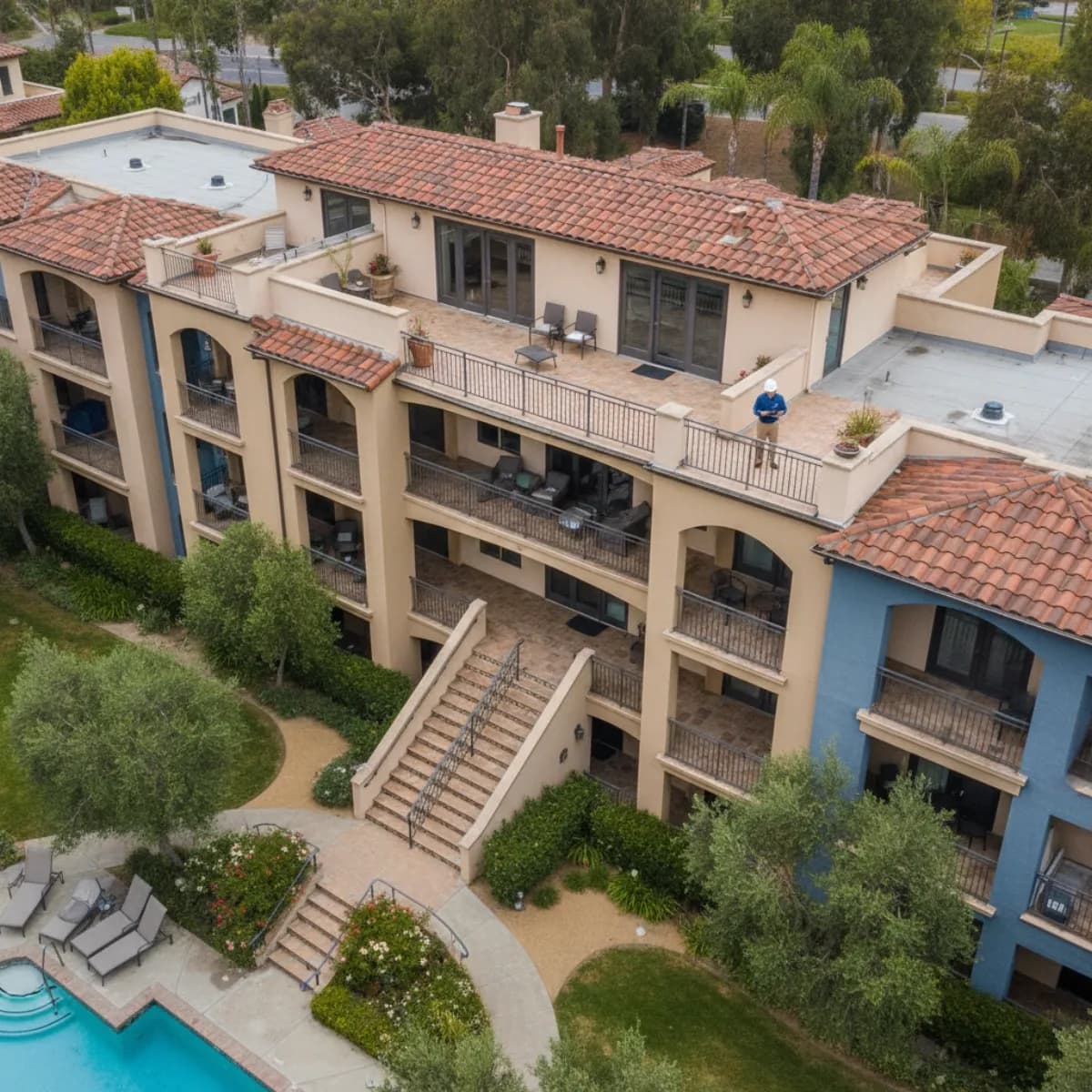
Rooftop decks are the SB 326 category where inspection most often triggers significant roofing work. Nearly every California rooftop deck assembly includes wood blocking at parapet walls, wood sleepers under deck pavers or wood decking, and wood sheathing as the substrate for the waterproofing membrane. All of this wood is in scope under SB 326.
Inspectors evaluate five rooftop deck components:
- • Waterproofing membrane (TPO, PVC, modified bitumen, liquid-applied) — condition, seam integrity, UV weathering
- • Parapet wall flashings — counterflashing, cap flashing, termination bar
- • Drain scuppers and overflow drains — clear flow, membrane integration
- • Railing and guardrail attachments — through-membrane penetrations, bolt corrosion
- • Underlying wood framing and sheathing — dry rot, moisture damage, structural deflection
When inspectors identify membrane failures or water intrusion into the underlying wood framing, remediation typically requires pulling up the deck topping, replacing damaged sheathing, installing new waterproofing membrane, and re-flashing penetrations and parapets. Costs for this scope range from $15,000 to $200,000+ per building depending on roof deck area and damage extent. Associations facing this scope often bundle SB 326 remediation with a full flat-roof replacement below, which is more cost-effective than repairing decks-only and leaves the whole roof system under a single new warranty.
Rooftop Deck Remediation Quote in 30 Seconds
Our satellite measures your building's rooftop deck area and matches you with CSLB-licensed contractors experienced with SB 326 timelines.
Interactive SB 326 Compliance Checker
Enter your property details to see current compliance status, next inspection due date, and estimated cost ranges.
SB 326 / SB 721 Compliance Checker
Check your HOA or apartment balcony inspection status, next due date, and estimated cost.
Property Type
Balconies, decks, walkways, stairs, landings — count each one.
Qualified Inspectors Under AB 2114
The original SB 326 restricted inspections to California-licensed architects or structural engineers only. That pool proved inadequate to service the statewide backlog before the January 2025 deadline. AB 2114 (signed 2024) expanded the pool to include licensed civil engineers. As of 2026, any of these three license types can perform the inspection:
- • California Licensed Architect
- • California Licensed Structural Engineer (SE)
- • California Licensed Civil Engineer (PE)
The inspector must be independent of any contractor who would perform remediation work — you cannot use the same firm for both inspection and repair without a conflict-of-interest waiver. Best practice is to engage the inspection firm first, receive the stamped report, then separately competitive-bid the remediation scope.
The 120/120 Day Remediation Clock
If an SB 326 inspection identifies any condition that poses an immediate threat to life safety (structural instability, significant dry rot in load-bearing members, failing railings), Civil Code 5551 triggers a statutory timeline:
- Day 0: HOA receives the inspection report identifying life-safety conditions.
- Day 0–120: HOA must apply for a building permit for corrective work.
- Day 120+: Permit issued (by local jurisdiction).
- Day 120–240 (second 120 days): HOA must complete corrective work.
Missing these windows exposes board members to personal fiduciary liability and can accelerate insurance non-renewal. Non-emergency deficiencies (cosmetic damage, minor weathering) fall outside the 120/120 clock but must still be tracked and remediated on a reasonable schedule documented in HOA records.
The 2026 Master Policy Crisis
The sharpest consequence of SB 326 in 2026 is not regulatory penalty — it is insurance. Master policy carriers for California HOAs have watched SB 326 non-compliance correlate strongly with catastrophic claims (balcony collapses, rooftop deck failures, water intrusion claims). Starting with 2025 renewals and accelerating through 2026, carriers are:
- • Requiring a current SB 326 report as a renewal condition
- • Surcharging non-compliant HOAs 200–300% on master premiums
- • Non-renewing associations that cannot produce documentation, with some HOAs forced into surplus-lines carriers at 4–5x prior premiums
- • Requiring remediation completion before binding new coverage on identified deficiencies
Boards that have not yet completed a first inspection should prioritize it ahead of the next master policy renewal. Inspection cost ($350–$1,500 per EEE) is trivial compared to the premium surcharge or non-renewal cost of skipping it. If remediation is needed, RoofVista can connect HOA boards with pre-vetted C-39 contractors experienced with rooftop deck waterproofing and membrane replacement under SB 326 timelines.
Frequently Asked Questions
Frequently Asked Questions
What is SB 326 and does it apply to my HOA?
SB 326 is a California law, codified at Civil Code section 5551, that requires every condominium homeowners association with three or more units to inspect its exterior elevated elements (EEE) on a recurring cycle. EEE includes balconies, decks, walkways, stairways, elevated landings, and rooftop decks that the association has a maintenance obligation for, specifically those supported in whole or substantial part by wood or wood-based products and that are more than six feet above ground level. The law was enacted in 2019 after the 2015 Berkeley balcony collapse that killed six people. If your association has 3 or more units and any qualifying elevated element, SB 326 applies. Single-family homes and duplexes are outside SB 326 scope (apartment rentals fall under SB 721 instead), though local jurisdictions may layer additional requirements.
What counts as an "exterior elevated element" under SB 326?
An EEE under Civil Code 5551 is any exterior structural element that is (1) supported in whole or substantial part by wood or wood-based products, (2) more than six feet above grade, and (3) the HOA has an obligation to maintain. The most common qualifying elements are balconies attached to upper-floor units, exterior walkways accessing second-floor or higher units, exterior stairways between levels, elevated landings, and rooftop decks on top of underlying units. Concrete post-tensioned balconies, steel-frame walkways with non-combustible decking, and grade-level patios are generally outside EEE scope. Rooftop decks are explicitly covered when their substructure or waterproofing system includes wood framing, wood blocking, or wood-based sheathing, which is nearly every standard California rooftop deck assembly.
Does SB 326 cover rooftop decks and roof parapets?
Yes, rooftop decks are squarely within SB 326 scope when they sit above a unit that has an association maintenance obligation and include any wood framing, blocking, or sheathing. Inspections must evaluate the waterproofing membrane, flashings at parapet walls, drain scuppers, railing attachments, and the interface between the deck assembly and the roof system below. This is where SB 326 intersects directly with roofing work: a failing rooftop deck waterproofing layer typically manifests first as interior leaks in the unit below, and remediation usually requires partial or full roof membrane replacement alongside deck reframing. Parapet walls themselves are not listed EEE components but are commonly inspected in the same visit because parapet flashing failures are a frequent root cause of deck waterproofing failures.
How often does SB 326 inspection need to happen?
SB 326 requires an initial inspection by January 1, 2025, and thereafter at least once every nine years. The first inspection deadline has now passed. Associations that missed the January 2025 deadline are technically non-compliant and face escalating insurance consequences: master policy carriers increasingly require documented SB 326 compliance at renewal, with several major carriers declining to renew or imposing 200-300% premium surcharges on HOAs that cannot produce a current inspection report. The nine-year recurring cycle resets from the most recent inspection date. Associations with known deficiencies may be required to inspect more frequently by their insurer or their structural engineer of record. Local jurisdictions can also require shorter cycles; check with your city building department.
Who is qualified to perform SB 326 inspections?
Originally, SB 326 restricted inspections to California-licensed architects or licensed structural engineers only. AB 2114, signed in 2024, expanded the qualified inspector pool to include licensed civil engineers. All three license types can now perform SB 326 inspections, but they must be independent of the contractor who would perform any remediation, must visually inspect a statistically significant sample of each EEE type (typically at least 15% or enough to establish representative condition), and must issue a stamped written report documenting observed conditions, the sampling methodology, and any corrective action needed. Reports must be retained for two inspection cycles (18 years) and are typically shared with master-policy insurers at renewal.
What happens if my HOA fails SB 326 inspection?
If the inspection report identifies any condition that poses an immediate threat to life safety, Civil Code 5551 triggers a specific timeline: the association must apply for a building permit for corrective work within 120 days of receiving the report, and must complete the corrective work within 120 days of permit issuance. Missing those windows exposes the board to personal liability and the association to insurance non-renewal. Less urgent deficiencies are documented with a recommended remediation schedule but do not trigger the 120/120 clock. Remediation costs vary dramatically: surface-level waterproofing repairs run $10,000–$50,000 per building, while structural reframing of multiple balconies or full rooftop deck rebuilds can exceed $500,000 per building. Many associations assess special reserves or take out HOA loans to fund SB 326-driven repairs.