Key Takeaways
- • ~10,000 Eichler homes in California, mostly Bay Area peninsula cities.
- • Tongue-and-groove sheathing IS the finished ceiling — tear-off must not damage it.
- • White TPO is the dominant 2026 retrofit choice ($8–$14/sqft, Title 24 compliant).
- • Atrium perimeter flashing adds ~12% to labor cost.
- • Adding insulation during re-roof can cut heating/cooling bills 30–50%.
In This Guide
What Makes an Eichler Roof Different
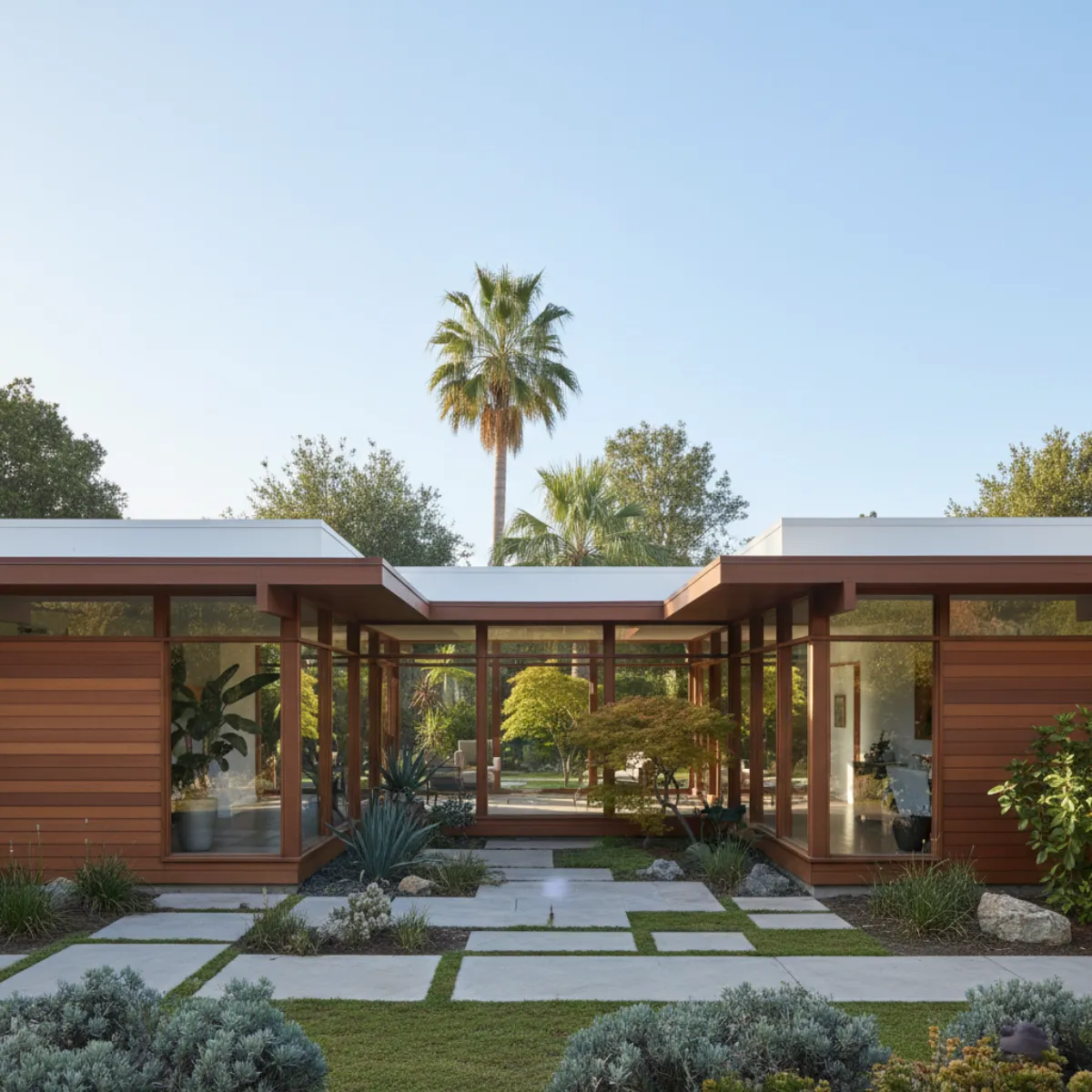
Joseph Eichler built roughly 11,000 homes in California between 1949 and 1974, primarily in the Bay Area peninsula cities of Palo Alto, Sunnyvale, Mountain View, San Mateo, and Burlingame, with smaller concentrations in Orange County (North Tustin, Granada Hills area) and Thousand Oaks. His architects — Jones & Emmons, Anshen & Allen, and later Claude Oakland — designed homes that expressed mid-century modern ideals through three signature features that make roof replacement fundamentally different from a conventional home.
1. Post-and-Beam Structure
Instead of load-bearing walls, Eichler homes use a grid of wood posts supporting exposed horizontal beams. This allows the glass walls and open plans the style is known for. It also means the roof load path runs through specific beam locations, which a re-roofer must not compromise during fastener placement.
2. Tongue-and-Groove (T&G) Sheathing = Ceiling
Eichler roofs use 2x6 or 2x8 tongue-and-groove decking as both the structural sheathing and the finished interior ceiling. There is no attic cavity. Any fastener, hole, or damage to the T&G during tear-off shows directly from inside the living space. This is the single biggest differentiator from conventional roof replacement.
3. Central Atrium
Many Eichler plans include an open-air atrium in the center of the home, with the roof wrapping around a central opening. The atrium perimeter requires precise flashing detailing to prevent water intrusion into the interior vestibule. Atrium flashing complexity adds roughly 12 percent to labor cost versus a conventional flat roof of equivalent area.
TPO vs PVC vs Modified Bitumen for Eichlers
Four membrane categories dominate 2026 Eichler retrofits. Each has a distinct value proposition:
White TPO (Dominant Choice)
$8-14/sqft · 15-25yr warranty · Title 24 cool-roof compliant. Hot-air-welded seams, bright white reflectance, inexpensive per-sqft. Sure-Weld (Carlisle), GAF EverGuard, and Firestone UltraPly are industry leaders. The default 2026 choice for value-conscious Eichler owners.
PVC (Premium Long-Life)
$10-16/sqft · 25-30yr warranty · Best chemical resistance. Sika Sarnafil G410 and Duro-Last Platinum are common on Bay Area Eichlers. Worth the 20-30 percent premium if you intend to stay 15+ years.
Modified Bitumen (Traditional)
$9-13/sqft · 15-20yr life · Cool-rated white variants available. Torch-down or self-adhered application. Traditional look that respects the original mid-century aesthetic. Less puncture resistance than TPO/PVC.
Spray Polyurethane Foam (SPF)
$10-15/sqft · 20yr life with recoat · R-6 to R-7 per inch insulation. Monolithic seamless application. Particularly valuable on Eichlers where the flat roof doubles as the ceiling — the radiant insulation benefit is immediate. Requires acrylic topcoat recoat every 10-15 years.
Interactive Eichler Material Picker
Enter your roof area and atrium configuration to see cost, lifespan, and Eichler-fit ratings by material.
Typical Eichler: 1,400-2,400 sqft including atrium opening perimeter.
Eichler Fit: Excellent
Dominant 2026 Eichler retrofit choice. Bright white, highly reflective, weldable seams, Title 24 cool-roof compliant, 15-25 year manufacturer warranty. Preserves the original low-slope aesthetic.
Estimated Cost Range
$16,128 – $28,224
Expected Lifespan
22 yrs
Atrium Premium
+12%
Illustrative 2026 California pricing. Actual cost depends on deck condition (Eichler decks often need partial replacement), atrium perimeter complexity, tongue-and-groove sheathing preservation, and structural inspection findings. Request a satellite estimate for a site-specific quote.
Get an Eichler-Experienced Roofer Quote
Our satellite measures your Eichler's flat roof and matches you with California contractors who preserve tongue-and-groove sheathing and atrium flashing integrity.
Atrium Flashing and Perimeter Detailing
The atrium perimeter is where Eichler roofs most often fail. The roof-to-parapet transition around the atrium opening must shed water inward to a central drain or outward to a perimeter gutter, and it must do so across a geometry that includes corners, inside changes in direction, and post-and-beam intersections.
Best-practice atrium detailing includes: (1) tapered insulation to create positive slope toward drains (original Eichler decks are flat and often pond water otherwise), (2) primary flashing at the atrium curb using metal cant strip and counterflashing, (3) secondary waterproofing on the vertical atrium wall extending 18-24 inches above the roof deck, (4) termination bar with continuous sealant at the top of the vertical membrane, and (5) dedicated overflow scupper or drain for emergency water routing. Budget an extra day of labor for atrium detailing on any Eichler re-roof.
Tongue-and-Groove Preservation
The T&G sheathing that forms your interior ceiling cannot be damaged during tear-off. Four practices distinguish Eichler-experienced crews:
- • Hand tear-off only. No power rippers, no pry bars driven at an angle.
- • Pre-drilled fasteners. Prevents splitting of 50+ year old fir T&G that has dried and hardened.
- • Salvaged replacement stock. When a T&G board is damaged beyond repair, experienced crews source vintage fir T&G from reclaimed-lumber yards to match original grain and color. New fir looks wrong from below.
- • Daily moisture protection. The T&G is living inside the house. Any rain or dew during tear-off can warp, stain, or fail to finish properly. Experienced crews install temporary poly or tarpaulin protection every night until the new membrane is in place.
Adding Insulation During Re-Roof
Original Eichler roofs have minimal or no thermal insulation above the T&G deck. This is the single most important reason Eichlers have a justified reputation for being hard to heat and cool. Re-roof is the moment to fix it.
Two retrofit strategies are effective without interior destruction: (1) Above-deck rigid foam (ISO or EPS) at R-20 to R-40, installed on top of the T&G, under a cover board, under the new membrane. Raises finished roof height 3-6 inches but delivers excellent thermal performance. (2) Spray polyurethane foam (SPF) applied directly over the T&G with an acrylic topcoat, providing R-6 to R-7 per inch in a monolithic application with no height change visible from inside. SPF is particularly popular for Eichler retrofits because it preserves the original roof line.
Either strategy typically cuts Eichler heating and cooling bills 30-50 percent and often qualifies for utility rebates, CoolCalifornia credits, and AB 2167 insurer discounts as documented in ourCool Roof Rebate Stack guide.
Solar, NEM 3.0, and Roof Timing
Eichler flat roofs are excellent solar platforms because the low-slope geometry allows flexible azimuth orientation on tilt frames at the optimal 15-25 degree pitch. Under 2026 NEM 3.0 rates, battery-paired solar on an Eichler can dramatically offset the daytime cooling load driven by the home's extensive glass walls.
Two coordination rules: (1) Replace the roof first. Attaching solar mounts to an aging membrane voids the membrane warranty and creates leak paths. (2) Prefer ballasted mounting systems (heavy concrete or polymer blocks) that avoid any through-membrane penetrations. Full NEM 3.0 economics in ourNEM 3.0 guide.
Frequently Asked Questions
Frequently Asked Questions
What kind of roof does an Eichler home have?
Eichler homes, designed by Joseph Eichler and his architects (Jones & Emmons, Anshen & Allen, Claude Oakland) between 1949 and 1974, use low-slope flat roofs with exposed post-and-beam construction. The roof system sits directly on tongue-and-groove (T&G) 2x6 or 2x8 sheathing, which also serves as the finished interior ceiling inside the living spaces. There is no attic cavity — the roof deck is the ceiling. Original roofs were almost all built-up gravel-over-asphalt, installed with a coal-tar pitch system that required specialized application. Most original Eichler roofs have been replaced at least once, typically with modified bitumen (1990s-2010s) or more recently with TPO or PVC single-ply membranes (2015-2026). Roof slopes are typically 1:12 to 2:12, engineered for drainage without visible tilt.
What is the best roof replacement material for an Eichler?
White TPO (thermoplastic polyolefin) single-ply membrane is the dominant 2026 Eichler retrofit choice. It checks every box: bright white reflectance meets and exceeds Title 24 cool-roof prescriptive minimums (critical in the Bay Area climate zones where most Eichlers live), weldable seams provide superior water integrity versus traditional modified bitumen overlaps, 15-25 year manufacturer warranties are standard, and the low-profile appearance preserves the original mid-century aesthetic. PVC (brands like Sika Sarnafil G410 or Duro-Last Platinum) is the premium alternative with longer lifespan (25+ years) and better chemical resistance — worth the 20-30 percent cost premium for long-term owners. Modified bitumen remains a respectful choice for preservation-minded owners who want to match the original aesthetic language. EPDM (black rubber) is generally avoided on Eichlers because black does not meet Title 24 cool-roof compliance without additional coatings.
How much does an Eichler roof replacement cost in 2026?
A typical Eichler roof replacement in 2026 runs $15,000 to $38,000 installed, depending on material choice, roof area (most Eichlers are 1,400-2,400 square feet), and atrium configuration. Per-square-foot ranges: modified bitumen $9-13/sqft, TPO $8-14/sqft, PVC $10-16/sqft, spray polyurethane foam with acrylic topcoat $10-15/sqft. Eichler-specific factors that increase cost: atrium perimeter flashing (adds approximately 12 percent to labor), tongue-and-groove deck preservation (requires careful removal of existing material to avoid damaging the T&G), structural bracing for any sagging beams, and parapet cap flashing on homes with short parapets. Bay Area labor rates (particularly in Palo Alto, Sunnyvale, and San Mateo) push Eichler pricing toward the upper end of these ranges versus identical work in LA.
How do you replace an Eichler roof without damaging the tongue-and-groove ceiling?
Careful tear-off sequencing is the single most important step. Because the T&G sheathing is the finished interior ceiling, there is no margin for error — any punched hole, torn board, or over-driven fastener shows from below. Experienced Eichler roofing contractors use four specific practices: (1) Hand-pulling of existing membrane and fasteners rather than power tear-off, (2) replacement of damaged T&G boards with salvaged mid-century stock that matches original grain and color (new fir T&G typically looks wrong without aging), (3) pre-drilling new mechanical fasteners to prevent splitting, and (4) daily moisture protection during tear-off since the T&G is living inside the house. Budget one extra day of tear-off time versus a conventional flat roof. This is why you want an installer with documented Eichler experience — a generic commercial flat-roof crew will move too fast and damage the ceiling.
Can I add insulation to an Eichler roof during replacement?
Yes, and it is the single most valuable simultaneous upgrade. Original Eichler roofs had minimal or no insulation above the T&G deck, giving the homes a justified reputation for being hard to heat and cool. Modern retrofit options during re-roof include: (1) Above-deck rigid foam insulation (ISO or EPS) typically R-20 to R-40, installed on top of the T&G, under a cover board, under the new membrane — the cleanest long-term solution but raises the finished roof height 3-6 inches. (2) Spray polyurethane foam (SPF) with a coated topcoat provides R-6 to R-7 per inch in a monolithic application, adds no visible height change from inside, and is particularly popular for Eichler retrofits. (3) Interior insulation below the T&G is architecturally destructive and generally avoided. Above-deck rigid or SPF can transform Eichler energy performance dramatically, often cutting heating and cooling bills 30-50 percent.
Does a new Eichler roof work with solar panels and NEM 3.0?
Yes, with specific considerations. Eichler flat roofs are generally excellent solar platforms because the low-slope geometry allows flexible azimuth orientation of panels at optimal tilt angles (typically 15-25 degrees on a tilt frame). Three coordination points: (1) Replace the roof first, always. Solar mount penetrations through a new TPO or PVC membrane are straightforward, but cutting into a 20-year-old roof risks voiding membrane warranty and creates leak paths. (2) Use ballasted mounting systems (heavy concrete or polymer blocks) rather than through-penetration mounts whenever possible. Ballasted systems avoid all roof penetrations and preserve membrane integrity. (3) NEM 3.0 battery pairing is especially valuable for Eichlers because their large glass walls create daytime cooling load that a battery-enabled solar system can offset directly.