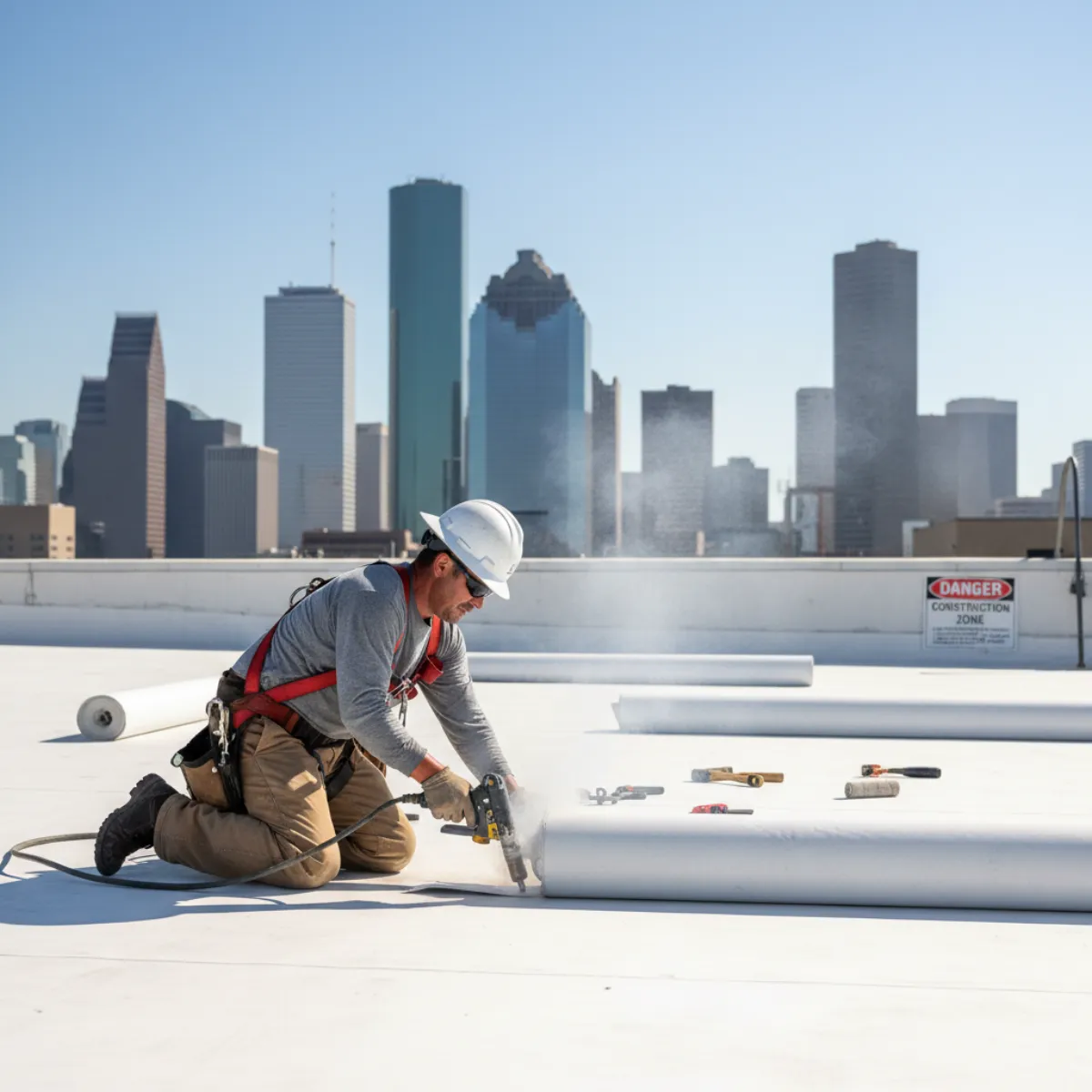
Flat and low-slope roofing is a major segment of the Texas roofing market, covering millions of square feet across commercial buildings, retail centers, warehouses, medical facilities, restaurants, and an increasing number of modern residential homes. In cities like Houston, Dallas, San Antonio, and Austin, flat roofs are everywhere — from downtown office towers to suburban strip malls to contemporary single-family homes with clean architectural lines.
The Texas climate presents unique challenges for flat roofing systems. Summer surface temperatures on flat roofs routinely exceed 160 degrees Fahrenheit, UV radiation is among the highest in the continental United States, and intense summer thunderstorms can dump inches of rain in under an hour — creating ponding water problems that degrade membranes and overload drainage systems. Add in the hail risk across Hail Alley — from the DFW metroplex through the I-35 corridor to the Panhandle — and the material selection, installation quality, and drainage design of a Texas flat roof become critical decisions that directly impact building performance and owner costs for decades.
This guide covers the five primary flat roofing systems used in Texas — TPO, EPDM, modified bitumen, PVC, and spray polyurethane foam — with Texas-specific pricing, performance data, energy efficiency comparisons, building code requirements, drainage solutions, hail resistance ratings, and maintenance schedules. Whether you are replacing a commercial flat roof, adding a flat-roof extension to your home, or evaluating cool-roof upgrades to cut energy costs, you will have everything you need to compare quotes from pre-vetted contractors and make an informed decision.
Why Texas Heat Makes Flat Roofing Material Choice Critical
Texas flat roofs face environmental stresses that accelerate membrane aging and increase energy costs. Understanding these challenges is essential for choosing the right system.
Extreme UV Radiation
Texas receives some of the highest UV radiation levels in the continental United States, with the southern and western regions experiencing UV indices of 10 or higher for 5 to 6 months of the year. Flat roofs bear the full brunt of direct overhead sun exposure with no slope to deflect radiation. Dark-colored membranes like traditional black EPDM can reach surface temperatures exceeding 170 degrees Fahrenheit on summer afternoons, accelerating membrane aging and driving cooling costs to extreme levels. Cool-roof membranes (white TPO, PVC, or white EPDM) reflect up to 80 percent of solar radiation, keeping surface temperatures 50 to 60 degrees cooler and reducing interior cooling loads by 20 to 30 percent.
Thermal Cycling Stress
Texas flat roofs endure dramatic daily temperature swings — surface temperatures can range from 80 degrees at dawn to over 160 degrees by mid-afternoon, then drop back below 90 after sunset. This 70 to 80 degree daily cycle causes repeated expansion and contraction of the roofing membrane, fasteners, flashing, and substrate. Over thousands of cycles per year, this thermal movement fatigues seams, pulls fasteners, cracks flashing sealants, and weakens membrane-to-substrate bonds. Single-ply membranes like TPO and PVC handle thermal cycling better than rigid systems because they are designed to flex with temperature changes, while modified bitumen systems use their multi-layer construction to distribute thermal stress across multiple reinforced plies.
Ponding Water After Summer Thunderstorms
Texas summer thunderstorms are intense and sudden — a supercell can drop 2 to 4 inches of rain in under an hour, then the sun returns and temperatures spike back above 100 degrees. This cycle of heavy rain followed by intense heat creates the perfect conditions for ponding water problems on flat roofs. Standing water magnifies UV damage by acting as a lens, accelerates biological growth (algae, mold, moss), and adds significant structural weight — every inch of ponding water weighs 5.2 pounds per square foot. Proper drainage design with a minimum slope of one quarter inch per foot, adequately sized primary drains, and emergency overflow scuppers is non-negotiable for Texas flat roofs.
Hail Vulnerability on Low-Slope Surfaces
Flat and low-slope roofs in Texas Hail Alley face a unique vulnerability: hailstones strike at near-perpendicular angles rather than glancing off at an angle as they do on steep-slope roofs. This direct impact concentrates more force on the membrane surface, increasing the risk of punctures and fractures. Standard 60-mil TPO and PVC membranes can sustain punctures from hailstones as small as 1.5 inches in diameter. Upgrading to 80-mil membranes provides substantially better hail resistance. Modified bitumen with its granule surface and reinforced multi-layer construction offers the best hail protection among flat roof systems. EPDM rubber absorbs impact well due to its flexibility but can develop hidden micro-tears at seam and flashing transitions.
Energy savings potential: Switching from a dark-colored flat roof to a white Energy Star-rated TPO or PVC membrane can reduce building cooling costs by 20 to 30 percent in Texas. On a 10,000 square foot commercial building in Houston or Dallas, this can translate to $2,000 to $5,000 in annual electricity savings — often recovering the cost premium of a cool-roof membrane within 3 to 5 years through energy savings alone.
Texas Flat Roofing Materials: Complete Comparison
Five flat roofing systems dominate the Texas market. Each has specific strengths that make it the best choice for particular applications, budgets, and building types.
TPO (Thermoplastic Polyolefin)
Best value cool-roof optionTPO is the most popular flat roofing membrane in Texas and for good reason. Its white reflective surface earns Energy Star certification and can reduce cooling costs by 20 to 30 percent in the punishing Texas sun. TPO membranes are heat-welded at the seams, creating a continuous waterproof bond that is stronger than the membrane itself. Available in 45-mil, 60-mil, and 80-mil thicknesses, with 60-mil being the standard for most Texas commercial and residential applications. TPO handles Texas heat well but can become brittle over time if the formulation is poor — stick with established manufacturers like Carlisle, Firestone, or GAF. Installation is faster than most other flat roof systems, which translates to lower labor costs.
EPDM (Ethylene Propylene Diene Monomer)
Most UV-resistant membraneEPDM is a synthetic rubber membrane that has been used on flat roofs for over 50 years. It is the most proven flat roofing system in terms of long-term durability and UV resistance. EPDM comes in black and white versions — in Texas, the white version is strongly recommended for its cool-roof properties, though black EPDM is extremely durable against UV degradation (counterintuitively, black EPDM rubber is formulated with carbon black that provides excellent UV stability). Seams are joined with adhesive or tape rather than heat welding, which makes seam integrity more dependent on installer skill. EPDM is the most forgiving material for buildings with minor structural movement, as its rubber composition stretches up to 300 percent without tearing.
Modified Bitumen
Best hail resistanceModified bitumen is an evolution of the traditional built-up roof (BUR) and remains extremely popular for Texas commercial flat roofing. It consists of reinforced asphalt sheets with polymer modifiers — APP (atactic polypropylene) for heat resistance or SBS (styrene-butadiene-styrene) for flexibility. The granule-coated surface provides built-in hail resistance and UV protection, making modified bitumen the most hail-resistant flat roofing membrane available. Installation can be torch-applied, cold-adhesive, or self-adhered. In Texas, cold-applied and self-adhered methods are increasingly preferred due to fire concerns with torch application on occupied buildings. Modified bitumen is the best choice when hail resistance is the primary concern.
PVC (Polyvinyl Chloride)
Best chemical and grease resistancePVC is the premium single-ply flat roofing membrane, offering the best chemical resistance of any flat roof system. This makes PVC the go-to choice for Texas restaurants, commercial kitchens, manufacturing facilities, and any building where grease, oil, or chemical exhaust contacts the roof surface — animal fats from kitchen exhaust vents will destroy TPO and EPDM membranes but PVC is completely resistant. Like TPO, PVC seams are heat-welded for watertight integrity. PVC membranes are inherently fire-resistant and earn Class A fire ratings without additional fire barriers. The higher cost compared to TPO is justified for any application involving chemical or grease exposure.
Spray Polyurethane Foam (SPF)
Highest insulation valueSpray foam is a unique flat roofing system that combines the roofing membrane and insulation into a single seamless application. Liquid polyurethane is sprayed directly onto the existing roof substrate where it expands to form a monolithic insulation and waterproofing layer. An elastomeric coating (typically silicone or acrylic) is then applied over the foam for UV protection and weather resistance. SPF delivers the highest R-value per inch of any roofing insulation (R-6.5 per inch), making it exceptionally energy-efficient for Texas buildings. The foam conforms to any roof shape including irregular surfaces, making it ideal for re-roofing over existing systems without tear-off. The elastomeric coating must be reapplied every 10 to 15 years to maintain UV protection, but this renewal process effectively extends the roof lifespan indefinitely at a fraction of the cost of full replacement.
Texas Flat Roofing Cost Comparison
Side-by-side pricing for the five primary flat roofing systems installed in Texas, including projected costs for a typical 2,000 square foot flat roof.
Flat Roofing Material Costs in Texas (2026)
| Material | Cost / sqft | Lifespan (TX) | Cool-Roof | 2,000 sqft est. |
|---|---|---|---|---|
TPO Most popular in TX | $4.00 - $8.00 | 15-25 yrs | Energy Star | $8,000 - $16,000 |
EPDM | $3.50 - $7.00 | 20-30 yrs | White only | $7,000 - $14,000 |
Modified Bitumen | $4.00 - $8.00 | 15-20 yrs | With coating | $8,000 - $16,000 |
PVC Best for restaurants | $5.00 - $10.00 | 20-30 yrs | Energy Star | $10,000 - $20,000 |
Spray Foam (SPF) No tear-off needed | $4.00 - $7.00 | 25-50 yrs | R-6.5/inch | $8,000 - $14,000 |
Cost-saving tip: Spray foam (SPF) can often be applied directly over an existing flat roof without tear-off, saving $1.00 to $2.50 per square foot in removal and disposal costs. For a 5,000 square foot commercial roof, eliminating tear-off saves $5,000 to $12,500 in labor and disposal fees while adding seamless insulation value. Ask your contractor whether your existing substrate is a candidate for SPF overlay.
Texas Building Code Requirements for Flat Roofs
Texas adopts the International Building Code (IBC) and International Residential Code (IRC) as its baseline. Each municipality can amend and enforce additional requirements.
Structural and Drainage Requirements
- Minimum slope: 1/4 inch per foot for all low-slope roofing systems (IBC Section 1502)
- Dual drainage: Primary drainage system plus emergency overflow (scuppers or secondary drains) required (IBC 1502.2)
- Ponding load: Structural design must account for potential ponding water load — 5.2 lbs per square foot per inch of depth
- Parapet height: Parapets at roof edges must meet minimum height requirements based on roof slope and drainage design
Wind, Fire, and Energy Requirements
- Wind uplift: Membrane attachment must resist local design wind speeds — 115 to 160 mph depending on Texas location
- Fire classification: Class A, B, or C rating required based on building type, occupancy, and proximity to other structures
- Energy code (IECC 2021): Minimum R-25 insulation for commercial flat roofs and R-38 for residential in most Texas climate zones
- Cool-roof credits: Some Texas municipalities offer energy code credits for installing Energy Star-rated cool-roof membranes
Municipal variations: Cities like Houston, Dallas, Austin, San Antonio, and Fort Worth often impose additional flat roofing requirements beyond the state baseline code. Houston, for example, has enhanced drainage requirements due to its high rainfall volume, and coastal cities enforce stricter wind uplift standards. Always verify local building department requirements before starting a flat roofing project. A pre-vetted contractor from RoofVista will be familiar with your local code requirements.
Commercial vs. Residential Flat Roofing in Texas
Flat roofing serves both commercial and residential applications in Texas, but the requirements, scale, and material choices differ significantly.
Commercial Flat Roofing in Texas
Commercial flat roofing in Texas encompasses office buildings, retail centers, warehouses, restaurants, medical facilities, and manufacturing plants. These buildings typically have larger roof areas (5,000 to 100,000+ square feet), more penetrations from HVAC units, exhaust vents, and mechanical equipment, and require compliance with commercial building codes including fire ratings, wind uplift testing, and energy code insulation requirements. Commercial flat roofs often include parapet walls, interior drains with leaders, rooftop equipment curbs, and walkway pads for maintenance access. TPO and modified bitumen dominate the Texas commercial market, with PVC specified for restaurants and chemical-exposure applications. For buildings over 20,000 square feet, material and labor economies of scale can reduce per-square-foot costs by 15 to 25 percent compared to smaller installations.
- Roof areas from 5,000 to 100,000+ square feet
- Extensive HVAC and mechanical penetrations
- Commercial building code compliance required
- Parapet walls and internal drainage systems
- Rooftop equipment curbs and walkway pads
- Economies of scale on larger projects
Residential Flat Roofing in Texas
Residential flat roofing in Texas is common on modern architectural-style homes, patio covers, garage additions, room additions, and sections of otherwise steep-slope homes where a flat or low-slope transition exists. Texas residential flat roofs are typically smaller (200 to 3,000 square feet), have fewer penetrations, and must meet IRC residential building code standards which differ from commercial IBC requirements. The most popular residential flat roof materials in Texas are TPO for new construction and spray foam for re-roofing existing flat sections. A significant number of Texas residential flat roof failures trace back to inadequate drainage — many homebuilders install flat sections without proper slope or overflow drainage, leading to ponding problems within the first 5 years. Homeowners adding flat-roof extensions or patio covers should insist on a minimum one-quarter-inch-per-foot slope and at least two drainage points.
- Roof areas from 200 to 3,000 square feet
- Modern homes, patios, additions, and transitions
- IRC residential code compliance
- Fewer penetrations than commercial
- TPO and spray foam most popular
- Drainage design is critical for smaller roofs
Drainage Design: Preventing Ponding Water in Texas
Proper drainage is the single most critical factor in flat roof longevity. Texas thunderstorms make drainage design even more important than in other states.
Why Ponding Water Is a Critical Problem in Texas
Texas summer thunderstorms are uniquely challenging for flat roofs. A supercell can drop 2 to 4 inches of rain in under 60 minutes, then clear out and leave the roof under full sun exposure at 100-plus degrees. This rapid cycle of heavy rain followed by intense heat creates conditions where ponding water becomes a compounding problem: the standing water acts as a magnifying lens that concentrates UV radiation on the membrane beneath, promotes rapid algae and mold growth in the warm moisture, and adds structural weight that can cause further deflection — which in turn creates deeper ponding in a self-reinforcing cycle.
Every inch of standing water adds 5.2 pounds per square foot of dead load to the roof structure. On a 5,000 square foot roof with 2 inches of ponding, that is an additional 52,000 pounds of weight the structure was never designed to carry. In extreme cases, progressive ponding has caused structural collapse of flat roofs in Texas, particularly on older steel-frame commercial buildings with inadequate drainage.
Drainage Solutions
- Tapered insulation: Creates positive slope across the roof deck, directing water to drain points — the most effective long-term ponding solution
- Interior roof drains: Drain points connected to interior leaders — preferred for large commercial roofs with parapet walls
- Scuppers and overflow drains: Wall-mounted openings that allow water to exit through parapet walls — essential for emergency overflow
- Crickets and saddles: Built-up areas around HVAC units and large penetrations that divert water toward drains
Warning Signs of Drainage Problems
- Visible ponding 48+ hours after rain: Any standing water remaining after two days indicates a drainage failure
- Staining rings on membrane: Circular discoloration marks indicate repeated ponding locations
- Algae or vegetation growth: Green growth on the membrane signals chronic moisture retention
- Sagging visible from ground: Visible deflection in the roof line suggests structural overloading from ponding weight
Not sure about your drainage? Get an instant satellite-powered assessment through RoofVista to evaluate your flat roof condition, then compare quotes from vetted Texas contractors who specialize in flat roof drainage solutions. Get your instant estimate.
Texas Flat Roof Maintenance Checklist
Regular maintenance is the difference between a flat roof that lasts 15 years and one that lasts 30. Texas conditions demand more frequent attention than cooler climates.
Biannual Professional Inspections
Schedule professional flat roof inspections twice per year — once in early spring before the storm season and once in late fall before winter. In Texas, the spring inspection is critical to identify winter damage before heavy rains arrive. The inspector should check all membrane seams, flashing transitions, penetration seals, drain conditions, and overall membrane integrity. Core cuts can reveal hidden moisture in the insulation layer that visual inspection cannot detect.
Clear Drains and Scuppers Monthly
Texas vegetation, dust, and debris accumulate rapidly on flat roofs, clogging drains and scuppers. During fall and spring, leaves and pollen can block drainage within days. Check and clear all drains, scuppers, and overflow devices at least monthly and after every significant storm. A single clogged drain can turn a properly sloped flat roof into a ponding disaster during a Texas thunderstorm.
Inspect After Every Major Storm
After any hailstorm, severe thunderstorm, or high-wind event, inspect the flat roof for membrane punctures, lifted seams, displaced flashing, and debris damage. In Hail Alley markets like Dallas-Fort Worth, San Antonio, and Austin, post-storm inspection is essential because flat roof membrane damage is often invisible from the ground and may not manifest as a leak until the next rain event.
Address Ponding Water Within 48 Hours
Industry standards define ponding water as any standing water that remains 48 hours after rainfall. If you observe ponding, identify the cause — clogged drain, inadequate slope, or structural deflection — and correct it promptly. Chronic ponding accelerates membrane degradation, promotes biological growth, and adds structural loading. In Texas heat, ponding water also creates a magnifying lens effect that concentrates UV damage on the membrane beneath.
Recoat Spray Foam Roofs on Schedule
If your flat roof uses spray polyurethane foam (SPF), the protective elastomeric coating must be reapplied every 10 to 15 years. In Texas, the intense UV exposure may accelerate coating degradation, requiring recoating on the shorter end of this range. The recoating process costs roughly $1.50 to $3.00 per square foot — a fraction of full replacement — and effectively resets the roof weathering clock for another decade.
Cool-Roof Energy Savings for Texas Flat Roofs
In a state where air conditioning accounts for 40 to 50 percent of commercial electricity costs, the reflective properties of your flat roof membrane directly impact your bottom line.
Surface temperature reduction with white TPO or PVC versus dark membranes in Texas summer
Reduction in building cooling costs with Energy Star-rated cool-roof membrane
Typical payback period for cool-roof upgrade through energy savings in Texas
How Cool-Roof Membranes Work in Texas Heat
A standard dark-colored flat roof absorbs up to 90 percent of solar radiation, converting it to heat that transfers directly into the building below. On a Texas summer afternoon, this drives surface temperatures above 170 degrees Fahrenheit, forcing HVAC systems to work overtime and dramatically increasing electricity consumption. White TPO and PVC membranes reverse this equation by reflecting up to 80 percent of incoming solar radiation back into the atmosphere. The result is a surface temperature of 110 to 120 degrees instead of 170 — a difference that translates directly into reduced cooling load, lower electricity bills, extended HVAC equipment lifespan, and improved interior comfort.
For Texas building owners, the economics of cool-roof membranes are compelling. A 10,000 square foot commercial building in Houston or Dallas switching from a dark membrane to white TPO can save $2,000 to $5,000 annually in electricity costs. Over a 20-year roof lifespan, that is $40,000 to $100,000 in cumulative savings — far exceeding any cost premium for the cool-roof membrane itself. Many Texas utility providers also offer rebates for cool-roof installations, further improving the return on investment.
Spray foam bonus: SPF roofing systems deliver the highest combined energy performance because they add both a reflective surface coating and high-R-value insulation in a single application. At R-6.5 per inch, a 2-inch SPF application provides R-13 insulation on top of whatever existing insulation is already in the roof assembly. For Texas buildings with outdated or inadequate insulation, SPF can dramatically reduce both cooling and heating costs while simultaneously waterproofing the roof.
Current Texas Roofing Material Prices
Live pricing data from vetted Texas contractors for all roofing materials including flat roof options. For flat roof-specific pricing, see the comparison table above. For full cost details, see our Texas Roof Cost Guide.
Need a Flat Roof Quote? Get an Instant Estimate
Enter your address for an AI-powered satellite assessment. Compare quotes from vetted Texas flat roofing contractors — no spam, no obligation.
Get Your Free EstimateTexas Flat Roofing FAQ
Answers to the most common questions Texas property owners ask about flat and low-slope roofing systems, materials, costs, and maintenance.
What is the best flat roofing material for Texas heat?
White TPO and PVC membranes are the best flat roofing materials for Texas heat. Both are Energy Star rated cool-roof systems that reflect up to 80% of UV radiation instead of absorbing it. In Texas, where summer surface temperatures on a dark roof can exceed 170 degrees Fahrenheit, a white TPO or PVC membrane keeps the surface 50-60 degrees cooler, reducing cooling costs by 20-30%. TPO costs $4-$8 per square foot installed and PVC costs $5-$10 per square foot, making TPO the more cost-effective option for most Texas flat roof applications.
How much does a flat roof cost in Texas?
Flat roofing costs in Texas vary by material: TPO runs $4-$8/sqft installed, EPDM costs $3.50-$7/sqft, modified bitumen runs $4-$8/sqft, PVC costs $5-$10/sqft, and spray foam (SPF) costs $4-$7/sqft. For a typical 2,000 sqft flat roof, total project costs range from $7,000 to $20,000 depending on material, substrate condition, and penetrations. Commercial roofs with extensive HVAC penetrations, parapet walls, and drainage requirements typically cost 15-25% more than simple residential installations.
How does Texas hail affect flat roofing membranes?
Hail impacts flat membranes differently than steep-slope materials. TPO and PVC can sustain punctures from hailstones 1.5 inches or larger, though thicker 80-mil membranes offer significantly better resistance than standard 60-mil. EPDM rubber is more flexible and absorbs impacts better but can develop micro-tears at seams. Modified bitumen is the most hail-resistant flat option due to its multiple reinforced layers. After any hail event, flat roofs need professional inspection because punctures are often invisible from the ground.
What causes ponding water on flat roofs in Texas and how do you fix it?
Ponding water — standing water remaining 48+ hours after rainfall — is the most common flat roof problem in Texas. Causes include inadequate slope (minimum should be 1/4 inch per foot), clogged or undersized drains, structural deflection from HVAC weight, and building settling. Texas thunderstorms can dump 2-4 inches in under an hour, overwhelming undersized drainage. Solutions include tapered insulation for proper slope, additional interior drains or overflow scuppers, and crickets around large penetrations. Every inch of ponding adds 5.2 lbs/sqft of structural load.
Does Texas Building Code require specific standards for flat roofs?
Texas adopts the IBC and IRC as its baseline, though each city can amend and enforce its own requirements. Key flat roof standards include minimum 1/4-inch per foot slope for drainage (IBC 1502), primary drainage plus emergency overflow system (IBC 1502.2), wind uplift resistance for local design speeds (115-160 mph across TX), fire classification based on building type, and IECC 2021 energy code compliance requiring minimum R-25 insulation for commercial and R-38 for residential. Cities like Houston, Dallas, Austin, and San Antonio may impose additional requirements.
How long does a flat roof last in Texas?
Flat roof lifespan in Texas is shorter than in cooler climates due to extreme UV and heat cycling. TPO lasts 15-25 years (vs. 25-30 in northern states), EPDM lasts 20-30 years thanks to excellent UV resistance, modified bitumen lasts 15-20 years, and PVC lasts 20-30 years. Spray foam with properly maintained elastomeric coating can last 25-50 years because the coating is reapplied every 10-15 years. Regular maintenance — biannual inspections, prompt repairs, clear drains — is critical to achieving maximum lifespan in Texas.
What are cool roof requirements for flat roofs in Texas?
Houston requires a minimum SRI of 78 for commercial flat roofs under its city energy code. Austin incentivizes cool roofs through its green building program and ECAD ordinance. San Antonio offers CPS Energy rebates for qualifying cool roof installations. White TPO and PVC membranes meet these requirements naturally. Reflective coatings can bring existing dark membranes into compliance. Cool roofs reduce cooling costs 15-25% and help mitigate urban heat island effects in Texas cities.
How does wind uplift affect flat roofing in Texas?
Wind uplift is critical for Texas flat roofs. Gulf Coast design wind speeds reach 130-150 mph, and North Texas tornado areas can see 100+ mph winds. Flat roofs are vulnerable because wind creates suction on the membrane. Perimeter and corner zones experience 2-3x higher uplift than the roof field. Fully adhered systems provide the strongest resistance and are required in the TWIA coastal zone. Mechanically attached systems work for interior Texas. A WPI-8 inspection is required for TWIA windstorm insurance eligibility.
More Texas Roofing Resources
Explore our other Texas-specific guides to make a fully informed decision about your roof.
Texas Roofing Hub
Overview of roofing across the Lone Star State, including city pages for Dallas, Houston, San Antonio, Austin, and more.
Texas Roof Replacement
Complete guide to roof replacement costs, timeline, and contractor vetting for Texas homeowners.
Houston Metro Roofing
Roofing quotes for Houston and the greater Houston metro area including flat roofing for commercial properties.
Texas Storm Damage Repair
Hail and storm damage repair for Texas flat roofs, including insurance claim guidance.
Texas Metal Roofing
Metal roofing options for Texas homes including standing seam, hail resistance ratings, and energy efficiency.
Texas Roof Cost Guide
Comprehensive pricing for all roofing materials in Texas including regional cost variations by metro area.